The AI Consultant Decision Framework
AI strategy consulting is the work of mapping which parts of your business AI can realistically help – usually support, operations, or analytics – and turning that map into a roadmap you can act on; an AI strategy consultant – or AI strategy advisor; the market uses both titles for the same work – is the person you pay to do it, typically $15,000–$50,000 for a scoped engagement. The work is valuable when the advice is not obvious. Often it is obvious. You’re reading articles about AI. You’re following AI newsletters. You’re listening to podcasts about AI strategy. But you’re still not sure what to do about AI for your business.
A consultant might help. Or a consultant might charge you $25,000 to tell you what you already know, just with a 40-page deck and a nice tone of voice.
The core problem with AI consulting is that the advice is often obvious once you hear it. “You should focus on customer support automation because that’s where you lose the most time.” That’s obvious. You probably already knew it. But you needed to pay someone $20,000 to give you permission to pursue the obvious idea.
Here’s how to figure out if you actually need an outside consultant, or if what you really need is clarity and execution. First, what the job actually is and what it costs – because most buyers are asked to decide before anyone tells them either.
What an AI Strategy Consultant Actually Does
Strip away the deck and the vocabulary, and a real AI strategy engagement produces four things.
A current-state assessment: where the business leaks time and money, which of those leaks are the kind AI can plug, and – the part most often skipped – whether your data is in any condition to support automation. Half of AI strategy is data strategy wearing a nicer jacket.
An opportunity map: the candidate use cases, ranked by value and feasibility rather than by novelty. A good map has three or four items on it and a reason each is where it is. A bad map has fifteen and no order.
Build-versus-buy recommendations for each candidate: off-the-shelf tool, configured platform, or custom system, with the honest answer usually being the cheapest option that survives a pilot. Our AI implementation cost guide has the price bands those recommendations should be checked against.
A roadmap: pilots in sequence, an owner for each, a success metric that would make you stop, and a rough budget. For regulated industries, a governance layer sits alongside it – which use cases need human review, what the NIST AI Risk Management Framework expects, where the compliance exposure is.
What an AI strategy consultant does not do is build the system. That is an AI development partner’s job, and it is a different skill, a different contract, and a different price. Strategy consulting answers the question “what should we do.” A development partner answers “how do we build it.” The firm that offers to do both in one engagement is usually a vendor in consultant clothing – the third category below.
AI Strategy Advisor vs. AI Strategy Consultant
Buyers search for both titles and vendors use them interchangeably, so it is worth saying what the words usually signal. The difference is in the shape of the engagement, not the expertise.
AI strategy consultant usually means a scoped engagement: an assessment, an opportunity map, and a roadmap, delivered in four to eight weeks for a fixed fee, after which the consultant leaves. You are buying a deliverable.
AI strategy advisor usually means a standing relationship: a fractional or retained expert who sits in on decisions as they come up – which pilot to fund, whether a vendor’s proposal is sane, when to stop. You are buying judgment on call, billed monthly. The advisory retainer in the rates section below is this model.
The same person can sell both. What should decide it is what you need next. If you have never mapped where AI fits, buy the scoped version and insist on a roadmap with owners and budgets. If projects are already in motion and the hard part is the stream of vendor decisions they generate, an advisor on retainer is cheaper than a second assessment. In either shape the independence test is identical: an advisor paid by the tools or the implementation partners they recommend is a salesperson with a nicer title – which is the reason buyer-side technology advisory exists as a category.
Engagement Models and 2026 Rates
AI strategy consulting is sold in five shapes. The shape tells you more about what you will get than the firm’s name does.
| Model | What you get | 2026 range | Best when |
|---|---|---|---|
| Hourly advisory | Time from a named expert, no fixed deliverable | Technologists $150–$300/hr; MBA-background strategists $250–$500/hr; vendor-affiliated $100–$250/hr | One specific question; a few hours of review on work you have already done |
| Scoped engagement | Assessment, opportunity map, build-vs-buy calls, roadmap | $15K–$50K over 6–12 weeks | One big decision that has to be right |
| Phased consulting (small and mid-market) | Discovery, then pilot, then roadmap, then implementation support – paid phase by phase | Discovery $5K–$15K; pilot $3K–$10K; roadmap $2K–$5K; implementation $20K–$50K; $30K–$80K total over 12–18 weeks | Businesses that want measured results before committing to a rollout |
| Fractional AI advisor | Retained, ongoing, lighter-touch; on call as decisions arise | Monthly retainer – a few thousand dollars a month at the low end, scaling with seniority and time commitment | A steady stream of AI decisions and no senior AI voice in the room |
| Strategy deck only | A 40-page presentation on trends, use cases, and vendors | $15K–$30K | Rarely. This is the market’s most common product and its least useful |
Three things move the price inside those ranges. Regulation – healthcare, finance, and public sector add review cycles and governance work. Data complexity – a business with a clean warehouse gets an assessment; a business with seven systems and no documentation gets an archaeology project. And seniority – the person in the pitch is not always the person doing the work, and the rate should follow the person.
How to read a quote: the price should be broken into phases with a named deliverable for each. A single number for “AI strategy” is a strategy deck with the phases hidden. The full fee requested upfront is a red flag; phase-by-phase payment is the norm for anyone confident in their work. And ask the independence question early – any financial relationship with the tools or platforms being recommended converts strategy into pre-sales. Our guide to AI consulting for small business goes deeper on the phased model and the numbers to hold a proposal against.
The AI Consultant Problem
There are three main categories of people selling AI consulting right now, and understanding the difference matters.
The technologists are engineers and data scientists who’ve decided to go independent or start an agency. They understand how to build AI systems. What they often don’t understand is business strategy or ROI. They’ll build you beautiful things that don’t move the needle. They’re expensive ($150-300/hour) and good at implementation but not strategy.
The MBA consultants have strategy consulting backgrounds (McKinsey, BCG, Bain alums, or similar). They understand business strategy, ROI, and change management. What they often don’t understand is AI specifically. They’ll give you smart frameworks that apply to any technology, not AI-specific insights. They’re very expensive ($250-500/hour) and good at strategy but potentially slow at recognizing what’s actually technically feasible.
The vendors in consultant clothing work for vendors (Microsoft, Google, AWS, implementation agencies) or have revenue-sharing relationships with them. Their “AI consulting” is really a pre-sales function. They’re trying to sell you something. They’re moderately expensive ($100-250/hour) and often have conflicts of interest that shape their recommendations.
All three will charge you serious money. All three will produce professional-looking deliverables. And most of them will give you advice you could have figured out on your own if you’d spent 20 hours reading, thinking, and talking to your team. Before spending money, read our guide on what good AI consulting looks like so you know what to expect when you do hire someone.
AI Strategy Advisor vs. Consultant: Which One Do You Actually Need?
The two words get used interchangeably, but they describe different relationships. A consultant is scoped: you hire them for a deliverable – an assessment, a roadmap, a build-vs-buy recommendation – and when it ships, they leave. An AI strategy advisor is ongoing: a retained, lighter-touch relationship where someone who already knows your business is on call as decisions come up, quarter after quarter. Consulting answers a question you have right now. Advisory gives you a sounding board as the AI landscape – and your own strategy – keeps shifting under you.
Which one fits follows from the shape of the problem. One meaty decision to get right – a regulated rollout, a half-million-dollar bet – points to a consultant with exact-match expertise. A steady stream of smaller AI calls and no senior AI voice in the room points to a fractional advisor. What neither should be is a standing subscription to confidence. If you already know the answer, you don’t need either one.
When You Definitely Don’t Need a Consultant
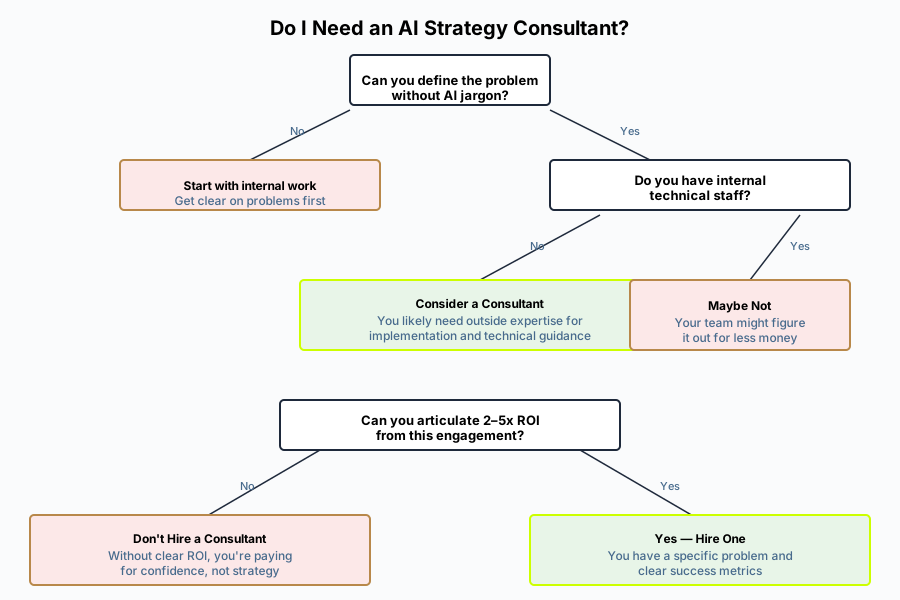
- Can you define the problem without AI jargon?
- No → Start with internal work first; get clear on your actual problems before spending money.
- Yes → continue:
- Do you have internal technical staff?
- No → Consider a consultant (you likely need outside expertise for implementation and technical guidance)
- Yes → Maybe not (your team might figure it out for less money)
- Can you articulate 2–5x ROI from this engagement?
- No → Don’t hire a consultant (you’d be paying for confidence, not strategy)
- Yes → Hire one (you have a specific problem and clear success metrics)
Save your money if you fall into any of these categories.
You don’t have a specific problem you’re trying to solve. You’ve read some articles about AI and you think it might be useful. You want to “develop an AI strategy.” But you don’t have a concrete problem – reduced customer support velocity, inefficient sales process, manual data work, high churn – you just have a vague sense that AI might help somewhere.
In this case, a consultant will take your money and produce a vague strategy that recommends a bunch of things. Some might be useful. All of it probably won’t be. You’ll end up with a list of 15 potential AI initiatives and no way to prioritize. What you actually need is internal work first. Get clear on what your actual problems are. That’s not consulting work. Do it yourself with your team.
Common Failure Mode
You hire a consultant because you want an AI strategy but you haven't defined what problem you're solving. The consultant, being smart, develops a roadmap that covers all possible AI opportunities: customer support automation, data analytics, content generation, personalization, recruiting tools. It's comprehensive. It's also useless. You can't do all of it. You don't know which to prioritize. The roadmap becomes shelf-ware. You would have been better off spending 10 hours with your team defining your actual problem before spending any money on consulting.
You already have AI projects in progress and they’re moving. Your team is implementing an AI customer support tool. Your engineering team is exploring generative AI for code assistance. You’re exploring AI for content. You don’t need a consultant to “develop your strategy.” You need to execute what you’re already doing and learn from that execution. The best strategy learning happens in the doing, not in PowerPoint.
You have a tiny budget and limited time. If you have $10,000 total budget for AI and you spend $8,000 on consulting, you have $2,000 to actually implement something. That’s not a good use of money. Spend the $10,000 on tools, pilots, and execution. Spend your time talking to your team about what problems to solve. Don’t spend it talking to an external consultant about what you already know.
You can hire domain experts directly. If your problem is “we need to figure out how to use AI for customer support,” you could hire a fractional customer support consultant with AI expertise for $3,000/month for 3 months. Or you could hire a domain-specific consultant (someone who’s built customer support AI before) for the same price. Either way, you’re getting someone who actually understands your specific problem domain. That’s better than a generalist AI strategist.
You already know the answer but you’re looking for permission. This is the biggest category and it’s worth naming. You know you should implement an AI customer support solution. You know it’ll save time and money. You’re not asking for strategy advice. You’re asking for someone to tell you it’s the right decision so you can feel confident about it. In that case, don’t hire a consultant. Talk to customers of that tool. Read reviews. Run a pilot yourself. Make your own decision. A consultant will charge you $15,000 to say “yes, you should do it,” which is not a good use of money.
When You Actually Might Need One
You might actually benefit from bringing in outside expertise in these specific situations.
You have a specific, meaty problem that requires expertise you don’t have inside. You’re in a regulated industry (healthcare, finance) and you need to understand how to implement AI while staying compliant – the EU AI Act, the NIST AI Risk Management Framework, and the OECD AI Principles all sit upstream of any consulting engagement worth paying for in this space. You have a complex data infrastructure and you need someone who understands both AI and systems integration. You’re trying to decide between building a custom model or buying a vendor solution and you need someone with deep experience in both approaches.
In these cases, an outside expert with specific expertise can save you time and money. But you need to hire based on expertise, not on brand name or credentials. You’re paying for someone who’s solved the exact problem you have before.
You’re making a big bet on AI and you need external validation or a second opinion. You’re going to invest $500,000 in an AI initiative. Your team thinks it’s the right move but you want an outside perspective. You want someone to poke holes in your strategy, identify risks you haven’t thought of, validate your assumptions. That’s a legitimate use of consulting.
But be specific: you’re not hiring them to “develop your AI strategy.” You’re hiring them to validate or challenge the strategy you already have. That’s different work and it’s worth different money.
You’re genuinely stuck and your team can’t move forward. You’ve been trying to implement an AI tool for 3 months and you keep hitting walls. Integration is harder than expected. Your team doesn’t know how to set it up. The tool doesn’t work the way you thought it would. You’ve read the documentation and watched the videos and you’re still stuck. In this case, someone with hands-on experience might be able to unlock you in days instead of weeks.
You’re building something custom and you need guidance on architecture or approach. You’re going to fine-tune a model. You’re going to build a custom integration. You’re going to use AI in a way that nobody in your org has experience with. You need someone who’s done this before to guide you through the gotchas and the right approach. That’s a legitimate consulting need.
In all of these cases, what you’re paying for is specific expertise that saves you time or money or both. You’re not paying for someone to think about your business. You’re paying for someone who’s solved the exact problem you have before.
How to Know If a Specific Consultant Is Worth It
Have they done this exact thing before? If you need help implementing an AI customer support solution in a regulated industry, you need someone who’s implemented AI customer support solutions in regulated industries. Not someone who’s done customer support consulting or regulated industry consulting. The intersection.
If they can’t point to 2-3 specific examples of having done exactly this before, they’re not worth the premium price of a consultant. They’re a smart person who’ll figure it out along with you, which is different.
Can they prove the ROI of their work? Ask to see case studies with real metrics. “Company X had 200 customer support emails per week. We implemented AI customer support. Now they handle 400 emails per week with the same team.” Real numbers. Real outcomes. If they can’t show this, how do you know they’re good?
Are they willing to work on a performance basis? If a consultant is confident in their advice, they should be willing to tie part of their compensation to outcomes. “You pay me $15,000 upfront. If we achieve our ROI targets, you pay me an additional $10,000.” A consultant who won’t do this is not confident in their own advice.
Questions to Ask
Ask: "How much of your compensation would you be willing to tie to outcomes?" If they say "I don't do performance-based work," that's fair – some consultants won't. But then ask: "How do you measure success for your clients? How do you know if your recommendation actually worked?" If they don't have a clear answer, they're not measuring impact. They're shipping documents.
Do they have relevant domain expertise or have they worked in your industry? Someone who’s consulted for 5 SaaS companies will understand SaaS better than someone who’s consulted for 50 companies across 20 industries. Depth beats breadth in consulting.
How transparent are they about what they don’t know? If you ask them about a specific technical problem and they try to sound knowledgeable when they’re not, that’s a red flag. A good consultant says: “I haven’t done that exact thing before. Here’s how I’d figure it out. Here’s who I’d talk to.” A bad consultant pretends to know everything.
Do they listen more than they talk? In your discovery call, are they asking about your business or are they pitching you? The best consultants spend 70% of the time listening, 30% talking. The worst consultants are the opposite.
The Alternative: DIY AI Strategy
If you’re not sure about hiring a consultant, try this structured approach first. It takes time but costs nothing and you’ll understand your business better at the end.
Step 1: Identify your actual problems (2-4 hours). Get your leadership team in a room. Don’t talk about AI. Talk about what’s inefficient, what’s costing time or money, what’s limiting growth. Write down 5-10 problems. Prioritize them by impact.
Step 2: Research AI solutions to those problems (10-20 hours). For your top 3 problems, research: Are there AI solutions? What do they cost? What do customers say about them? Read reviews on G2 and Capterra. Watch YouTube reviews. Download free trials. Our guide on AI tools for small business breaks down how to evaluate these properly.
Step 3: Talk to companies who’ve solved these problems (5-10 hours). Find 3-5 companies similar to yours who’ve implemented AI to solve one of your problems. Email them. Ask them: Did it work? What took longer than expected? Would you do it again? Real conversations with real users are worth way more than a consultant’s theory.
Step 4: Run a pilot (4 weeks). Pick the most promising solution for your top problem. Run it for 4 weeks with real data and real workflows. Measure whether it actually solved the problem.
Step 5: Make a decision (1 hour). If the pilot worked, roll it out. If it didn’t work, try a different solution or a different problem.
Total time: 20-40 hours. Total cost: $0. And at the end, you have real data about what works and what doesn’t. That’s better than any consultant’s strategy document.
Key Signal
If you run the DIY AI strategy process and you actually execute on what you learn, you've just done better consulting than most consultants deliver. The real insight you've gained isn't "what AI should we do?" It's "here's what our team cares about and here's what will actually move the needle for us." That clarity is worth more than any consultant's framework. If you need outside help, bring them in to accelerate execution on what you already know, not to think about your business.
When to bring in a consultant at this point: If you run the pilot and it doesn’t work, and you don’t know why, then a consultant might help. Or if you run the pilot and it works partially, and you need help scaling it, then a consultant might help. But you’ll hire them to solve a specific problem, not to develop a vague strategy.
The Consultant ROI Calculation

| DIY strategy | Consultant path | |
|---|---|---|
| Your time | 20–40 hrs @ $100–150/hr = $2k–$6k | 10–20 hrs @ $100–150/hr = $1k–$3k |
| Fees / tools | Tools & research: $500–$2k | Consulting fees: $30k–$80k |
| Wrong-direction risk | $5k–$20k in wasted time | Much lower (expert vetting) |
| Timeline | 4–8 weeks | 6–12 weeks |
| Total | $7.5k–$28k | $31k–$83k |
DIY wins on cost if you’re right. Consultant wins on speed and reducing wrong-direction risk.
Here’s how to do the math: A good consultant costs $15,000-50,000. The outcomes need to be at least $75,000-100,000 in value (2-5x return) to be worth it. Otherwise you’re better off investing that money in execution.
What counts as value? Time savings you can measure (50 hours saved at $100/hour = $5,000). Revenue directly created (5 new customers = $50,000). Cost avoided (not implementing something that wouldn’t have worked = $20,000). Speed advantage (getting to market 2 months faster = $50,000).
If you can’t articulate how you’ll get to 2-5x return from the consultant, don’t hire them. And if the consultant can’t articulate this for you – if they can’t explain how their recommendation generates that kind of value – don’t hire them. You’re not being cheap. You’re being smart.
Common Failure Mode
You hire a consultant who promises to help you develop an AI strategy. The engagement costs $30,000. Four weeks later, you have a 40-page PowerPoint about AI trends, use cases, and vendor options. But nowhere in the deck does it say "you should specifically do X because it will generate Y value." The consultant hedges. Everything is conditional. Everything is "it depends." You paid for strategy and got a literature review. A good consultant makes a specific, defendable recommendation and can explain why. If they can't, you're paying for consulting theater.
How to Choose an AI Strategy Consultant: Seven Criteria
If you have decided the engagement is warranted, the selection comes down to seven checks. A consultant worth the fee clears all of them.
- Exact-match experience. Your problem, in your industry, at your scale – the intersection, not any one of the three.
- Case studies with real numbers. Before-and-after metrics a client would recognize, not adjectives.
- Independence from the tools. No revenue share, referral fee, or partnership with any platform they are likely to recommend – in writing.
- A specific recommendation. Ask what they told their last client to do. If the answer is “it depends,” you are buying a literature review.
- Phased pricing with named deliverables. Discovery, pilot, roadmap – each priced, each with an artifact.
- Skin in the outcome. Some portion of the fee tied to results, or at minimum a written success metric they are willing to be measured against.
- A discovery call where they listen. Roughly 70 percent listening, 30 percent talking. The reverse ratio is a pitch.
The same independence test applies to anyone advising you on vendor selection, not just AI strategy – our guide to what a buyer-side technology advisor is walks through it for the broader category.
Conclusion
Most small and mid-size companies don’t need an AI consultant. They need clarity on their own problems, some research time, the willingness to run a pilot, and a decision-making framework.
Hire an AI consultant if:
- You have a specific, complex problem that requires deep expertise you don’t have inside.
- You’re making a large bet and you need external validation.
- You’re genuinely stuck and need hands-on help to unstick.
- You can articulate a clear 2-5x ROI from the engagement.
Otherwise, do the work yourself. It’s cheaper and you’ll understand your own business better.
Related Guides
- What Good AI Consulting Actually Looks Like – How to hire and structure a consulting engagement
- AI for Startups – The pressure-filter version for venture-backed companies
- AI Tools for Small Business: A Buyer’s Guide – Evaluate tools honestly during your DIY research
- AI Design Agencies – If what you actually need is design work, hire differently
- How to Select an AI Development Partner – When the next step after strategy is implementation
- How to Select a Technology Partner – Consultants are partners; use this framework to evaluate them
- How to Evaluate a Technology Partner – The vendor evaluation process applies to consultants too
Frequently Asked Questions
Do I need an AI strategy consultant?
No, if you don't have a specific problem to solve, already have projects in motion, have a tiny budget, or are looking for permission to do what you already know. Yes, if you have a complex domain-specific problem, are making a big bet, or are genuinely stuck.
How much does an AI strategy consultant cost?
Engagements typically run $15,000–$50,000. Hourly rates: technologists $150–$300/hr, MBA consultants $250–$500/hr, vendor-affiliated consultants $100–$250/hr. If you cannot see a 2–5x return path, the math doesn't work.
How does a strategy consultant differ from a development partner?
A strategy consultant tells you which problems AI should solve for your business. A development partner builds the system. Most companies don't need strategy consulting – they need clarity on their own problems, then execution. Confusing the two wastes money.
How can I tell if an AI consultant is worth the fee?
Have they solved this exact problem before? Can they show case studies with real numbers? Will they tie part of compensation to outcomes? If the answer to all three is no, they're a smart generalist figuring it out with you – at your expense.
What's the DIY alternative to hiring an AI strategy consultant?
Identify your actual problems with leadership (2–4 hours). Research AI solutions for the top three (10–20 hours). Talk to 3–5 peer companies who solved them (5–10 hours). Run a four-week pilot. Total: 20–40 hours, $0. You'll likely know more than a consultant would teach you.
When does paying for AI consulting actually make sense?
Regulated-industry implementations, large bets requiring external validation, or genuinely stuck projects a hands-on expert can unstick. Always hire for specific expertise, not for brand name. Always insist on clear ROI math before signing.
Who sells AI consulting, and how do they differ?
Three groups. Technologists (ex-engineers, good at systems, weak on ROI). MBA consultants (strategy backgrounds, good frameworks, not AI-specific). And vendors in consultant clothing (implicit sales agents). Match the type to the problem.
Do I need an AI strategy advisor or a consultant?
A consultant is scoped – you hire them for a deliverable like an assessment or roadmap, and they leave when it ships. An AI strategy advisor is an ongoing, retained relationship for a steady stream of AI decisions. One big decision points to a consultant; continuous smaller calls point to a fractional advisor. Neither should be a subscription to confidence.
What does an AI strategy consultant actually do?
Four things, when the work is real: a current-state assessment of where time and money leak and whether your data can support automation; an opportunity map that ranks AI use cases by value and feasibility; build-versus-buy recommendations for each; and a roadmap with pilots, owners, and success metrics. Some add vendor shortlists and governance guidance for regulated work. What they do not do is build the system – that is an AI development partner's job.
How much does AI strategy consulting cost per hour and per project?
Hourly, by consultant type: technologists $150–$300/hr, MBA-background strategists $250–$500/hr, vendor-affiliated consultants $100–$250/hr. Per project, a scoped assessment and roadmap runs $15K–$50K over 6–12 weeks. Small and mid-market phased engagements run $30K–$80K total: discovery $5K–$15K, pilot $3K–$10K, roadmap $2K–$5K, implementation support $20K–$50K. A strategy-deck-only engagement at $15K–$30K is the market's most common product and its least useful.
How do I choose an AI strategy consultant?
On seven criteria: exact-match experience with your problem in your industry, case studies with real numbers, no financial ties to the tools they recommend, a willingness to make a specific recommendation rather than a literature review, phased pricing with named deliverables, some fee tied to outcomes or at least clear success metrics, and a discovery call where they listen more than they pitch. The independence test is the one most buyers skip and the one that matters most.