AI Design Agency Selection Framework
An AI design agency is a design firm that has restructured part of its process around AI tools – changing speed, economics, or output. AI design agencies range from pure AI-native shops to traditional firms with an AI layer, and the category barely existed 18 months ago, so there’s widespread confusion about what these agencies actually deliver and whether you need one. You’ll see “AI-powered design” splashed on websites. You won’t know if that means they’re using Figma plugins or if AI fundamentally changed their model.
The truth is more interesting. Some agencies have genuinely restructured around AI – which changes speed, economics, and output. Others bolted AI tools into existing processes and rebranded. Both can work for you, if you know what you’re buying.
This guide cuts through the marketing. What do they deliver? What does it cost? How do you spot legitimate AI integration versus commodity work dressed up as innovation?
Understanding the AI Design Agency Spectrum
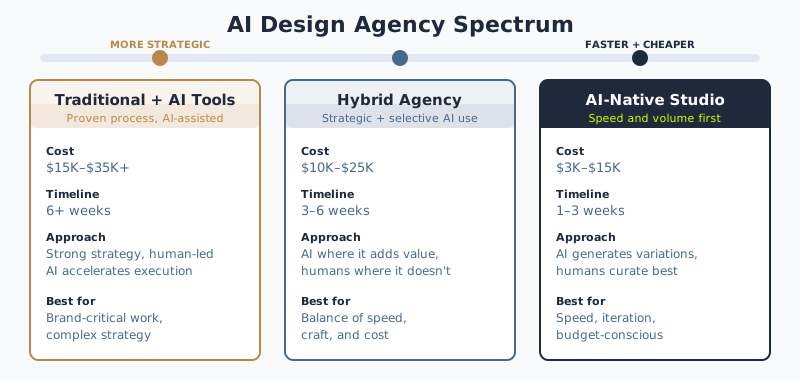
| Traditional + AI Tools | Hybrid Agency | AI-Native Studio | |
|---|---|---|---|
| Cost | $15K–$35K+ | $10K–$25K | $3K–$15K |
| Timeline | 6+ weeks | 3–6 weeks | 1–3 weeks |
| Approach | Strong strategy, human-led; AI accelerates execution | AI where it adds value, humans where it doesn’t | AI generates variations, humans curate best |
| Best for | Brand-critical work, complex strategy | Balance of speed, craft, and cost | Speed, iteration, budget-conscious |
AI-Native vs Traditional Models
AI in design doesn’t exist as a binary. There’s a spectrum, and where an agency sits on it affects everything: their pricing, their speed, the quality of output, and whether they’re a fit for your project.
Pure AI-native shops operate entirely differently from traditional agencies. They view AI as the primary tool, not a supplement. A project flow might look like: AI generates 50 design variations based on your brief → the team curates and evolves the strongest 5 → they refine using AI but with human judgment. This approach changes the unit economics entirely. They’re processing volume faster but need fewer senior designers in the room.
Traditional agencies with AI layer have kept their core workflow intact and added AI tools into specific tasks. Maybe they use AI for generating backgrounds, iterating on layouts at scale, or producing icon libraries. The core creative decisions still run through experienced designers. This is lower-risk for complex or brand-critical work, but you don’t get the cost benefits.
Hybrid Approach
Hybrid shops (increasingly common) have learned where AI genuinely accelerates good work and where it creates busywork. They might use AI to generate 10 mood board variations but use humans for type pairing decisions. They use AI for responsive web layout variations but have a designer review for interaction patterns. They’re selective.
The honest version: there are maybe 20-30 agencies truly leveraging AI to fundamentally change their model. Another 200+ have bought subscriptions to Figma’s design systems tools and are calling themselves AI-powered.
Key Signal
When an agency says they're "AI-powered," ask them to describe their process for a logo design project. How much is AI? How much is human? If they can't give you a specific breakdown – "AI generates 50 variations, we review and edit down to 5, we refine using AI and human judgment" – they're using AI as a marketing claim, not as a process change. Real AI agencies have clear workflows. Fake ones use AI as a buzzword.
What They Actually Deliver
AI-Native Shop Outputs
Let’s be specific about what emerges from these three approaches, because they produce genuinely different work.
Pure AI-native shops typically deliver:
- 5-8 direction variations where traditional agencies deliver 2-3. You’re seeing more directions faster.
- Rapid iteration on feedback. “Make that more modern” takes hours instead of weeks.
- Complete design systems with component libraries often included as part of the project. AI can generate 200 button states and icon variations in time that would cost $15K in traditional labor.
- Faster handoff to development because their design is often designed-for-production rather than designed-for-polish.
- Generally weaker strategic thinking about which direction solves the actual business problem. More designs doesn’t mean better thinking.
Traditional Agency Approach
Traditional agencies with AI deliver what they’ve always delivered, just faster in some areas:
- Deep strategic alignment with your business. They’re spending that time on strategy, not layout iteration.
- Higher-craft design work for premium brands where every detail matters.
- Better at complex design challenges that need actual design thinking, not just variation generation.
- Slower delivery, but the “slowness” is often strategy time that matters.
Hybrid Agency Results
Hybrid agencies deliver the most balanced work:
- Strategic thinking paired with rapid iteration.
- Design quality that doesn’t suffer because they’re not defaulting to AI for every decision.
- Faster delivery than pure-traditional shops but with more intentionality than pure AI shops.
- Higher cost than pure AI shops, lower cost than high-end traditional agencies.
Real project example: a B2B SaaS rebrand. A pure AI shop delivered 12 direction variations in 1.5 weeks. The strategy and competitive positioning came straight from a brief. Eight of the directions were variations on the same idea because AI doesn’t know to explore different strategic territories – it explores different executions of what it was shown. A hybrid shop spent 3 weeks on competitive analysis and strategy, then delivered 3 directions that each represented a different positioning. The execution quality was higher on the hybrid shop’s work, but the AI shop’s approach was right for a founder who just wanted execution speed. For more context on strategy-driven design, see our guide on product design agencies.
Pricing Models and Cost Reality
AI-Native Pricing
Here’s where the AI-native model actually disrupts traditional pricing.
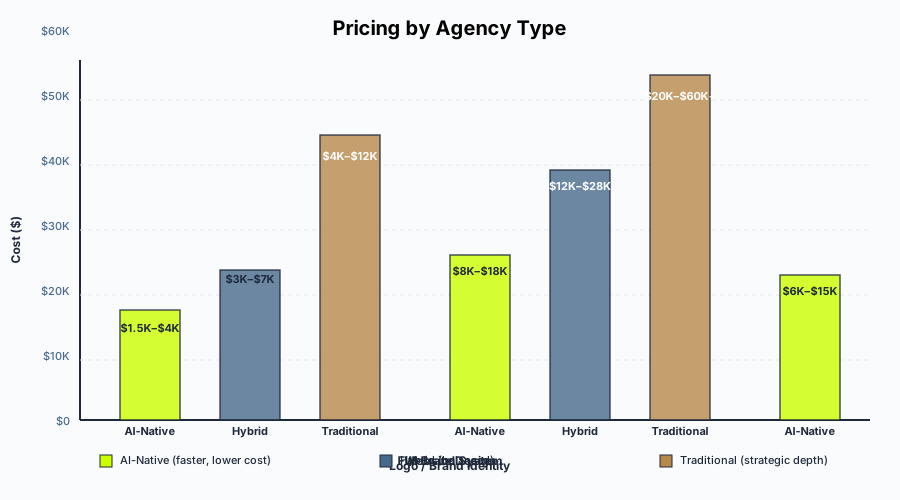
Pure AI-native agencies typically charge:
- Logo design: $1,500–$4,000. They’re generating 30 concepts; you’re choosing one. Compare to $3,000–$8,000 at traditional agencies.
- Website design: $8,000–$18,000 for a marketing site. Traditional agencies: $15,000–$35,000.
- Brand identity system: $6,000–$15,000. Includes hundreds of design assets because generation is cheap. Traditional agencies: $12,000–$30,000.
The cost curve is different because human labor cost is lower. One designer managing AI output can handle 4x the volume of a traditional designer.
The catch: they’re often cheaper because they’re cheaper to run, not because they’re undercutting. Some charge less, some charge nearly the same but deliver more volume.
Traditional Agency Pricing
Traditional agencies with strategic depth charge:
- Logo: $4,000–$12,000. They’re charging for strategy, craft, and their reputation.
- Website: $20,000–$60,000+ for substantive work.
- Brand system: $18,000–$60,000+.
These numbers haven’t moved much because their model hasn’t changed – AI just made individual tasks faster, not the overall timeline.
Hybrid Shop Pricing
Hybrid shops (if they’re actually good) charge:
- Logo: $3,000–$7,000. Faster than traditional, more strategic than pure AI.
- Website: $12,000–$28,000.
- Brand system: $8,000–$22,000.
There’s also a dangerous pricing middle where an agency charges premium prices ($20K–$40K) while actually delivering mostly AI output with minimal human curation. This exists. Look for it.
Value Proposition
What you’re actually paying for:
- With pure AI shops: volume and speed. You get more options, faster iteration, lower unit cost.
- With traditional shops: strategy, craft, and someone who’ll fight for good design decisions even if they’re not what you initially wanted.
- With hybrid shops: balance, but you pay a premium for that balance.
Most project failures with AI-native shops happen because clients confused “more design variations” with “better strategy.” You got what you paid for; it just wasn’t what you needed.
Common Failure Mode
You hire an AI-native shop because they're 70% cheaper than traditional agencies. They deliver 12 logo variations in 1.5 weeks. You love it. But every variation is a different color treatment of the same concept. There's no strategic thinking about positioning, target audience, or what makes your brand different. You pick the variation you like best, but it doesn't actually differentiate you. Three months later, you've hired a consultant to do the strategic work that should have happened in week one. You saved $8,000 on design and spent $15,000 on strategy consulting. Net loss: $7,000.
Vetting AI design agencies right now?
Bring the portfolios or proposals you're weighing – in 15 minutes we'll tell you which are worth the callback and whether the pricing matches what's actually AI-generated.
Get a second opinion →Evaluating Quality and Red Flags
Red Flags for Surface-Level AI
Here’s how to separate actual AI integration from marketing noise.
Red flags indicating surface-level AI adoption:
- They mention AI in the first sentence of their homepage but never mention strategy, research, or discovery. AI is the placeholder for “we don’t think deeply.”
- Their portfolio has 100+ projects shown. Speed isn’t quality; volume is a symptom of thin design thinking.
- They guarantee delivery in absurdly short timelines (logo in 48 hours). Real work takes time regardless of tooling.
- They say they can start immediately with zero discovery. You’re not getting custom thinking; you’re getting a template.
- They show 20 logo variations where every variation is the same idea executed different ways. This suggests AI-as-generator, not AI-as-accelerator.
Questions to Ask
Ask the agency: "Show me two projects from your portfolio where you could have delivered more variations faster using AI, but you didn't. Why did you choose not to?" The answer tells you whether they're using AI strategically or just using it to maximize output. Good agencies make deliberate choices about when AI helps and when it doesn't.
Legitimate Integration Signals
Signs of legitimate AI integration:
- They discuss which parts of their process use AI, not whether they use it. They’re clear: “We use AI to generate 50 layout variations, then curate down to 3 strategic directions.”
- Their discovery process is real. Even fast projects start with questions about your business, competitors, and customers.
- Their portfolio shows diverse project types with real outcomes. One designer’s work doesn’t look like every other project.
- They discuss iteration with you, not iteration for you. They’re asking “which direction resonates with your market” not “here are 20 options.”
- Their recent projects reflect current AI capability (last 9–12 months), not samples from before generative AI was mainstream.
Portfolio Assessment
Evaluating the portfolio:
- Look at responsive designs. AI struggles with interaction and flow across devices. If all the mobile versions look generic, that’s a clue.
- Check type pairing and hierarchy. This is where human design sense shows. AI defaults to safe choices.
- Look at how they handle constraints. Do projects show thoughtful problem-solving or do they look like they defaulted to “modern” aesthetics?
- Ask about revision rounds. If they say “unlimited revisions,” they might mean they use AI to churn out variations rather than think through feedback.
- If the portfolio includes animation, judge it by what shipped rather than what rendered – Lottie or Rive files running in a live product, not MP4s – which is the bar the motion design agency guide sets for product motion.
Making Your Choice: AI-Native vs. Traditional Plus AI
This decision depends on three things: your budget, your timeline, and the strategic complexity of what you’re designing.
Choose an AI-native agency if:
- You need multiple directions explored quickly and cost-effectively.
- Your design challenge is primarily about execution quality, not positioning strategy.
- You’re comfortable iterating yourself; you like having input on direction.
- Your timeline is 2–4 weeks and you’re flexible on delivery schedule.
- You’re designing something where more options genuinely helps (social content suite, icon library, marketing site with flexible creative).
- Your budget is under $15K and speed matters.
Choose a hybrid shop if:
- You need both strategic thinking and rapid iteration.
- You want someone who’ll push back on bad directions.
- Your timeline is 3–6 weeks.
- Your budget is $10K–$25K.
- You value craft and attention to detail in execution.
- You want a partnership, not a vendor-customer relationship.
Choose a traditional shop with minimal AI if:
- You’re rebranding a company with complex positioning needs.
- Your design will be mission-critical (financial services, healthcare, legal).
- You need someone to truly understand your business strategy, not just execute a brief.
- Your budget is $25K+.
- Your timeline is 6+ weeks.
- You want someone who’ll own the outcome, not just deliver assets.
The hardest question: Do you need an agency at all, or do you need Figma plugins and a freelancer?
Honestly, if you need 10 logo variations quickly and cost is primary, a freelancer with a Figma subscription costs $500–$2,000. You won’t get strategy, but you get options. This works for founders testing positioning. It breaks down when you need thoughtful guidance or when the work is complex.
Agencies (even AI-native ones) add value when you need integrated thinking across multiple disciplines (AI, UX, software) or when you need someone else to own the quality bar. If you’re choosing between freelancers and agencies more broadly, read our guide on hiring a product designer which covers both options.
Final real-world scenario: A Series A startup needed a website redesign. They got quotes: $18K from a hybrid shop (5 weeks), $28K from a traditional agency (6 weeks), and $6,500 from a pure AI shop (1.5 weeks). They chose the pure AI shop, got 12 layouts they could iterate on immediately. Saved $12K. Three months later they’d refined it into something good. A traditional agency might have gotten to something good in week 6, but the startup needed working cash more than polish.
What matters is matching the agency type to what you actually need, not what the marketing promises.
Key Signal
The best indicator of an agency's true capability is how they describe their own constraints. "We don't use AI for typography pairing because we believe that requires human judgment" or "We use AI to generate 50 layouts, but we always start with a strategic brief because direction without strategy is wasted execution." Agencies that are honest about where AI helps and where it doesn't are the ones leveraging it effectively. Agencies that use AI for everything are trying to minimize labor, not maximize quality.
How to Evaluate an AI Design Agency: Seven Questions
AI design agencies are easy to compare on price and nearly impossible to compare on the pitch, because every pitch now says the same thing. The questions below separate an agency that has reorganized its process around AI from one that has reskinned its website.
- Which steps are AI, and which are human? Ask for the process, step by step. A real answer names specific stages – exploration, iteration, production – and says which tool does what. A vague answer means the process is whatever the designer felt like that day.
- Where does senior judgment sit? Speed is the AI-native advantage; taste is not. Who reviews the fifty directions and picks the three worth showing you, and how senior are they?
- Does the price match the economics? AI-native shops run logos at $1.5K–$4K and websites at $8K–$18K. A shop describing an AI-native process at traditional prices is charging you for a discount it kept.
- Can they show strategic work? Positioning, differentiation, competitive framing. AI explores what it was shown; it does not know to explore elsewhere. If your project needs strategy, the portfolio must prove a human supplied it before.
- What does a fee buy, and what do revisions cost? Number of directions, rounds, and the price of one more of each. AI makes the first fifty cheap and the fifty-first no different – the pricing should reflect that.
- Who owns the output? Rights to AI-generated elements, disclosure of what was generated, and licensing of anything the model was fed. In writing.
- Which shipped products can we visit? Not case-study renders – live sites, live apps, with a client who will take a reference call.
An agency that answers all seven crisply has done the reorganization. One that answers three has done the marketing.
Related Guides
- How to Hire a Product Designer: The Buyer’s Playbook – The full framework for finding design talent (freelance, agency, or hybrid)
- Product Design Agencies: How to Evaluate, Compare, and Choose – Deeper dive on evaluating traditional and hybrid design agencies
- Website Design vs. Development: What You Actually Need – Clarify whether you need design-focused or development-focused work
- How to Write a Design RFP That Gets You the Right Agency – Structure your search properly
- UX Design for Startups: What to Invest In and What to Skip – Prioritize design investment when capital is scarce
Frequently Asked Questions
What is an AI design agency?
A design firm that has restructured part of its process around AI tools – changing speed, economics, or output. The category ranges from pure AI-native shops that generate 50 variations per brief to traditional agencies that quietly use AI for icon libraries.
How much does an AI design agency cost?
Pure AI-native: logos $1,500–$4,000, websites $8,000–$18,000, brand systems $6,000–$15,000. Traditional agencies with an AI layer charge 2–4x those ranges. Hybrid shops sit between. If someone charges traditional prices for AI-native output, that is the dangerous middle.
Should I pick an AI-native shop or a traditional agency?
AI-native when you need many directions quickly and the challenge is execution, not positioning. Traditional when the work is mission-critical or requires deep strategy. Hybrid when you need both – and are willing to pay for the balance.
How do I know if an agency is really using AI?
Ask them to break down their process for a logo project. Real AI agencies answer with specifics: 'AI generates 50 variations, we curate to 5, we refine with human judgment.' Marketing-only agencies give vague answers about being 'AI-powered.' The breakdown is the test.
What are the red flags with AI design agencies?
They mention AI on the homepage but never strategy or research. They guarantee delivery in 48 hours. Their portfolio has 100+ projects that look similar. They show 20 logo variations that are all the same idea with different colors. Volume is not quality.
Is an AI design agency cheaper than a traditional one?
Yes, roughly 50–70% cheaper for comparable scope – because the labor model is different, not because they undercut. A pure AI shop that charges traditional prices is not passing savings through. That is the pricing middle to avoid.
What does an AI design agency not do well?
Strategic positioning work. AI explores executions of what it was shown; it does not know to explore different strategic territories. If your project requires differentiation, positioning, or a deep understanding of competitive landscape, AI-native shops underdeliver.
How do I compare AI design agencies against each other?
Ask each the same seven questions: which steps of the process are AI and which are human, where the senior human judgment sits, how pricing relates to the AI economics (an AI-native shop charging traditional prices is the dangerous middle), whether they can show strategic positioning work, how many directions a fee buys and what revisions cost, who holds the rights to AI-generated elements, and which shipped products a buyer can actually visit. The answers separate a reorganized process from a reskinned one.
Who owns the rights to AI-generated design work?
Get it in writing. Copyright protection for AI-generated elements is unsettled and varies by jurisdiction, so the contract – not the law – is what secures your position. Insist on full assignment of all deliverables, disclosure of which elements were AI-generated, and confirmation that any training material, stock, or model licensing permits commercial use of the output.