Software Development RFP Guide
A software development RFP is a written solicitation that defines the problem, the scope, the budget range, and the evaluation criteria – and invites development partners to propose against it. Done well, it attracts qualified firms and filters out unqualified ones. Done badly, it does the reverse. Most software development RFPs produce bad outcomes. They’re too vague and vendors guess at scope and pad estimates. Or they’re too detailed and vendors follow instructions instead of thinking. Or they’re too rigid and the best firms decline to respond entirely. The RFP process was designed for commodity procurement – paper clips, office furniture, janitorial services. Software development is not a commodity. Treating it like one is why most RFP-driven selections end in buyer’s remorse.
That said, a well-written RFP is still the most effective way to compare multiple development partners on a level playing field. The problem isn’t the RFP concept – it’s the execution. Most organizations write them poorly. This guide gives you a framework for writing an RFP that attracts qualified partners, discourages unqualified ones, and generates the information you actually need to make a good decision.
For a comparison of RFP vs. other selection approaches, see RFP vs. structured search. For design-specific RFPs, see how to write a design RFP.
Should You Even Write an RFP?
An RFP is the right approach when you need to evaluate 3+ vendors side-by-side under comparable conditions, when your organization has formal procurement requirements (common in enterprise, government, healthcare), when you have a project scope detailed enough to describe meaningfully, and when you have internal stakeholders who need to participate in the decision but can’t attend multiple vendor pitches.
An RFP is unnecessary (and counterproductive) in several common scenarios. If you don’t know what you need yet, an RFP will just result in confused proposals. Run a discovery engagement first – hire a consultant, do internal planning, get clarity on the problem before you ask vendors to solve it. If the ambiguity is about what the product should be rather than how to build it, product development outsourcing – which buys judgment, not just execution – is a better fit than a build RFP. If you’ve already decided on a vendor, a “courtesy RFP” to satisfy procurement is theater. It wastes everyone’s time and damages your reputation with good firms. They’ll remember that you pretended to consider them while you’d already made your decision.
For small projects under $50K, the overhead of writing, distributing, evaluating, and presenting is disproportionate. A few good conversations and a reference check process will give you better information faster. And if speed is your primary constraint – if you need to start development in two weeks – skip the RFP entirely and use a structured vendor search instead. The RFP process adds 4–8 weeks to your timeline.
Common Failure Mode
Sending a 30-page RFP with detailed technical specifications and a requirement for fixed-price proposals. The best development firms won't respond – they know a fixed-price commitment to a 30-page spec is a recipe for disputes. The firms that do respond are either desperate or planning to lowball and make it up in change orders.
What Goes Wrong with Software RFPs
Understanding why RFPs fail helps you avoid the disasters.
Too much specification, not enough business context. An RFP listing 200 user stories without explaining why those stories matter gives vendors no way to assess whether your proposed solution is right. They’ll price the work – but they can’t tell you if you’re building the wrong thing or the right thing the wrong way. Include the business problem, the outcomes you’re trying to achieve, and the constraints. Not just the feature list.
No budget guidance whatsoever. Companies withhold budget to avoid “anchoring” vendors. The result is chaos: you get proposals ranging from $50K to $500K because they’re scoping entirely different projects. You can’t compare them because they’re making fundamentally different assumptions. Provide a budget range. Or at minimum, an order of magnitude. This helps vendors scope a realistic response and self-select out if they can’t deliver in your budget. That’s a feature, not a bug.
Broken evaluation criteria. If your scoring matrix weights “lowest price” at 40%, you will select the cheapest vendor. Guaranteed. If you weight “relevant experience” but don’t define how you’ll assess it, every vendor will claim extensive relevant experience. Think hard about what actually predicts success on your type of project. See the technology partner selection process for a proven evaluation framework.
Compressed question periods. Vendors need time to read the RFP, develop questions, get answers, and absorb the answers before they can write a thoughtful proposal. A three-day Q&A window produces proposals based on guesses. Allow at least two weeks from RFP distribution to the question deadline, then another two weeks from answers to proposal submission. This takes longer, but the quality difference is enormous.
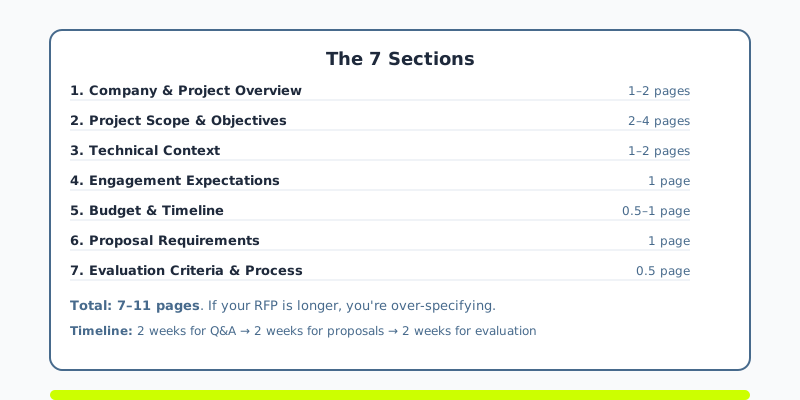
| Section | Length |
|---|---|
| 1. Company & Project Overview | 1–2 pages |
| 2. Project Scope & Objectives | 2–4 pages |
| 3. Technical Context | 1–2 pages |
| 4. Engagement Expectations | 1 page |
| 5. Budget & Timeline | 0.5–1 page |
| 6. Proposal Requirements | 1 page |
| 7. Evaluation Criteria & Process | 0.5 page |
| Total | 7–11 pages |
If your RFP is longer, you’re over-specifying. Timeline: 2 weeks for Q&A → 2 weeks for proposals → 2 weeks for evaluation.
The Template: Section by Section
Use this as a starting point and adapt it to your situation. Not every section applies to every project.
1. Company and Project Overview (1–2 pages)
Who you are, what you do, and why this project matters. Describe your company’s size, industry, and context. Explain the business problem this software solves. Say who will use it (internal team, customers, partners) and what systems it needs to integrate with. List any regulatory or compliance requirements up front.
This section should be readable by someone who’s never heard of your company. If a vendor can’t understand your business and why this project matters from just this section, rewrite it until they can. This is where you set the tone. You’re not a transaction waiting to happen – you’re a business with real constraints and real outcomes you need to achieve.
2. Project Scope and Objectives (2–4 pages)
What you want built and how you’ll measure success. Start with business objectives – not features, but outcomes. “We need to reduce invoice processing time from 3 days to 4 hours” is a business objective. “We want a dashboard” is a feature.
Describe the 3–5 core user workflows as narratives, not feature lists. “A procurement manager needs to compare vendor proposals side-by-side, score them against weighted criteria, and produce a recommendation memo for the steering committee.” Not “user dashboard” or “vendor comparison feature.”
Be explicit about what’s essential for launch and what can come later. Don’t hide the nice-to-haves in the requirements list – call them out separately. Vendors will price everything if you don’t distinguish.
State non-functional requirements plainly. Performance expectations. Accessibility standards. Security requirements. Uptime SLAs. If you don’t care about something, say so. If you do, be specific.
Finally, say what’s explicitly out of scope. This prevents vendors from padding their proposals with work you don’t need.
Key Signal
Describe workflows, not features. Features are solutions. Workflows are problems. You want vendors to propose the right solution to your problem, not price your pre-designed solution. The vendors who push back on your proposed feature list and suggest simpler alternatives are the ones you want.
3. Technical Context (1–2 pages)
Describe your technical environment: existing stack (languages, frameworks, cloud), integration requirements, deployment environment (cloud, on-premise, hybrid), security and compliance needs. List any hard technical constraints and which ones are preferences.
Here’s the trap: don’t dictate technology unless you have a real business reason. “Our CTO prefers React” is not a reason. “Our internal team maintains React applications and will maintain this system after you build it” is a reason. Let vendors propose the right technical approach if you’re open to it. They often see better solutions than the ones you pre-designed.
4. Engagement Expectations (1 page)
How you want to work together. Do you prefer fixed-price, time-and-materials, or a dedicated team model? (Or are you open to vendors recommending?) Who should be on the team and what level of seniority? How often do you want to talk? What reporting do you need? Who makes decisions and how? Who owns the code when we’re done?
See fixed fee vs. time and materials for a breakdown of engagement models and their tradeoffs.
5. Budget and Timeline (0.5–1 page)
Provide a budget range. “$150K–250K” helps vendors scope realistically without anchoring them to a number. If you can’t share a specific budget, at least state the order of magnitude (“six-figure investment” or “five-figure budget”).
Explain timeline expectations. When do you need development to start? When does it need to go live? Are there hard deadlines driven by regulatory requirements, market conditions, or contractual obligations?
Are you open to phasing the work (discovery → MVP → full build)? This usually produces better results than trying to spec everything upfront and then executing one big build.
6. Proposal Requirements (1 page)
Tell vendors exactly what you want to see in their proposal: their understanding of the problem (this shows whether they’ve actually read and comprehended your RFP), their proposed approach and methodology, the actual people who would work on the project with their background, a timeline with milestones, pricing broken down by phase if applicable, 2–3 case studies with client references, and any assumptions or risks they’ve identified.
7. Evaluation Criteria and Process (0.5 page)
Be transparent about how you’ll evaluate. Use weighted criteria (e.g., 30% relevant experience, 25% proposed approach, 20% team quality, 15% price, 10% cultural fit – adjust to your priorities). Explain your selection timeline: when you’ll review, shortlist, invite finalists to present, and make a decision. Say whether you’ll have presentations or interviews. Say how many vendors you plan to bring to the next round.
Questions to Ask Yourself
Before sending the RFP, have someone outside the project team read it and tell you what they think you're building. If their summary doesn't match your intent, the RFP needs revision. If your own team can't agree on what success looks like, you're not ready to issue an RFP.
Budget and Timeline Guidance
Software development costs vary wildly based on scope, complexity, and team quality. These US market ranges for custom development should inform your RFP budget guidance section.
A simple application (CRUD operations, limited integrations, standard UI) – think internal tools, customer portals, data dashboards – typically runs $50K–150K over 2–4 months.
A moderate application (multiple user roles, integrations, custom workflows) – think marketplace MVPs, multi-tenant SaaS, operational platforms – typically runs $150K–400K over 4–8 months.
A complex application (real-time requirements, ML/AI, regulatory compliance, high availability) – think fintech platforms, healthcare systems, enterprise software – typically runs $400K–1M+ over 8–18 months.
These ranges assume you’re phasing the work: discovery, then MVP, then iterating based on learning. If you try to specify the entire project upfront and get a fixed-price quote, expect 30–50% higher costs. That premium reflects the vendor’s risk – they’re pricing for all the scope uncertainty you’re pushing onto them.
Evaluating the Proposals
Proposal quality predicts project quality. A thoughtful, well-organized proposal that demonstrates genuine understanding of your problem predicts a partner who will bring the same care to the project. A generic, buzzword-filled proposal that reads like a template copy-paste predicts exactly that – a templated engagement.
Assess understanding before evaluating solutions. The most important section is where vendors restate their understanding of your problem. If they’ve missed the point entirely, nothing else matters. If they understood the problem but proposed a different solution than you expected, that’s often a good sign. It means they’re thinking, not just following your pre-written instructions. You want partners who understand the problem deeply enough to challenge your assumptions.
Judge the team, not just the proposal. Two vendors might write equally strong proposals. The difference will be in the actual people. Never accept a proposal that doesn’t name the specific developers, designers, and project managers who would work on your project. And insist on meeting them before you decide. Ask the proposed lead developer to walk through a past project they’ve shipped and explain the decisions they made. Watch how they think. That’s what your project will get.
Watch for pricing red flags. A fixed-price bid significantly lower than others usually means they’ve underestimated the scope or they plan to make it up in change orders later. A proposal that doesn’t break down pricing by phase or role is hiding something – you can’t evaluate what you can’t see. And false precision on pricing (estimates to the nearest thousand when the scope is ambiguous) suggests they’re pricing to win rather than pricing to deliver.
For a comprehensive evaluation framework, see the technology partner selection process. For the specific due diligence steps to run on shortlisted candidates, see the technology vendor due diligence checklist.
Related Guides
- RFP vs. Structured Search – when an RFP isn’t the right approach
- How to Write a Design RFP – the design-specific version of this guide
- How to Choose a Software Development Company – full evaluation framework
- Outsourcing Software Development – the broader buyer’s decision framework
- MVP Development Partner – the parallel approach for first-version engagements
- Fixed Fee vs. Time and Materials – pricing model comparison
- Common Mistakes in Technology Partner Selection – pitfalls to avoid
Frequently Asked Questions
Should I use an RFP for software development?
Yes when you need to compare 3+ vendors side-by-side, when procurement requires formal solicitation, and when the scope is detailed enough to describe. No for projects under $50,000 – the RFP adds 4–8 weeks of overhead that isn't worth the structure.
How long does an RFP process take?
4–8 weeks from publication to signed contract, if run with discipline. Allow at least two weeks for vendor Q&A, then another two weeks for proposal submission. Compressing either window produces proposals based on guesses.
What should a software development RFP include?
Seven sections: company overview, scope as business outcomes (not features), technical context, engagement expectations, budget range, proposal requirements, and evaluation criteria. Skip any section where you'd pad – brevity reads as clarity.
Should I share my budget in the RFP?
Yes. Withholding budget produces proposals ranging from $50K to $500K because vendors are guessing at scope. A range like '$150K–$250K' lets qualified firms scope realistically and unqualified firms self-select out. That's a feature.
What does a software development project typically cost?
Simple applications (CRUD, standard UI): $50K–$150K over 2–4 months. Moderate (multi-role, integrations): $150K–$400K over 4–8 months. Complex (real-time, ML, compliance): $400K–$1M+ over 8–18 months. Fixed-price adds 30–50% over T&M.
What goes wrong with software development RFPs?
Too much specification, not enough business context. No budget guidance. Evaluation weights that select for price over capability. Compressed Q&A windows. Treating software like a commodity. Each mistake pushes away the best vendors and attracts the worst.
How do I evaluate software development proposals?
Start with the 'understanding of the problem' section – if they missed the point, nothing else matters. Judge the proposed team, not just the pitch. Watch for low bids (underestimated scope or future change orders) and false precision on unclear scope.