The MVP Decision Framework
An MVP development partner is an outside firm you hire to ship the smallest product that will test a business hypothesis – typically a 4–8 week engagement costing $15,000 to $75,000. Engagements above $150,000 are products, not MVPs. Choose one when you need speed and outside perspective more than you need permanent engineering headcount. The MVP itself has become the most misunderstood concept in product development. Founders use it to mean “version 1 of my product.” Development agencies use it to mean “the smallest thing we can sell you.” Neither definition is useful.
An MVP is a learning instrument. It exists to test a hypothesis about your market as cheaply and quickly as possible. The output of an MVP is not software – it’s validated knowledge about whether your customers will pay for what you’re building. If your MVP doesn’t produce a clear yes-or-no signal about a specific business hypothesis, it’s not an MVP. It’s just an underfunded product launch.
This distinction matters enormously when you’re deciding how to build it, who to build it with, and how much to spend. The right approach depends on what you need to learn, not what you want to ship.
What an MVP Actually Is
An MVP tests one thing: will customers engage with this product in the way your business model requires? That’s it. Everything else is secondary.
For a SaaS product, that means proving target users will sign up, complete onboarding, and use the core feature repeatedly. You’re not testing whether the product is beautiful or feature-complete – you’re testing activation and retention. I worked with a productivity tool founder who spent eight weeks building a gorgeous dashboard before testing their core hypothesis (that users would actually adopt the tool daily). They learned in user testing that nobody cared about the dashboard. They cared about whether the core feature worked. Six weeks of polished UI was wasted effort.
For a marketplace, the test is entirely different. Both sides of the two-sided market have to show up. I’ve seen marketplace founders build excellent supply-side experiences and then get zero demand, or vice versa. The MVP needs to prove you can achieve liquidity – that you can get enough sellers and buyers interested in using the same platform at the same time. This usually requires manual work on one side (you personally recruiting early sellers, or you as the first buyer) to jump-start the network.
For an internal tool, the question is adoption. Employees have been using a spreadsheet for five years. Your job isn’t to build something technically impressive – it’s to build something they’ll actually switch to. Many internal tool MVPs fail because they’re technically sound but require a behavior change that the organization isn’t ready to make. The MVP needs to prove the change is worth it.
Common Failure Mode
Building a "full product" and calling it an MVP because it doesn't have all the features yet. If your MVP takes 6 months and costs $200K, it's not an MVP. It's a product that launched before it was ready – one of the recurring [decision errors that lead to re-selection](/guides/common-mistakes-technology-partner-selection) inside the first year. Real MVPs take 4–8 weeks and cost $15K–75K depending on technical complexity.
The specifics depend on what you’re testing, but here’s what you can almost always skip: user accounts and authentication systems (use magic links or manually onboard people), admin dashboards (manage your MVP users manually via database), payment processing (Stripe Checkout or even manual invoicing), email notifications, mobile apps (responsive web is fine), and infrastructure that scales to thousands of users (you need 10 good ones, not 10,000 mediocre ones).
What you absolutely need: the core value proposition – that one thing that makes someone choose your product over the status quo. You need enough polish that users evaluate the value, not the janky UX. And you need analytics to measure the specific behavior you’re testing. Nothing else. Not “nice to have” features, not architectural elegance, not code quality that would impress your team. Just the core, measurable hypothesis.
A fintech founder I worked with planned an MVP with full multi-tenant architecture, audit logging, and compliance features. They were planning to spend $200K over six months. The actual hypothesis was: “Do B2B customers prefer this specific approach to settlement?” We cut it down to a functional prototype that answered that one question in six weeks for $25K. They got their answer, iterated the approach based on feedback, and then built the real thing properly. The first MVP would have proven nothing except their perfectionism.
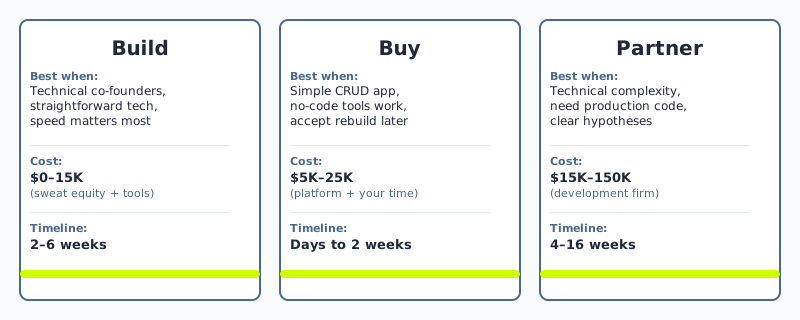
| Build | Buy | Partner | |
|---|---|---|---|
| Best when | Technical co-founders, straightforward tech, speed matters most | Simple CRUD app, no-code tools work, accept rebuild later | Technical complexity, need production code, clear hypotheses |
| Cost | $0–15K (sweat equity + tools) | $5K–25K (platform + your time) | $15K–150K (development firm) |
| Timeline | 2–6 weeks | Days to 2 weeks | 4–16 weeks |
Build vs. Buy vs. Partner
This is the fundamental decision. Each path has wildly different cost structures, timelines, and risk profiles – and each produces different problems downstream.
Build internally makes sense when you have technical co-founders or a small engineering team already in place. You get maximum speed (no onboarding, no contracts, no negotiation), maximum control, and the codebase becomes your asset immediately. The technical team knows your product inside and out from day one.
The trap is real though. If your technical team is also your founding team, building the MVP means those same people aren’t talking to customers, closing sales, or validating the business model. Your engineers are spending time on deployment pipelines and database migrations instead of being available to react when customer feedback suggests a pivot. The best technical co-founders I’ve worked with recognize this tension explicitly and ruthlessly push for the simplest possible MVP – not the most technically elegant one.
Choose this when you have technical founders with strong product judgment, your MVP doesn’t require specialized technical expertise (ML, real-time infrastructure, etc.), and speed matters more than polish.
Buy (no-code/low-code) has gotten genuinely good. Tools like Bubble, Webflow, Retool, and Airtable can build functional products in days instead of weeks. For many MVP categories – internal tools, simple marketplaces, landing-page-plus-backend, directory sites – no-code is the fastest path to an answer.
But here’s the reality: no-code works great until it doesn’t. You’ll hit platform limitations exactly when your product starts succeeding. I watched a marketplace founder validate their model perfectly on Bubble. Three months later, when they wanted to move to custom code and expand their feature set, the migration was painful and expensive – essentially a full rebuild. This is fine if you know going in that success means rebuilding. It’s catastrophic if you assumed the no-code version would just evolve.
Choose this when your MVP is straightforward (CRUD operations, standard workflows), you need to validate fast with zero engineering investment, and you explicitly accept that scaling beyond MVP will require a rewrite.
Partner with a development firm makes sense when you need technical expertise you don’t have in-house, when you need a level of polish that no-code can’t match, or when you need code that can evolve into your real product without a full rewrite.
The hard truth: most development agencies are not good at MVPs. They’re optimized for building fully-scoped products with clear specifications and happy clients. MVP work requires a completely different mindset – the willingness to cut scope ruthlessly, ship imperfect code, and optimize for learning speed over code quality. Agencies that can’t make this shift will build you something beautiful and over-engineered that takes three months and costs twice your budget to test one hypothesis.
Choose this when your MVP requires genuine technical complexity (machine learning, real-time infrastructure, hardware integration – for AI specifically, see how to select an AI development partner), when you need production-grade architecture that your team will build on top of, and when you have crystal-clear hypotheses to test.
Key Signal
Ask potential MVP partners this question: "What would you cut from the scope?" If they agree with everything on your feature list, they're not the right partner. Good MVP developers are aggressive scope cutters. They'll push you to define the one thing your MVP needs to prove and strip out everything else. This is one of the [evaluation signals that predict delivery](/guides/how-to-evaluate-a-technology-partner) better than portfolios do.
What MVP Development Actually Costs
Pricing for MVP development is wildly inconsistent because everyone’s using “MVP” to mean something different. Here’s what the money actually gets you at each tier.
$5K–15K gets you a proof of concept. This is a clickable prototype, a landing page with a signup flow, or a no-code implementation that demonstrates the core idea. It’s enough to show to customers and measure interest. It’s not a working product – it won’t scale, it won’t handle real usage, and it probably won’t stay running for six months. But it’s enough to prove customers care.
$15K–50K is where most startups actually test product-market fit. You get a working application with one core workflow, a basic UI that doesn’t win design awards, and infrastructure that can support a few hundred users. The code is pragmatic, not elegant. It’ll live for 4–8 weeks and then you’ll decide: does this work or not? This is the sweet spot for learning fast.
$50K–150K is production-grade. This is a polished application with authentication, payment integration, responsive design, and architecture that your team can actually build on top of without a complete rewrite. The code will survive beyond MVP. It takes longer (8–16 weeks) because more care goes into sustainability. Choose this when your market expects quality (enterprise, healthcare, fintech), or when the technical requirements genuinely demand it. A SaaS company serving enterprises will need this tier. A marketplace testing liquidity might not.
$150K+ is not an MVP – it’s a product. If a development firm quotes you $150K to “test a hypothesis,” they’re building a full product. That might be the right decision for your situation. But be clear about what you’re actually doing – and pick the pricing model that matches: fixed-fee makes sense when scope is locked, time-and-materials when the discovery is genuinely open.
Questions to Ask Yourself
What is the minimum I need to build to test my riskiest assumption? If the answer involves more than 3 core screens, you're probably building too much. What happens if the MVP succeeds? Do I need to rebuild, or can this codebase evolve? If you need production-grade code, budget accordingly. What happens if the MVP fails? How much am I willing to lose to find out?
Selecting an MVP Development Partner
If you go the partner route, the evaluation criteria are different than selecting a full-scale development firm. Read the software development partner selection guide for the comprehensive framework, but here’s what actually matters for MVP work.
Look for startup experience, not enterprise experience. Enterprise development firms optimize for predictability, documentation, and protecting themselves from scope creep. MVP development is the opposite: speed, adaptability, and comfort with ambiguity. When you talk to a potential partner, ask them to walk through specific products they’ve taken from concept to market. Not features they’ve built for existing platforms. Not bespoke software for fortune 500 companies. Products. They should have examples of three to five MVPs they’ve shipped in the last year.
Evaluate their product judgment, not just their technical skills. The best MVP partners will make you uncomfortable. They’ll challenge your feature list and suggest simpler ways to test your hypothesis. They’ll say “you don’t need that yet” more often than “sure, we can build it.” A partner who just builds everything you specify is a contractor. You need someone with product sense who’ll push back.
Check their delivery pace. Ask about their last three MVPs. How long from kick-off to deployed product? If the answer is 4–6 weeks, they know what they’re doing. If it’s 3–6 months, they’re not building MVPs – they’re building products slowly. That’s a different thing entirely.
Understand the actual team. MVP work succeeds with small, senior teams. Two experienced developers and a designer will ship faster and better than six junior developers every time. Ask specifically who will work on your project. Get their resumes. If they describe the team as “a delivery manager, two senior engineers, and four junior engineers,” that’s not an MVP team. That’s overkill.
Clarify the architecture question. After the MVP succeeds, what happens to the code? Can your internal team take over development? Is it designed to evolve or is it throwaway? The answer should align with your actual post-MVP plan. Some teams build “throw-it-away” MVPs because they know the learning will change everything. Others build MVPs on production-grade code because they plan to iterate continuously. Both are valid – just make sure you agree with your partner.
See reference checks for technology partners for how to validate these claims with real client references.
MVP Development Partner Selection Criteria
If the partner route is the right one, the selection is short – six checks, and a good partner clears them in the first call.
- They ask about the hypothesis before they quote. An MVP tests one thing. A partner who prices the build without asking what you are trying to learn is pricing a product.
- They have shipped MVPs, at MVP prices, and can name them. Four to eight weeks, $15K–$75K, with a founder who will take a call. Enterprise references are not the same evidence.
- They push scope out, not in. The right partner’s first instinct is to remove the admin dashboard and the user accounts. The wrong partner’s instinct is to add a phase two.
- The pitch team is the build team. Named people, with the seniority to make product calls in a standup rather than a status meeting.
- The codebase is yours and is legible. Ask what the handoff looks like for a second team – documentation, tests, deployment. An MVP that only its builder can run is a hostage, not an asset.
- They tell you what they would not build. A partner with no opinion about what to leave out has not built an MVP before.
A quote above $150K fails the test before it starts – whatever it is, it is not an MVP.
Managing the MVP Engagement
MVP engagements fail for different reasons than product builds. Understanding these patterns will save you from the most common disasters.
Scope creep disguised as “learning.” You test the MVP with five customers. Customer A wants feature X. Customer B wants feature Y. Customer C wants both plus feature Z. You feel like you’re learning, so you build all of it. Now you’ve spent 12 weeks and $80K to build a product instead of running a focused experiment. The problem: you can’t tell if the core hypothesis worked because you added everything else too. Discipline means deciding in advance: what signal will prove or disprove my hypothesis? Only features that directly address that question make it in.
Perfectionism from founders. The MVP ships. The button alignment is slightly off. The loading state looks janky. The colors could be better. You want to fix it before showing users. Resist this instinct with everything you have. Real users don’t care if your product is beautiful – they care whether it solves their problem. If you spend two weeks perfecting the UI before validating the core idea, you’ve burned money for nothing. This kind of premature optimization shows up consistently in our analysis of why technology projects fail.
Building for scale too early. Your MVP needs to handle 10–50 users, not 10,000. If your development partner is discussing caching strategies, microservices, database replication, or performance optimization, they’re solving the wrong problem. That work comes later, after you know people want what you’re building.
Realistic MVP timeline. This is what should actually happen: Week 1, align on the core hypothesis and define the user flow that proves or disproves it. Kick off development. Weeks 2–3, build the core functionality and test it internally. Week 4, put it in front of 5–10 real customers who match your target profile. Get feedback. Weeks 5–6, iterate based on what you learned and ship the improvements. Week 6–8, decision point. You have evidence now. Either the hypothesis holds (persevere), or it doesn’t (pivot or kill). Either way, you have an answer.
Key Signal
At the end of the MVP engagement, you should be able to answer: "Do we have evidence that customers want this product enough to pay for it?" If the answer is yes, invest in building the real thing. If the answer is no, you've spent $15K–75K to avoid spending $500K on something nobody wants. That's a win.
Related Guides
- How to Choose a Software Development Company – full evaluation framework for development partners
- How to Select a Product Development Partner – when you need judgment about what to build, not just build capacity
- Product Development Outsourcing – the broader category MVPs sit inside
- Outsourcing Software Development – when and how to outsource
- Software Development RFP Template – when the MVP scope is stable enough for a formal RFP
- Technology Vendor Due Diligence Checklist – comprehensive evaluation checklist
- Why Technology Projects Fail – failure patterns that apply to MVPs too
- Product Design Process – the design thinking that should precede MVP development
- AI for Startups – read this before adding AI to your MVP
Frequently Asked Questions
What is an MVP development partner?
An outside firm you hire to ship the smallest product that will test a business hypothesis – typically a 4–8 week engagement costing $15,000 to $75,000. They're optimized for speed over polish. Engagements above $150,000 are products, not MVPs.
How much should an MVP cost?
$5,000–$15,000 for a clickable prototype. $15,000–$50,000 for a working app that can find product-market fit. $50,000–$150,000 for production-grade code that survives beyond MVP. Anything above $150,000 is a product, not an MVP.
How long should an MVP take to build?
4–8 weeks for a real MVP. A clickable prototype in 2–3 weeks. A production-grade MVP in 8–16 weeks. If a partner quotes 3–6 months to build an MVP, they're building a product – which might be the right call, but don't confuse the two.
Build, buy, or partner for an MVP?
Build internally if you have technical co-founders and speed matters more than polish. Buy (no-code) for CRUD-heavy products where you accept a rewrite at scale. Partner when you need technical expertise, production-grade code, or polish that no-code can't match.
What should I skip when building an MVP?
User accounts (use magic links), admin dashboards (manage users via database), payment processing (Stripe Checkout), email notifications, mobile apps (responsive web is fine), and infrastructure that scales past 50 users. You need 10 good users, not 10,000 mediocre ones.
How do I find a good MVP development partner?
Look for partners with 3–5 recent MVP shipments, not enterprise resumes. Ask what they would cut from your scope – good partners are aggressive scope cutters. Check delivery pace: 4–6 weeks from kickoff to deployed MVP means they know what they're doing.
When should I not hire an MVP development partner?
When your scope is vague and you haven't defined the hypothesis you're testing. When no-code could do the job. When you have technical co-founders who can ship in six weeks. When you want polish more than speed. Agency MVPs fail when you haven't decided what you're learning.
How do I choose an MVP development partner?
Six criteria: they ask what hypothesis the MVP tests before they quote; they have shipped MVPs in 4–8 weeks at $15K–$75K and can name them; they push scope out rather than in; the people in the pitch are the people who build; they hand over a codebase a second team could take on; and they tell you what they would not build. A partner who quotes above $150K is quoting a product, not an MVP.