The Outsourcing Decision Framework
Outsourcing software development is the practice of hiring an outside firm to build to a specification – not to shape the product. It works as a capability decision (expertise or speed you don’t have internally). It fails as a cost decision. Most companies outsource for the wrong reason. They think it’s about cost reduction. They find a firm with lower hourly rates, hand over a specification, and expect working software to come back cheaper than building it internally. Then they spend the next twelve months managing communication gaps, reworking misunderstood requirements, and watching the “savings” evaporate into change orders.
Outsourcing works when it’s treated as a capability decision, not a cost decision. You outsource because you need expertise you don’t have, speed you can’t achieve with your current team, or capacity for a defined initiative that doesn’t justify permanent headcount. When the motivation is right, outsourcing is one of the most effective ways to build software. When the motivation is “it’s cheaper,” it almost never is.
This guide covers software development outsourcing – building code against a specification. If the specification does not yet exist, and you are expecting the partner to help shape what the product should do, you are actually looking to outsource product development, which is a different discipline priced differently. The distinction matters more than it sounds.
This guide provides a structured framework for deciding whether to outsource, choosing the right engagement model, evaluating partners, and managing the relationship to protect your investment. For guidance on evaluating specific development firms, see the software development partner selection guide. For the general partner evaluation methodology, see the technology partner selection process.
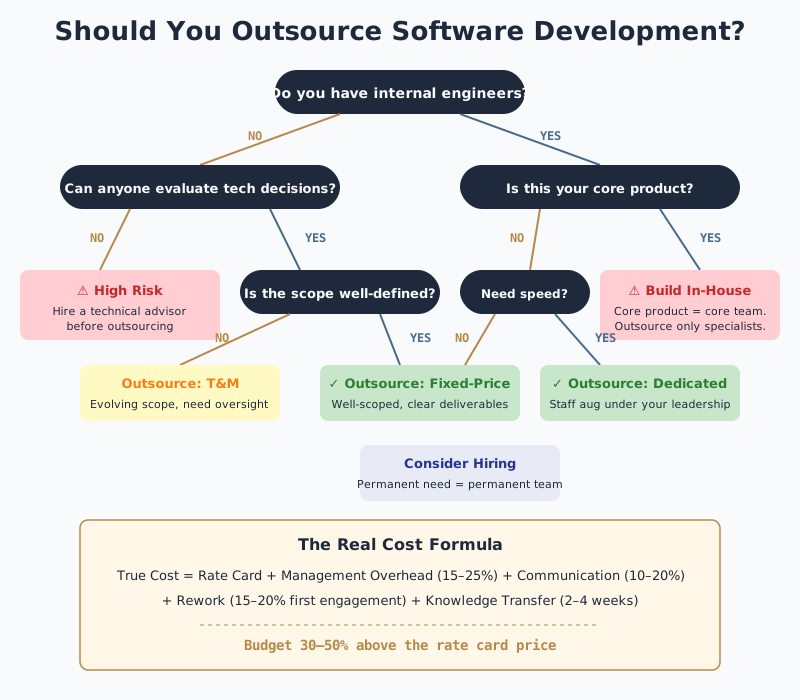
- No internal engineers → Can anyone evaluate tech decisions?
- No → High Risk: hire a technical advisor before outsourcing
- Yes → Is the scope well-defined?
- Yes → Outsource: Fixed-Price (well-scoped, clear deliverables)
- No → Outsource: T&M (evolving scope, need oversight)
- Have internal engineers → Is this your core product?
- Yes → Build In-House (core product = core team; outsource only specialists)
- No → Need speed?
- Yes → Outsource: Dedicated (staff aug under your leadership)
- No → Consider Hiring (permanent need = permanent team)
The Real Cost Formula: Rate Card + Management Overhead (15–25%) + Communication (10–20%) + Rework (15–20% first engagement) + Knowledge Transfer (2–4 weeks). Budget 30–50% above the rate card price.
When Outsourcing Actually Makes Sense
Outsourcing is not universally good or bad. It works in specific situations and fails in others. The distinction is predictable if you understand the underlying dynamics.
Outsourcing works well when:
- You need specialized expertise for a defined engagement. You’re building a machine learning pipeline but your team is full-stack web developers. You need a mobile app but your engineering organization has never shipped one. The expertise gap is real, specific, and bounded – you need it for this project, not permanently.
- You have a well-understood problem and need execution capacity. The requirements are clear. The architecture is defined. You need skilled hands to build it, and your internal team is committed to other priorities. This is the highest-success-rate outsourcing scenario.
- You’re building something adjacent to your core product. Internal tools, data pipelines, integrations, marketing sites – work that matters but isn’t your competitive advantage. Outsourcing these frees your best engineers for the work that differentiates your business.
- You need to move faster than hiring allows. Good engineers take 3–6 months to hire and another 3 months to onboard. An outsourcing partner can start delivering within weeks. For time-sensitive initiatives, this speed advantage is real.
Outsourcing fails when:
- You’re outsourcing your core product with no technical leadership in-house. If nobody on your team can evaluate architecture decisions, review code quality, or assess whether the partner’s technical choices will scale, you’re trusting the vendor to self-regulate. They won’t – not because they’re dishonest, but because their incentives aren’t aligned with your long-term maintenance costs. The IEEE Software Engineering Body of Knowledge (SWEBOK) is the canonical reference for what serious engineering oversight covers – software design, construction, testing, configuration management, security. If your in-house team can’t credibly hold a partner to those disciplines, the partner’s claims become unverifiable.
- The requirements are unclear and you expect the partner to figure them out. Discovery and requirements definition require deep domain knowledge and constant stakeholder access. Outsourcing this to a team in another timezone with no context about your business is a recipe for building the wrong thing efficiently.
- You chose the partner primarily on rate. A $50/hour developer who takes 3x longer and produces code that requires 2x the maintenance costs you more than a $150/hour developer who ships clean, well-architected software on time.
Common Failure Mode
Outsourcing product strategy along with development. The partner builds exactly what you specified – but what you specified was wrong. You needed someone to push back on requirements, not just execute them. A good outsourcing partner will challenge your assumptions. A cheap one will build whatever you ask for.
The Real Cost of Outsourcing
For the full 2026 price picture – project tiers, regional rates, and quote pressure-testing – see how much custom software development costs. What follows is the overhead math that page builds on.
Hidden Overhead Beyond Hourly Rates
Rate cards are misleading. The hourly rate is the most visible cost and the least important predictor of total spend.
What the rate card shows:
- Hourly or monthly rates by role (developer, designer, QA, PM)
- Optional: blended team rate
What the rate card doesn’t show:
- Management overhead. Someone on your team needs to manage the outsourcing relationship. For most engagements, this is 15–25% of a senior person’s time. If you don’t account for this, either nobody manages the relationship (and quality suffers) or someone does it on top of their existing work (and burns out).
- Communication costs. Timezone overlap, meeting cadence, documentation requirements, context transfer – all consume time. Cross-timezone outsourcing adds 10–20% communication overhead compared to co-located teams.
- Rework from misalignment. Even well-managed outsourcing relationships produce some work that misses the mark. Budget 15–20% rework on the first engagement with a new partner. This drops to 5–10% as the relationship matures.
- Knowledge transfer. When the engagement ends, you need to transfer knowledge to your internal team (or next partner). This isn’t free – plan 2–4 weeks of transition time.
- Technical debt. Outsourced code is written by people who won’t maintain it. Without strong code review and architecture oversight, outsourced teams optimize for shipping speed over long-term maintainability. You pay for this later.
Key Signal
A realistic outsourcing budget adds 30–50% on top of the raw development cost for management overhead, communication, rework, and knowledge transfer. If your business case only works at the rate-card price, outsourcing is not the right choice for this project.
The rate arbitrage trap: Nearshore and offshore rates are lower because labor costs are lower in those markets. This is real. But the savings are partially offset by higher communication costs, cultural alignment effort, and the management overhead of distributed work. For most mid-market companies, the true cost difference between a $75/hour offshore team and a $150/hour domestic team is 25–35% – not the 50% the rate cards suggest.
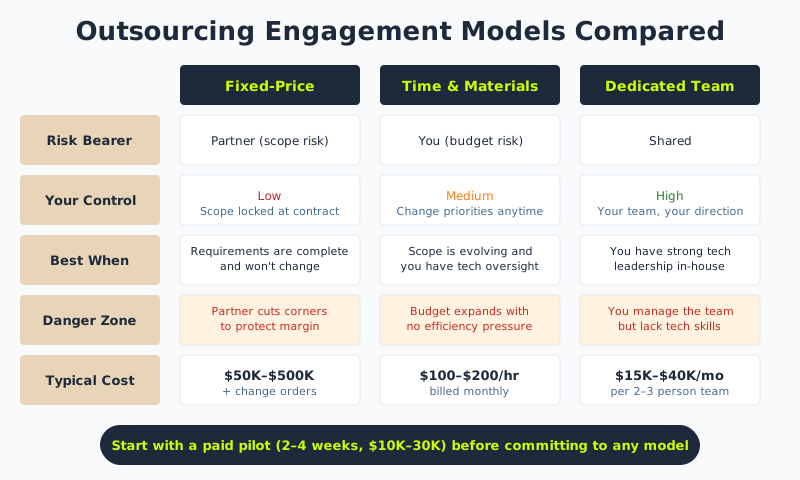
| Fixed-Price | Time & Materials | Dedicated Team | |
|---|---|---|---|
| Risk Bearer | Partner (scope risk) | You (budget risk) | Shared |
| Your Control | Low – scope locked at contract | Medium – change priorities anytime | High – your team, your direction |
| Best When | Requirements are complete and won’t change | Scope is evolving and you have tech oversight | You have strong tech leadership in-house |
| Danger Zone | Partner cuts corners to protect margin | Budget expands with no efficiency pressure | You manage the team but lack tech skills |
| Typical Cost | $50K–$500K + change orders | $100–$200/hr, billed monthly | $15K–$40K/mo per 2–3 person team |
Start with a paid pilot (2–4 weeks, $10K–30K) before committing to any model.
Engagement Models
Fixed-Price, T&M, and Dedicated Team Options
There are three fundamental models for outsourcing software development. Each has different implications for risk, control, and cost.
Fixed-price (project-based): You define the scope, the partner quotes a price, and they deliver for that price. In theory. In practice, fixed-price works only when the scope is genuinely fixed – which means the requirements are complete, the architecture is defined, and there are no unknowns. This is rare for custom software.
Fixed-price creates perverse incentives: the partner profits by minimizing effort, which means cutting corners on quality, testing, and documentation. You profit by expanding scope without additional cost, which leads to disputes. For a deeper analysis, see fixed fee vs. time and materials.
Time-and-materials (T&M): You pay for time spent. The partner bills hourly or monthly. You bear the risk of scope expansion; the partner bears no risk of underestimation. T&M works well when the scope is evolving, the partner is trustworthy, and you have technical leadership to evaluate whether the time being billed is producing proportional value.
The danger of T&M is that it removes the partner’s incentive to be efficient. Without oversight, a T&M engagement will expand to fill available budget. You need someone on your side who can assess whether the team is productive.
Dedicated team (staff augmentation): The partner provides engineers who work as part of your team, managed by your leadership. You get maximum control and integration, but you’re responsible for direction, architecture, and productivity. This model works best when you have strong technical leadership and need additional capacity – not additional expertise.
Questions to Ask Yourself
Can your team write a complete specification before development starts? If yes, fixed-price may work. If no, T&M or dedicated team is more realistic. Do you have technical leadership to manage the engagement daily? If yes, dedicated team gives you the most control. If no, T&M with a strong PM on the partner side is the safer choice.
How to Structure the Relationship
The structure of the outsourcing relationship determines whether problems surface early (when they’re cheap to fix) or late (when they’re expensive).
Start with a paid discovery or pilot. Before committing to a full engagement, run a 2–4 week paid pilot. Give the partner a real (but non-critical) piece of work. Evaluate their communication, code quality, problem-solving approach, and cultural fit. This costs $10K–30K and saves you from six-figure mistakes. Any partner who resists a paid pilot is either desperate for revenue or knows their work won’t withstand scrutiny.
Define clear ownership boundaries. Who owns the codebase? Who makes architecture decisions? Who approves deployments? Who manages the backlog? Ambiguity here creates conflict later. Document it in the contract, not just in conversation.
Establish a communication cadence. Daily standups are overhead for mature teams but essential for new outsourcing relationships. Start with daily syncs and reduce frequency as trust builds. Weekly demos of working software are non-negotiable – if you’re not seeing working software every week, you’re not seeing reality.
Require code review by your team. Every pull request from the outsourced team should be reviewed by someone on your side. This is your primary quality control mechanism. It also builds internal knowledge of the codebase, which you’ll need when the engagement ends. Code coming from an outsourced partner is part of your software supply chain – the NIST Cyber Supply Chain Risk Management (C-SCRM) program is the canonical guidance for assessing, monitoring, and remediating risks in that chain.
Build exit clauses into the contract. Define what happens if the engagement isn’t working: termination notice period, code handover requirements, documentation obligations, and transition support. You should be able to walk away within 30 days without losing your codebase or your progress.
Evaluating Outsourcing Partners
Communication Quality and Retention Rates
The evaluation process for outsourcing partners mirrors the general technology partner evaluation framework, with a few outsourcing-specific dimensions.
Evaluate their communication, not their pitch. The sales process tells you nothing about what working with the delivery team will be like. Ask to meet the actual engineers and PM who would work on your project – not the sales team. If they can’t commit specific people before you sign, they’re going to staff you with whoever is available.
Check their retention data. High developer turnover is the silent killer of outsourced engagements. When the engineer who built your system leaves and is replaced by someone who has to learn the codebase from scratch, you lose months of context. Ask for annual retention rates. Below 80% is a red flag.
Assess their experience with your engagement model. A firm excellent at dedicated team augmentation may struggle with fixed-price delivery, and vice versa. Ask for references from clients who used the same model you’re considering.
Look at their client concentration. If one client represents more than 40% of their revenue, your project will always be second priority when that client needs something. Healthy outsourcing firms have a diversified client base.
For a comprehensive evaluation checklist, see the technology vendor due diligence checklist. For guidance on checking references effectively, see reference checks for technology partners.
Key Signal
The best outsourcing partners will tell you when outsourcing is the wrong approach for your situation. They'd rather lose a deal than take on an engagement that's set up to fail. If a partner agrees to everything you propose without pushing back on anything, they're either inexperienced or desperate.
Managing the Engagement
The essentials are below; the full post-signature playbook – operating cadence, acceptance mechanics, vendor scorecards, escalation ladders, and continuous knowledge transfer – is in managing outsourced software development.
Signing the contract is the beginning, not the end.
The first 30 days determine everything. Use this period to establish working norms, validate assumptions about the partner’s capabilities, and course-correct before bad patterns solidify. If the first sprint doesn’t produce a working, deployable increment of software, escalate immediately. The problem won’t fix itself.
Measure output, not activity. Hours worked, tickets closed, and lines of code are vanity metrics. The only metric that matters is: are you getting working software that solves real problems at a pace that justifies the investment? Weekly demos keep this visible.
Invest in the relationship. Visit the team if they’re in another city. Bring them into your company’s communication channels. Include them in relevant all-hands meetings. The more the outsourced team feels like part of your organization, the more they’ll care about your outcomes – not just their billable hours.
Plan the transition from day one. Every outsourcing engagement ends eventually. From the first week, ensure that documentation is being written, knowledge is being shared, and your internal team is building familiarity with the codebase. The worst outcome isn’t a failed project – it’s a successful project that you can’t maintain after the partner leaves.
For guidance on how to structure contracts and commercial terms to protect your interests, see the fixed fee vs. time and materials guide. For common pitfalls to avoid throughout the engagement, see common mistakes in technology partner selection.
Related Guides
- Product Development Outsourcing – when the scope includes product thinking, not just code
- How to Choose a Software Development Company – evaluation framework for development partners
- MVP Development: Build vs. Buy vs. Partner – when the scope is a first shippable version
- Software Development RFP Template – when the engagement needs a formal solicitation
- Technology Partner Selection Process – the end-to-end selection methodology
- Fixed Fee vs. Time and Materials – pricing model comparison
- Why Technology Projects Fail – failure patterns and prevention
- Reference Checks for Technology Partners – how to validate claims
Frequently Asked Questions
Should I outsource software development?
Yes if you need specialized expertise for a defined project, capacity you can't hire fast enough, or work adjacent to your core product. No if you have no in-house technical leadership, no requirements, or are chasing rate savings. Outsourcing is a capability decision, not a cost decision.
What does outsourcing software development actually cost?
Rate cards mislead. The real budget adds 30–50% on top of raw development cost for management (15–25% of a senior's time), cross-timezone communication (10–20%), rework (15–20% first engagement), and knowledge transfer (2–4 weeks at the end).
Fixed-price, time-and-materials, or dedicated team?
Fixed-price only when scope is genuinely fixed – which is rare in custom software. Time-and-materials when scope is evolving and you have technical leadership to oversee it. Dedicated team when you have strong internal leadership and need capacity, not expertise.
How much can I save by going offshore?
Less than the rate card suggests. Offshore rates look 50% cheaper, but communication overhead, cultural alignment, and distributed-work management push real savings to 25–35% for most mid-market companies. Quality and velocity matter more than hourly rate.
How do I evaluate an outsourcing partner?
Meet the actual engineers who would work on your project, not the sales team. Check annual retention – under 80% is a red flag. Look at client concentration – if one client is more than 40% of revenue, your project comes second. Run a 2–4 week paid pilot.
How do I structure an outsourcing engagement?
Start with a 2–4 week paid pilot ($10,000–$30,000). Define clear ownership of codebase and decisions. Require code review by your team on every PR. Weekly demos of working software. Build in a 30-day exit clause so you can walk away with your codebase intact.
What's the biggest risk in outsourcing software?
Outsourcing the thinking, not just the building. A partner will build exactly what you specified – if what you specified was wrong, that's your loss, not theirs. Keep product strategy and architecture decisions in-house even when execution goes out.