Product Partner Selection Framework
Selecting a product development partner is harder than selecting a software development partner. Software development has relatively clear success criteria – the code works, the features meet the spec, the system performs under load. Product development success is murkier. Did the partner build the right thing? Did they help you make better product decisions? Did the end result move your business forward?
These questions are difficult to evaluate upfront, which is why so many companies default to evaluating what’s easy to measure: hourly rate, team size, portfolio prettiness, and whether the sales team is charming. None of these predict success.
This guide provides a structured evaluation framework specifically for product development partners – firms that combine design, engineering, and product strategy. For pure software development engagements, see the software development partner selection guide. For the general technology partner evaluation methodology, see how to evaluate a technology partner.
Define What Kind of Partner You Need
“Product development partner” means different things depending on what you need. Before evaluating firms, clarify which of these you’re actually looking for:
Full-stack product studio: Design + engineering + product strategy under one roof. They take a concept and turn it into a shipped product. Best for companies without in-house product or engineering teams. Most expensive, highest dependency on the partner’s judgment. See product development outsourcing for when this model works.
Design-led product firm: Strong in research, UX, and product design. Engineering may be in-house or outsourced to a separate development partner. Best for companies that have engineering capacity but lack product design expertise. See product design agency for evaluation criteria.
Engineering-led product firm: Strong in architecture, development, and technical product management. Design may be in-house or outsourced. Best for companies with clear product vision and design direction that need world-class engineering execution.
Hybrid/flexible firms: Offer different team compositions depending on the engagement. Can staff a designer-heavy team for discovery and a developer-heavy team for build. Best for long-term partnerships where needs evolve.
Questions to Ask Yourself
Where is your internal strength? If you have a strong product leader but no design team, a design-led firm fills the gap. If you have designers but no engineers, an engineering-led firm is the match. If you have neither, a full-stack studio is the most pragmatic option – but also the most expensive and the hardest to evaluate.
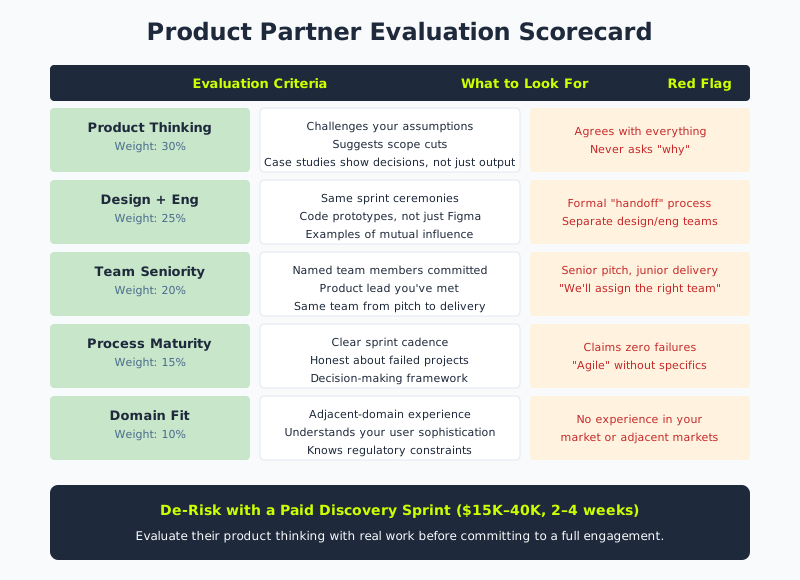
| Criterion | Weight | What to Look For | Red Flag |
|---|---|---|---|
| Product Thinking | 30% | Challenges your assumptions; suggests scope cuts; case studies show decisions, not just output | Agrees with everything; never asks “why” |
| Design + Eng Integration | 25% | Same sprint ceremonies; code prototypes, not just Figma; examples of mutual influence | Formal “handoff” process; separate design/eng teams |
| Team Seniority | 20% | Named team members committed; product lead you’ve met; same team from pitch to delivery | Senior pitch, junior delivery; “We’ll assign the right team” |
| Process Maturity | 15% | Clear sprint cadence; honest about failed projects; decision-making framework | Claims zero failures; “Agile” without specifics |
| Domain Fit | 10% | Adjacent-domain experience; understands your user sophistication; knows regulatory constraints | No experience in your market or adjacent markets |
De-Risk with a Paid Discovery Sprint ($15K–40K, 2–4 weeks) – evaluate their product thinking with real work before committing to a full engagement.
Evaluate Product Thinking
Challenge Assumptions During Discovery
This is the single most important evaluation criterion and the one most commonly skipped. Product thinking is the ability to connect user needs, business goals, and technical constraints into coherent product decisions.
How to test it:
Give them a real problem. Not a whiteboard exercise – an actual product challenge your company faces. Share enough context that they could form a point of view: what the product does, who uses it, what’s working, what isn’t, what you’re considering building next. Then ask: “What would you do?”
Good partners will ask clarifying questions, challenge your assumptions, suggest alternatives you haven’t considered, and demonstrate a framework for thinking about the problem. They won’t agree with everything you’ve said. They won’t pitch their solution – they’ll explore the problem.
Poor partners will nod along, agree with your diagnosis, and immediately suggest how they’d build what you described. They’re optimizing for winning the deal, not for helping you build the right thing.
Review their case studies for decision-making, not deliverables. A portfolio of beautiful screens tells you about their visual design capability. It tells you nothing about their product judgment. Ask to walk through a specific project:
- What was the original brief?
- How did the brief change after research?
- What did they cut from the scope and why?
- What surprised them about user behavior?
- What would they do differently?
These questions surface product thinking. If the answer to “what did you cut?” is “nothing – we delivered everything the client asked for,” they’re not product thinkers. They’re order-takers.
Key Signal
The best product partners will tell you when you're wrong. Not rudely, but clearly. "Based on our experience, the approach you're describing tends to fail because X. Here's what we'd recommend instead." If a firm agrees with every product decision you present during the sales process, they'll agree with every bad decision during the engagement too.
Evaluate Design and Engineering Integration
The defining characteristic of good product development firms is tight integration between design and engineering. In mediocre firms, design produces mockups, “hands them off” to engineering, and then fights about what was built vs. what was designed. In good firms, design and engineering collaborate continuously from day one.
Signs of genuine integration:
- Designers and engineers participate in the same sprint ceremonies
- Prototypes are built in code (not just Figma), especially for interactions and animations
- Engineering constraints inform design decisions early, not as late-stage vetoes
- The team can describe a recent project where a design decision was changed based on engineering input – and an engineering decision changed based on design input
- Design and engineering are evaluated on the same outcome metrics
Signs of fake integration:
- “Our designers and engineers work closely together” (generic claim, no specifics)
- Design team and engineering team are in different offices or timezones
- There’s a formal “handoff” document or process between design and engineering
- Designers have never touched a browser dev tools; engineers have never opened Figma
- The firm pitches design and engineering as separate phases with separate teams
Why this matters so much: Product quality lives in the details – the micro-interactions, the error states, the edge cases, the performance of animations, the behavior when data is missing. These details can only be right when design and engineering are making decisions together, in real-time, with shared context. No handoff document captures this. See the product design process guide for more on how healthy design and engineering collaboration works.
Assess Team Composition and Seniority
Product development is senior work. The decisions made in the first few weeks of a product engagement – architecture choices, design system foundations, user flow structures – compound throughout the entire lifecycle. Junior team members making these decisions creates compounding quality debt.
Ask for specific names and roles. Not “we’ll staff a team of 4–5 people.” Who, specifically, will work on your project? What’s their experience? How long have they been with the firm? Will they be dedicated to your project or split across multiple clients?
Evaluate the product lead. In most product development engagements, one person functions as the product lead – synthesizing research, facilitating decisions, managing scope, and maintaining the through-line from strategy to shipped features. This person’s judgment and communication skills matter more than any other factor. Meet them during the sales process.
Understand the staffing model. Some firms staff with a consistent team from start to finish. Others rotate people in and out based on project phase. Both can work, but you need to understand which model you’re getting and whether it fits your needs. For projects requiring deep domain knowledge, team continuity is critical.
Common Failure Mode
The senior team does the pitch and the discovery phase. Then they "transition" to the build phase and you discover your day-to-day team is entirely different – and significantly more junior – than the people who made the product decisions. Ask explicitly: will the people in this room be the people building the product?
Run the Due Diligence Process
Product development partners should go through the same due diligence as any technology partner. The technology vendor due diligence checklist covers the comprehensive framework. Here are the product-specific additions:
Check references from the product side. Don’t just talk to the CTO who managed the engineering relationship. Talk to the product manager or founder who worked with the partner on product decisions. Ask: Did they challenge your thinking? Did they help you avoid mistakes? Would you trust their product judgment again?
Review shipped products, not prototypes. Prototypes are designed to look good. Shipped products reveal the partner’s ability to handle real-world complexity – edge cases, error states, performance, accessibility. Ask to use a product they built (ideally one for a company similar to yours in size and stage).
Evaluate their process documentation. Not because process documents are inherently valuable, but because the quality of their documentation reveals their organizational maturity. How do they run sprints? How do they make design decisions? How do they handle scope disagreements? Mature firms have clear answers even if the answers aren’t identical to the ones in a textbook.
For detailed guidance on conducting reference checks, see reference checks for technology partners. For common mistakes in the selection process, see common mistakes in technology partner selection.
Structure the Engagement to Protect Yourself
Start with a paid discovery sprint. This is the most important structural decision. A 2–4 week discovery engagement ($15K–40K) lets you evaluate the partner’s product thinking, communication style, and cultural fit with minimal financial risk. The output – research findings, strategic recommendations, wireframes, a scoped backlog – is valuable regardless of whether you proceed with the same partner.
Separate decision rights from execution. The partner executes. You make the final product decisions. This sounds obvious, but in practice the line blurs. Define it clearly: the partner recommends, you approve. If there’s a disagreement, your product leader has the final call. This protects you from well-intentioned partners who optimize for what’s interesting to build rather than what’s important for your business.
Build in natural checkpoints. Structure the engagement with milestone reviews every 4–6 weeks where you and the partner jointly evaluate progress against the original goals. These checkpoints are opportunities to adjust scope, shift priorities, or – if necessary – end the engagement before the budget is consumed on work that isn’t delivering value.
Define success metrics upfront. Not deliverable metrics (features shipped, screens designed) but outcome metrics (user adoption, task completion rate, conversion). If you can’t agree on what success looks like before the engagement starts, you’ll definitely disagree about whether it was achieved afterward.
For guidance on commercial structuring and pricing models, see fixed fee vs. time and materials.
Related Guides
- Product Development Outsourcing – when and how to outsource product work
- MVP Development: Build vs. Buy vs. Partner – when the engagement is a first shippable version
- Product Design Agency – evaluating design-led firms
- Product Design Process – understanding the design process
- How to Choose a Software Development Company – evaluation framework for engineering partners
- Technology Partner Selection Process – the end-to-end selection methodology
Frequently Asked Questions
What is a product development partner?
An outside firm that combines design, engineering, and product strategy to help you build a product – not just build to a spec. They typically run $40,000–$150,000+ engagements and are evaluated on judgment, not just execution.
Product development vs software development partner – what's the difference?
A software partner builds what you specify. A product partner helps decide what to build. If you already know the problem, user, and solution, hire software. If any of those three is fuzzy, you need product thinking – harder to evaluate and more expensive to get wrong.
How do I evaluate a product development partner's thinking?
Give them a real product challenge. Ask 'what would you do?' Good partners ask clarifying questions, challenge your assumptions, and explore the problem. Poor partners agree with your diagnosis and immediately pitch how they'd build what you described.
What are the four types of product development partners?
Full-stack product studios (design, engineering, strategy under one roof). Design-led product firms (strong UX and research). Engineering-led firms (deep technical execution). And hybrid firms that flex team composition. Match type to your internal gaps.
Should I run a paid discovery sprint before committing?
Yes. A 2–4 week paid discovery ($15,000–$40,000) is the single most important structural decision. You get research, recommendations, wireframes, and a scoped backlog – valuable even if you don't proceed with the same partner. Cheap way to evaluate fit.
How do I assess team composition in a product engagement?
Ask for specific names, not roles. The people in the pitch should be the people building the product. Meet the product lead – their judgment drives outcomes more than any other factor. Watch for senior-to-junior swaps between sales and delivery.
What protects me from a bad product development engagement?
Four things. A paid discovery sprint before full commitment. Separated decision rights (partner recommends, you approve). Milestone checkpoints every 4–6 weeks. Outcome-based success metrics (user adoption, conversion) – not deliverable metrics.