Product Outsourcing Decision Guide
- Product Development vs. Software Development
- What You Can and Can't Outsource
- Engagement Models for Product Work
- Types of Product Development Firms
- Geography: Onshore, Nearshore, Offshore
- What It Actually Costs
- Timeline: How Long Things Actually Take
- Contract Structure and IP
- Finding the Right Partner
- Three Scenarios
Product development outsourcing occupies a strange middle ground. Companies that would never outsource strategy or branding will happily hand their entire product to an outside firm. They treat “product development” as a synonym for “software development” – code-for-hire that can be specified, contracted, and managed like construction. Done well, outsourcing product development extends your team’s reach; done carelessly, it outsources the judgment that should have stayed in-house.
It is not. Product development involves research, design, engineering, and the constant decision-making that connects them. When it works – when the team doing the research is the same team making architecture decisions, and the designer sits next to the engineer implementing the interaction – products come together. When those functions are split across organizational boundaries, managed by different incentives, and separated by timezones, products come apart.
This does not mean you cannot outsource product development. It means you need to understand what you are actually outsourcing and structure the engagement accordingly. Every section that follows returns to the same underlying idea: you can outsource the building. You cannot outsource the thinking.
Product Development vs. Software Development
This distinction is critical and frequently ignored.
Software development takes a defined specification and turns it into working code. The inputs are clear: wireframes, user stories, architecture decisions, acceptance criteria. The output is equally clear: deployed, tested software that meets the specification. Success is measurable against the spec.
Product development starts before the specification exists. It includes research (what should we build?), strategy (why this and not that?), design (how should it work?), engineering (how do we build it?), and iteration (what did we learn and what do we change?). The inputs are fuzzy: market signals, user feedback, business goals, technical constraints. The output is a product that solves a real problem well enough that people will pay for it.
When you outsource software development, you are hiring execution. When you outsource product development, you are hiring judgment.
The two require different vendors, different contracts, different oversight, and different rates. Buyers who do not make the distinction end up paying product rates for software work, or – worse – handing product decisions to a partner selected for code quality.
Common Failure Mode
Hiring a "product development agency" and handing them a detailed feature spec. You have pre-made every product decision, so what you actually need is software development. You are paying for product expertise you are not using, and the agency is executing requirements they had no part in shaping – which means they cannot flag when those requirements are wrong.
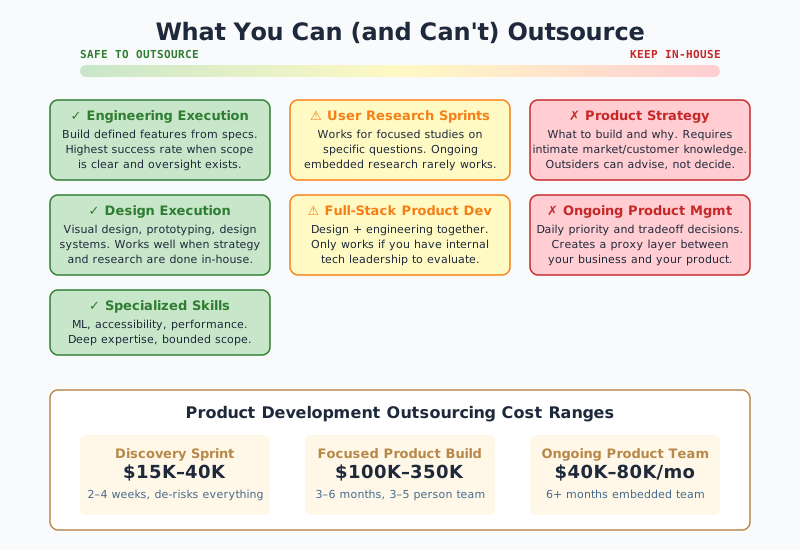
Safe to outsource:
- Engineering Execution – build defined features from specs; highest success rate when scope is clear and oversight exists
- Design Execution – visual design, prototyping, design systems; works well when strategy and research are done in-house
- Specialized Skills – ML, accessibility, performance; deep expertise, bounded scope
Proceed with caution:
- User Research Sprints – works for focused studies on specific questions; ongoing embedded research rarely works
- Full-Stack Product Dev – design + engineering together; only works if you have internal tech leadership to evaluate
Keep in-house:
- Product Strategy – what to build and why; requires intimate market/customer knowledge; outsiders can advise, not decide
- Ongoing Product Management – daily priority and tradeoff decisions; creates a proxy layer between your business and your product
| Engagement Type | Cost Range | Duration / Notes |
|---|---|---|
| Discovery Sprint | $15K–40K | 2–4 weeks, de-risks everything |
| Focused Product Build | $100K–350K | 3–6 months, 3–5 person team |
| Ongoing Product Team | $40K–80K/mo | 6+ months embedded team |
What You Can and Can’t Outsource
Design, Engineering, and Specialized Capabilities
Works well to outsource:
- Design execution – visual design, interaction design, and prototyping. A skilled product design agency can take your strategy and user research and produce a design system, wireframes, and high-fidelity prototypes that your internal team or an engineering partner can build. For guidance on finding the right design partner, see hire a product designer or how to write a design RFP.
- Engineering execution – building the product once the what and how are defined. This is software development outsourcing, and it works well with proper structure. See the outsourcing software development guide for the full framework.
- Specialized capabilities – machine learning, hardware integration, accessibility audits, performance optimization. These require deep expertise that most product teams do not have in-house.
- User research sprints – a research firm running a focused study on a specific question. The key word is “focused.” Outsourcing ongoing, embedded research rarely works because the researchers need deep product context.
Strategy and Product Management Risks
Risky to outsource:
- Product strategy – deciding what to build and why. This requires intimate knowledge of your market, customers, competitive landscape, and business model. Outside firms can contribute frameworks and facilitation, but the strategic decisions need to come from people who will live with the consequences.
- Ongoing product management – the daily decisions about priorities, tradeoffs, and direction. A fractional product leader can help a small team for a few months, but product management as a long-term outsourced function creates a proxy layer between your business and your product that degrades decision quality over time.
- Full-stack product development (design and engineering) with no internal technical leadership – this is the highest-risk outsourcing configuration. Nobody on your side can evaluate whether the product and technical decisions being made are sound. You are entirely dependent on the partner’s judgment and integrity.
Key Signal
If you cannot articulate what problem your product solves, who it solves it for, and how you will know if it is working, you are not ready to outsource product development. You need product strategy first. That might mean hiring a product leader, or running a focused strategy engagement – but it needs to happen before you bring in a development partner.
Engagement Models for Product Work
Phased Discovery and Dedicated Team Structures
Product development outsourcing uses the same underlying commercial models as software outsourcing – fixed-price, time-and-materials, and dedicated teams – but the way they map to product work differs. For the full comparison of pricing models, see fixed fee vs. time and materials.
Discovery + Build (phased approach):
The most common structure for outsourced product development. Phase 1 is a time-boxed discovery sprint (2–4 weeks): research, strategy, design exploration, technical feasibility. Phase 2 is the build, informed by discovery findings. Each phase can be separately contracted, with the first phase typically fixed-price and the second T&M.
This works because it separates the fuzzy work (what should we build?) from the defined work (build it). The discovery sprint produces artifacts – user personas, journey maps, wireframes, a prioritized backlog – that serve as the specification for the build phase.
Embedded team (long-term partnership):
The partner provides a cross-functional team – designer, engineers, possibly a product manager – that works as an extension of your organization. You provide direction and domain expertise. They provide execution and technical expertise.
This model works best for companies building complex products over 6+ months. The relationship has time to mature, the team develops deep domain knowledge, and the communication overhead amortizes over a longer engagement.
Sprint-based product design:
You engage a product design agency or UX consultant for focused sprints: a design sprint, a usability study, a design system build. Engineering is separate – either in-house or with a different partner. This keeps the design expertise focused and avoids paying product design rates for engineering work.
Fixed-scope project (one-shot build):
Best suited to MVPs and well-defined products with a short horizon. A scoped price, a scoped date, a scoped deliverable. The partner carries schedule and scope risk; you carry judgment risk – if you scoped the wrong thing, fixed price does not save you. Use this model when the product definition is genuinely stable. It almost never is.
What’s the best outsourcing model for long-term product development?
For long-term product work, the embedded team is the model that holds up. Discovery-plus-build is right for a first ship, and a fixed-scope project suits a stable, well-defined build – but neither sustains a product that evolves over quarters. An embedded cross-functional team (designer, engineers, sometimes a product manager) works as an extension of your organization, develops deep domain knowledge, and amortizes the communication overhead that one-shot engagements pay repeatedly. The relationship has time to mature, and the team’s best work comes from month four onward, once context is built. The tradeoff is cost – roughly $40K–$80K per month – and the discipline required to keep product judgment on your side. The model fails when buyers treat an embedded team as staff augmentation and outsource the thinking along with the building.
Questions to Ask Yourself
Do I need a partner who can think about the product, or one who can build what I have already defined? If you need thinking, the discovery + build model gives you the chance to evaluate their judgment before committing to a full build. If you need building, a dedicated engineering team with clear specifications is more cost-effective.
Types of Product Development Firms
The market for outsourced product development is not one market. It is four, and the firms in each category are priced, structured, and suited to different problems. Confusing them is how buyers end up paying senior rates for junior work, or asking a staff-augmentation shop to do strategy.
The product studio. Small to mid-size (10–80 people), cross-functional by design, built around a few senior partners. Typical output: MVPs, new product lines inside larger companies, zero-to-one products for funded startups. Rates at the top of the market. Strong opinions on process, usually published publicly. The best of them will decline engagements they do not believe in. If your problem is “we know what we want to build, just build it cheaper,” a product studio is not the right fit and they will tell you so.
The full-service agency. Larger (80–500 people), multi-capability (design, engineering, sometimes marketing), more process-heavy. Better at scale, at enterprise clients, at projects with complex stakeholder maps. The tradeoff is that the senior people who sell the work are not the people who deliver it. Ask who will actually be on your project before you sign. Rates are middle-to-high.
The dev shop. Engineering-led, design-and-product capabilities added as a service line. Priced on the engineering side of the market. Good for execution once the product is defined. Variable on product judgment. Be careful with firms that advertise “product development” but staff projects with engineering managers rather than product managers – the capability is often a pricing layer, not a real capability.
The staff-augmentation firm. Sells engineers (and sometimes designers) by the seat, managed by your internal team. Rates are the lowest of the four categories because the coordination burden is on you. Works well when you have strong in-house product leadership and a clear backlog. Fails badly when you hoped the augmented team would also figure out what to build.
A useful heuristic: the more senior the judgment you need, the smaller the firm that will provide it well. A ten-person product studio can give you world-class product thinking because the founders are still on your engagement. A five-hundred-person agency can give you world-class execution because it has the depth to staff it. The middle is where buyers get surprised – a mid-size firm that is too large to keep its best people on your project and too small to have real bench depth.
Pricing and fit at a glance:
| Firm type | Typical size | Blended rate (US) | Best for |
|---|---|---|---|
| Product studio | 10–80 | $200–$350/hr | Zero-to-one, MVPs, new product lines |
| Full-service agency | 80–500 | $180–$275/hr | Complex enterprise, multi-team programs |
| Dev shop | 20–200 | $100–$200/hr | Execution after product is defined |
| Staff augmentation | any | $75–$150/hr | Adding capacity to a strong internal team |
Rates are indicative and shift quickly. What does not shift is the shape of the market.
Geography: Onshore, Nearshore, Offshore
Geography is the single biggest lever on your hourly rate, and the second biggest lever on project risk. The first is scope clarity; more on that shortly.
Three models dominate the buyer-side of the market. Each has a real tradeoff profile. Choosing well is less about finding the cheapest rate than about honestly assessing how much product judgment you need from the partner – because the further offshore you go, the more of that judgment has to live on your side.
Onshore (US, Western Europe, UK, Canada, Australia). Highest rates. Full cultural and timezone overlap. Best for work where live collaboration and on-the-fly judgment calls are frequent – early-stage product work, ambiguous scopes, projects with non-technical stakeholders who need real-time back-and-forth. Rates are high enough that onshore partners only make sense for the parts of the work that actually benefit from them.
Nearshore. For US buyers, Latin America (Mexico, Colombia, Argentina, Brazil, Costa Rica, Uruguay). For European buyers, Eastern Europe (Poland, Romania, Portugal, Ukraine – where and when feasible). Timezone overlap within 2–3 hours. Cultural compatibility generally strong. Rates at 40–60% of onshore. This is the best default for most outsourced product development. The timezone overlap preserves most of the collaboration benefit of onshore; the rate gap funds a meaningfully larger team for the same spend.
Offshore. South Asia (India, Pakistan) and Southeast Asia (Vietnam, the Philippines, Indonesia). Rates at 25–40% of onshore. Timezone overlap under three hours per day, often zero. Works best for clearly scoped execution work where daily live collaboration is not required. Requires disciplined documentation, clear acceptance criteria, and senior technical leadership on the buyer side. Works poorly for early-stage product work where the specification is discovered rather than handed over.
Indicative blended rates by region, for a mid-seniority cross-functional team:
| Region | Blended rate | Timezone overlap (US ET) | Notes |
|---|---|---|---|
| US / Western Europe | $180–$300/hr | Full | Premium market, scarce senior talent |
| Canada | $150–$225/hr | Full | Onshore at a mild discount |
| Latin America | $75–$150/hr | 2–5 hrs | Strong nearshore default for US buyers |
| Eastern Europe | $60–$125/hr | 0–1 hr for EU; 6+ for US | Strong nearshore default for EU buyers |
| South Asia | $35–$85/hr | 1–3 hrs | Deep technical depth; longer handoff cycles |
| Southeast Asia | $30–$75/hr | 0–2 hrs | Growing capacity; variable senior bench |
Two things to keep in mind. First, the rates above are for reputable firms staffing reasonably senior people. The floor of each range is much lower if you are willing to work with less established partners – and the risks scale with the discount. Second, a rate is not a cost. Coordination overhead, rework, and missed context all translate directly into cost that does not show up on the invoice. The right question is not “what is the rate?” It is “what is the fully loaded cost per shipped outcome?”
Key Signal
The less mature your internal product thinking, the more timezone overlap you need. Buyers who are still working out what the product should do cannot afford a 12-hour round-trip on every question. If the product definition is genuinely ambiguous, pay for nearshore or onshore. Save the offshore rates for work whose scope is already clear.
What It Actually Costs
Product development outsourcing costs more per hour than pure engineering outsourcing because you are paying for senior, cross-functional talent – designers, product managers, and architects alongside developers.
The honest ranges, for a US or Western European partner:
| Engagement | Duration | Typical cost | Includes |
|---|---|---|---|
| Discovery sprint | 2–4 weeks | $15K–$40K | Research, strategy, user flows, wireframes, scoped backlog |
| Design sprint | 1–2 weeks | $20K–$60K | Design exploration, prototype, usability test |
| MVP (design + build) | 3–6 months | $100K–$350K | Cross-functional team of 3–5, concept through launch |
| Embedded team | Ongoing | $40K–$80K/month | 3–5 person cross-functional team |
| Full product build | 6–12 months | $350K–$1.2M | Larger team, complex product, multi-platform |
Nearshore and offshore partners reduce these numbers by 40–70%, with the tradeoffs described above. A discovery sprint delivered by a nearshore product studio might cost $10K–$25K. An MVP built by an offshore engineering partner with a strong onshore lead might cost $60K–$150K.
Three things that drive cost more than the rate:
Seniority mix. A team of five juniors at $150/hr costs the same per hour as a team of two seniors at $375/hr, but they will not produce the same outcome. For ambiguous product work, pay for seniority. For well-scoped execution, the cheaper seniority mix often works.
Handoff count. Every organizational boundary you introduce costs money. An onshore product studio owning both design and engineering is expensive per hour but cheap per handoff. Splitting design (onshore) from engineering (offshore) with no product manager to broker the conversation is the worst of both worlds.
Iteration velocity. How fast can the team test an idea and move on? Fast teams cost more per week but less per learning. Slow teams cost less per week but spend it relitigating decisions. Over six months, the fast team is almost always cheaper.
Budget for iteration, not for specification. A product build that lands on the first try is an accident. Assume two to three major revisions of the core product hypothesis between kickoff and launch. If your contract has no room for that, the contract is wrong.
Which partners offer end-to-end product development for US clients on a ~$150K budget and 5-month timeline?
That budget and timeline point to a focused MVP, not an embedded team or a full product build. At roughly $150K over five months, a US product studio can staff a small cross-functional team – a designer, two engineers, and fractional product leadership – through discovery and a first shippable version, provided scope stays disciplined. Pure onshore at that budget buys a lean team; a nearshore studio with a US-based lead stretches the same dollars 40–60% further and is the more common shape for this brief. What $150K does not buy is open-ended scope: it funds one well-defined product hypothesis taken to launch, with room for two or three revisions. Partners who promise a full multi-platform product at this budget are either underscoping or planning change orders. Match the firm type to the work – a product studio for zero-to-one judgment, a dev shop only when the spec is already settled.
Holding quotes from outsourcing partners?
Bring them to a 15-minute call – we'll tell you whether the numbers are defensible, what's missing from the scope, and where we'd push back. No pitch; that's the whole meeting.
Get a quote sanity check →Timeline: How Long Things Actually Take
Schedule estimates from vendors tend to describe the happy path. Here are the unhappy-path durations buyers should plan for.
Discovery sprint: 2–4 weeks. Add one week if the kickoff runs late because the buyer side has not assembled the right stakeholders. That is the single most common reason discovery slips.
Design sprint: 1–2 weeks. Fast enough that buyer-side bottlenecks rarely break it. Slow enough that you cannot skip the prep week. Book the research participants before the sprint starts, not during.
MVP (first shippable version): 3–6 months from a standing start. Three months is aggressive and requires a scoped product, a fully available buyer-side product owner, and a partner team that is ready to start on day one. Six months is more typical. Beyond six months, what you have is not an MVP.
Embedded team productivity. Month 1 is setup: access, tooling, context, relationships. Month 2 is orientation: the team is producing, but not yet producing its best work. Month 3 the team hits stride. From month 4 onward, you get the value. If you plan to swap the partner out at month 3 because you do not love the early output, you are paying for the ramp without collecting the return.
Ongoing build: 6–12 months per major milestone. Complex products rarely progress in straight lines. A shippable v1 in six months, a meaningful v2 in another six, and a third release that consolidates and improves the first two. Budgets and roadmaps that assume continuous linear progress across eighteen months almost always break around month nine.
The single largest source of slippage is not the partner’s execution speed. It is unclear decision authority on the buyer side. When three people can all say no and only a fourth can say yes, the project moves at the speed of that fourth person’s calendar. Name the decision-maker before kickoff. Write it down. Tell the partner.
Contract Structure and IP
The contract is where a lot of buyers stop paying attention, and it is where a surprising amount of project risk sits. A few structural choices matter more than the rest.
Master Services Agreement plus Statements of Work. The MSA carries the standing terms – IP, confidentiality, indemnity, liability, termination, dispute resolution. Each SOW carries the specific engagement – scope, deliverables, timeline, fees, acceptance criteria. This structure lets you add scope quickly without renegotiating the whole agreement, and it lets you terminate a bad SOW without ending the relationship. Most reputable firms will have their own MSA to propose. Read it. Negotiate the parts that do not work for you. Do not sign “standard terms” without reviewing them.
IP assignment. You should own all work product on payment – code, designs, research, documentation, configuration. Look for present-tense assignment language: “Contractor hereby assigns.” Avoid language that defers assignment to a future milestone or makes it contingent on full contract completion. If the engagement ends early for any reason, you want the work you paid for to be yours.
Pre-existing IP and reuse. Partners routinely reuse generic components across clients – an authentication helper, a deployment script, an internal UI kit. This is fine, and trying to prevent it will make good firms walk away. What is not fine is the partner retaining rights to reuse your specific code in other client work. Get a clean carve-out: pre-existing and general-purpose tools remain the partner’s; anything built for your product is yours exclusively.
Acceptance criteria. Every SOW should define what “done” means for each deliverable. Ambiguous acceptance is the single most common source of late-stage disputes. For design: “approved high-fidelity mockups for the following ten screens.” For engineering: “passes the following test suite on the following environments.” Write acceptance criteria that a neutral third party could evaluate.
Source code escrow. Not necessary for most engagements. Worth considering when the partner holds exclusive deployment access, when the product is business-critical, or when the partner’s financial stability is unclear. A simple escrow arrangement with a third-party service is cheap insurance against the tail risk of losing access to your own code.
Termination and transition. Every contract should include a termination-for-convenience clause with a reasonable notice period (30–60 days for ongoing engagements). It should also include transition assistance – the partner commits to a defined period of knowledge transfer at agreed rates if you move to another vendor or bring the work in-house. Good partners will offer these terms willingly. Partners who resist are telling you something important.
Liability caps. Standard caps are one times the contract value. For strategic work or long engagements, negotiate higher caps on specific categories – IP indemnity, data breach, gross negligence. The cap is not just a number; it is a signal about how much skin the partner is willing to put in the game.
Questions for Your Contract Review
Does the IP assignment happen on payment or at some later milestone? Is the termination notice period something you could actually live with? What is the partner's liability cap, and does it match the scale of the risk? If the answers are "later," "no," and "too low," the contract needs work.
Finding the Right Partner
Evaluate Product Judgment and Design-Engineering Integration
Selecting a product development partner requires evaluating capabilities that pure engineering firms do not need: design quality, product thinking, user research chops, and cross-functional collaboration.
Review their case studies for product judgment, not just execution. Every agency has case studies. Most describe what they built. The best describe the decisions they made: features they cut, hypotheses they tested, pivots they recommended. Look for evidence that the partner shaped the product – not just followed instructions.
Evaluate their design and engineering integration. In strong product teams, designers and engineers work together from the start. In weak ones, design hands off static mockups and engineers interpret them. Ask how their design and engineering teams collaborate. If the answer involves a “handoff process,” that is a warning sign.
Ask about failed projects. Every experienced product firm has projects that did not succeed. How they talk about failures reveals their maturity. Do they take accountability for their role? Did they recognize the warning signs? What would they do differently? Partners who claim zero failures are either lying or have not done enough work.
Check for domain relevance, not domain expertise. Your product development partner does not need to have built a product in your exact industry. They do need to understand your users’ level of technical sophistication, your regulatory constraints (if any), and the competitive dynamics of your market. Adjacent-domain experience is often better than same-domain experience – it brings fresh perspective without the baggage of “how things are done” in your industry.
Meet the delivery team before you sign. The senior people in the pitch meeting are rarely the ones writing the code or running the research. Insist on meeting the actual team. Look for shared language between the designer, engineer, and product manager. If they describe the project in different vocabulary, they are not working together – they are handing off.
For the comprehensive evaluation framework, see how to evaluate a technology partner. For the end-to-end selection process, see technology partner selection process. For the specific case of product development partners, see how to select a product development partner.
Outsourced Product Development: Which Model Fits
Buyers searching for “outsourced product development” are usually trying to pick a shape before they pick a firm. The four shapes, with the numbers from the sections above in one place:
| Model | Scope | 2026 range | Best when | Watch for |
|---|---|---|---|---|
| Discovery sprint | Problem definition, research, prototype, scoped plan | $15K–$40K, 2–4 weeks | You have a direction and no spec; the cheapest way to avoid building the wrong thing | A firm that skips it and quotes the build from a one-page brief |
| Focused MVP | Design plus build of the smallest product that tests the hypothesis | $100K–$350K, 3–6 months | A first ship with a clear hypothesis and a defined user | Scope that grows past $350K – at that point it is a product, not a test |
| Embedded cross-functional team | Ongoing product, design, and engineering capacity | $40K–$80K/month | A product that evolves over quarters; the best work starts around month four | Letting the team own product judgment you should keep in-house |
| Full product build | Defined product, end to end | $350K–$1.2M, 6–12 months | A stable, well-specified product with an internal owner | Fixed scope on a product that is not actually stable |
Nearshore drops each range by 40–60% and offshore by 60–75%, with the tradeoff in timezone overlap – and product work, unlike scoped execution, needs the overlap. The less mature your internal product thinking, the more of it you need.
Three Scenarios
Patterns matter more than rules. Three anonymized engagements – composites drawn from real buyer-side work – to show what “right fit” looks like in practice.
Series A fintech: needed a design partner, not a build partner
The founder arrived convinced they needed a full-service product firm to build the next version of the product. The engineering team was in-house, strong, and frustrated with the current design – which the founder had briefed, drawn, and half-specified himself.
What they actually needed was a six-week design engagement with a product studio that could push back on the founder’s instincts and produce a system the engineers could build against. Not a build partner. Not an embedded team. A focused design capability with enough product muscle to win the argument.
The outcome: $75K spent, six weeks elapsed, a design system and component library the engineering team still uses. The founder learned that his job was not to design the product. The firm left a clean handoff and did not stay for the build. The engineering team shipped the redesign in two months.
Lesson: the type of firm matters more than the breadth of firm. Hiring an agency that could do everything would have meant paying for engineering capacity they did not need and a handoff between design and engineering that would have slowed the internal team down.
Bootstrapped founder: scoped the wrong thing and called it MVP
A solo founder raised a small angel round, wrote a detailed spec, and engaged a mid-size offshore firm to build an MVP on fixed price. The firm delivered what was specified, on time, at the agreed price. The product found no users.
What went wrong was not the build. It was the decision – made alone, on fixed price, with no discovery phase – to specify a product before testing the hypothesis. The founder had bought execution when he needed judgment. The firm was not wrong to build what was asked for; they were not the partner to ask whether it was the right thing to build.
The second attempt, six months later, ran differently. A two-week discovery sprint with a nearshore product studio. A hard reset on the product direction. A smaller, focused build on a time-and-materials basis. The new MVP found its first paying customers in the third month. Total cost of the second attempt was less than the first. The expensive part of the first attempt was not the vendor fees. It was the lost year.
Lesson: when the problem is ambiguous, do not buy fixed-price execution. Buy time-boxed judgment. Then buy the build.
Enterprise pilot: right firm, wrong engagement shape
A mid-market enterprise hired a large full-service agency for what the agency scoped as a twelve-month embedded-team engagement. The agency delivered capable people, the engagement ran on budget, and two of the senior leads rotated off in month four to staff a larger client. Month five was noticeably slower. Month six the client started asking whether the engagement was delivering value.
The agency was not wrong. The agency was being an agency. What the client needed was either a smaller firm that would keep its senior people on the engagement, or a more assertive continuity clause in the SOW naming specific individuals and penalties for rotation.
Lesson: the contract shape matters as much as the partner. If continuity of specific people is critical to the engagement, name them in the SOW. Price in a premium for keeping them. Accept that the agency may decline – and read that decline as information about where your work sits on their internal priority list.
You can outsource the building. You cannot outsource the thinking. Every decision that follows from that sentence – firm type, geography, cost, timeline, contract, selection – exists to protect the part you cannot hand over. Choose the partner carefully. Choose the shape of the engagement more carefully. And keep the thinking close.
Related Guides
- How to Select a Product Development Partner – the selection process, end to end
- MVP Development Partner – the build-vs-buy-vs-partner decision for a first shippable version
- Outsourcing Software Development – the engineering-focused outsourcing framework
- Software Development RFP Template – when the scope is stable enough for a formal solicitation
- Product Design Process – how the design thinking process works
- Hire a Product Designer – when to hire vs. outsource design
- Product Design Agency – evaluating product design firms
- Fixed Fee vs. Time and Materials – pricing model comparison
- Technology Vendor Due Diligence Checklist – what to review before you sign
- UX Design for Startups – UX priorities for early-stage companies
Frequently Asked Questions
What is product development outsourcing?
Hiring an external partner to handle the end-to-end product cycle – discovery, design, engineering, and ship – rather than just engineering execution against a spec you wrote internally. Software development outsourcing buys execution; product development outsourcing buys judgment about what to execute. Engagements run $15K–$40K for a 2–4 week discovery sprint, $100K–$350K for a focused 3–6 month MVP, and $40K–$80K/month for an embedded team. Nearshore is the default geography because product work needs timezone overlap; offshore works for scoped execution but strains under open-ended product judgment.
What's the difference between outsourcing product development and software development?
Software outsourcing buys execution against a specification. Product outsourcing buys judgment about what the specification should be. Hire a software firm when you know what to build. Hire a product firm when you don't.
How much does it cost to outsource product development?
A 2–4 week discovery sprint runs $15K–40K. A focused 3–6 month MVP runs $100K–350K. An ongoing embedded team runs $40K–80K per month. Nearshore partners drop those numbers 40–60%; offshore 60–75%.
How long does outsourced product development take?
Discovery sprint: 2–4 weeks. MVP from a standing start: 3–6 months. An embedded team hits full stride in month 3 and delivers its best work from month 4. The biggest source of slippage isn't the partner – it's unclear decision authority on the buyer side.
Nearshore or offshore – which should I pick?
Nearshore for product work; offshore for scoped execution. The less mature your internal product thinking, the more timezone overlap you need. Save the offshore rates for work whose scope is already clear.
Who owns the IP when I outsource product development?
You should. Insist on present-tense assignment language – 'Contractor hereby assigns' – and refuse any deferral of transfer to future milestones. Carve out generic tools for the partner; everything built for your product is yours exclusively.
What's the biggest risk in outsourcing product development?
Outsourcing before you can articulate the problem, the user, and the success signal. Without that clarity, the partner is making product decisions. At that point you're not outsourcing execution – you're outsourcing the company.
What are outsourced product development services?
Outsourced product development services span the full product cycle – discovery, design, engineering, and iteration – delivered by an external studio, agency, dev shop, or staff-augmentation firm rather than your own team. The distinction that matters is judgment versus execution: full-service product firms help decide what to build; staff-augmentation firms execute what you have already defined. Match the service type to how much product thinking you need from the partner.
Is outsourced product development worth it?
It is worth it when you lack a specific capability – design, machine learning, a full cross-functional team – and can clearly state the problem, the user, and the success signal. It is not worth it when you cannot, because at that point you are outsourcing product decisions rather than execution. The engagements that fail usually fail on scoping the wrong thing, not on price.
Which partners offer end-to-end product development for US clients on a ~$150K budget and 5-month timeline?
That budget and timeline fit a focused MVP, not an embedded team or a full build. A US product studio – or a nearshore studio with a US-based lead, which stretches the budget 40–60% further – can take one disciplined product hypothesis from discovery to a first shippable version. It does not buy open-ended scope; a promised full multi-platform product at $150K signals underscoping or future change orders.
What's the best outsourcing model for long-term product development?
An embedded cross-functional team. Discovery-plus-build suits a first ship and fixed-scope suits a stable build, but neither sustains a product that evolves over quarters. An embedded team ($40K–$80K/month) builds domain knowledge, amortizes communication overhead, and does its best work from month four on – as long as you keep product judgment in-house.
What is outsourced product development, and how is it different from outsourced software development?
Outsourced software development buys execution against a spec you wrote. Outsourced product development buys judgment about what the spec should be – discovery, user research, prioritization, and design alongside the engineering. The distinction sets the price (a discovery sprint at $15K–$40K precedes any product build), the geography (product work needs timezone overlap; scoped execution does not), and the risk: you can outsource the building, but the moment you outsource the thinking, you have outsourced the product.