Product Design Agency Evaluation Framework
A product design agency is an outside firm that delivers research, interaction design, visual design, and often front-end prototyping for digital products – typically on engagements of $40,000–$150,000 for a defined scope. Most of them sell ambition and deliver decoration. They have beautiful pitch decks, impressive portfolios, and confident sales teams. Then you start working with them and realize: they’re not solving your problem, they’re following their process. Their process might not fit your problem. Their team might not have the depth you need. Their proposal might promise deliverables that don’t exist.
The best design agencies are rare. They think like operators, not artists. They push back when your requirements don’t make sense. They measure outcomes. They understand that a product is not a design exercise – it’s a business tool with constraints, stakeholders, and real people trying to accomplish real tasks.
This guide is for founders, product leaders, and executives who are considering hiring a design agency. You’re going to spend $40k–$150k+ on this. You deserve to know how to separate the good ones from the pretenders.
What to Look For in a Product Design Agency
Before you start evaluating agencies, know what you’re actually hiring for.
Are you hiring because:
- Your product exists but isn’t working the way you expected? (You need a redesign.)
- You’re building something new and want strategy thinking alongside execution? (You need product strategy + design.)
- Your internal team is overwhelmed and you need someone to run a full engagement? (You need a project manager disguised as a designer.)
- You want validation that your current direction is right before you build? (You need research and strategy, maybe not full design yet.)
These are different problems that require different agencies.
The generalist trap: Some agencies claim to do everything – brand, web design, product design, UX research, AI strategy. Agencies that do everything do nothing exceptionally well. The best product design agencies are focused. They do product design and UX research. That’s it. They might do brand work, but it’s adjacent to product, not their primary offering.
Look for agencies with product design depth. This means:
- They have shipped digital products with real users
- They can talk about information architecture, not just visual design
- They mention user research and validation, not just aesthetics
- Their portfolio shows iteration and different use cases, not just beautiful comps
- They’ve worked with founders/product teams, not just design directors who approve comps
If you’re evaluating a product design agency, you may also benefit from understanding how UX design consultants differ – some problems are better solved with outside perspective and process review rather than a full redesign engagement.
Check the team composition. A serious product design agency has:
- A senior designer or principal who owns the work quality
- A UX researcher (or someone who does research rigorously)
- A product strategist (sometimes this is the principal, but it’s a distinct skill)
- A project manager who keeps timelines sane
If the proposal lists “5 designers” with no hierarchy, you’re getting a factory. If they list one person who does everything, you’re getting freelancer-with-overhead.
Key Signal
Ask to meet the actual people who will do the work, not just the principal. Bait-and-switch is common – you hire the fancy partner, but a junior designer ends up on your project.
Look for red flags in the sales process:
- They promise results (“We’ll increase your conversions 30%”). Real agencies promise process. Outcomes depend on execution and market factors.
- They push you into their standard process without asking about your constraints. (“This is how we always do discovery.”)
- They don’t ask hard questions about your business model, competitive landscape, or current state. They jump to design.
- The proposal is vague on deliverables. (“We’ll deliver a design system and design artifacts” – doesn’t say what that means.)
- They can’t articulate a point of view. You ask them what they think your product should do, and they say, “Whatever your users want.”
What should I look for when evaluating product design agencies for a Series B tech company?
At Series B you are past zero-to-one and into scaling a product that already has users, so the agency you want designs for an existing system, not a blank canvas. Look for three things. First, experience designing within an established product and design system – ask to see work where they extended or rationalized an existing UI, not just greenfield concepts. Second, research depth: at this stage you have real usage data and real users to interview, and an agency that ignores both in favor of taste is the wrong fit. Third, a team structure that fits a multi-stakeholder org – a senior designer who owns the work, a researcher, and a strategist who can hold their own with your PM and engineering leads. Avoid generalist shops that do brand, web, and product equally; at Series B the cost of shallow product thinking compounds across every feature you ship. Ask for a work breakdown in hours and meet the named team before signing.
How to Evaluate Process and Team Structure
Design Lifecycle and Cross-Functional Integration
The proposal and pitch are theater. What matters is how they actually work.
Ask about their process in detail.
A good process looks like this:
- Discovery (1–2 weeks): Research, user interviews, audit of current state, stakeholder mapping
- Strategy/research synthesis (1 week): What did you learn? What are the key problems? What constraints do you have?
- Concept/exploration (1–2 weeks): Rough ideas, not high-fidelity comps. Testing concepts with stakeholders and users.
- Design execution (2–3 weeks): High-fidelity design, design specs, or prototype
- Testing/validation (1 week): Show the work to users. Iterate if needed.
- Handoff/implementation support (1 week): Annotate specs, work with dev team
If their process is significantly different, ask why. If it’s shorter, they’re skipping research. If it’s much longer, they’re padding scope.
Understand how they handle ambiguity.
Most problems are ambiguous when you start. The product you think you’re building changes once you do research. Good agencies have a framework for handling this. They don’t say, “Let’s nail down all requirements first.” They say, “Here’s how we’ll validate assumptions in phase one, and here’s where we might need to pivot.”
Ask: “What happens if during discovery we learn that the current direction is wrong?”
- Bad answer: “We’ll charge you extra to rethink.”
- Good answer: “We’ll surface that finding, model the implications, and help you decide whether to pivot or press ahead. That’s part of discovery.”
Common Failure Mode
Agencies that stick to their fixed process even when the problem changes mid-engagement. They discover something important but feel committed to the original scope and timeline. You end up with a beautiful design solution to the wrong problem.
Evaluate how they work with your team.
You’ll spend 3+ months with these people. They should integrate with you, not siloed from you.
- How often are there check-ins? (Should be weekly minimum, twice weekly is better.)
- Do they attend your internal meetings or just deliver work? (They should attend your product meetings.)
- Who has the final say on decisions? (Should be you, but they should push back with evidence.)
- How do they handle feedback? (Should synthesize, not just apply every note.)
Ask for references and specifically ask: “Did they understand your business? Did they feel like an extension of your team or an external vendor?”
Look at their research capability.
If they have a dedicated researcher, that’s a good signal. If “research” is the lead designer doing interviews, that’s weaker.
Ask:
- How many user interviews do you typically do? (Should be 8–12 minimum, maybe more depending on scope.)
- How do you recruit users? (Do they recruit actual users, or interview your team? There’s a huge difference.)
- What happens with research findings? (Does it inform design, or just justify decisions already made?)
- How do you validate designs with users? (Testing is not optional.)
Assess how they handle design systems and scalability.
A good agency doesn’t just solve your current problem. They build something that scales.
- Are they thinking about reusable components?
- Will they hand you documentation that your team can maintain?
- Do they build a design system you can extend, or a one-off solution?
Ask to see examples of design system work they’ve done. If they don’t have examples, they haven’t prioritized this. This is particularly important if you’re planning to expand your product or hire additional design resources later – a well-built system means you can scale without reinventing the wheel.
Questions to Ask
What happens after you hand off the design? Will your team maintain it, or will you need to hire us for every design change? A good agency leaves your team more capable, not more dependent.
Assessing the Proposal and Engagement Model
The proposal reveals what they actually think the work is.
Read it carefully. Specifically look for:
Deliverables definition. Don’t accept vague language.
- “Design artifacts” could mean sketches or high-fidelity comps. Ask which.
- “Design system” could mean a Figma library or a fully documented component system. Clarify.
- “Research deliverables” could mean a deck of findings or a full annotated insights report. Specify.
- “Motion” could mean a decorative hero animation or Lottie and Rive components engineering can actually ship – ask which, and whether a specialist or the screen designer staffs it, against the deliverables bar in the motion design agency guide.
Revision rounds. How many rounds of feedback before it costs extra?
- This varies, but typical is 2–3 rounds of revisions included, then extra rounds cost more.
- If they’re not clear, get it in writing. Unlimited revision is a trap that encourages endless feedback cycles.
Timeline and dependencies.
- Are they blocking on you for decisions or feedback? By when?
- What happens if you’re slow to respond?
- Is there flexibility if the work goes a different direction?
Who owns what.
- Is their designer full-time on your project or splitting time?
- If they’re splitting time, who backs them up if something urgent comes up?
- Who’s the primary contact if there’s an issue?
Testing and validation plan.
- Do they plan to test with users? How many?
- Do they recruit, or do you provide the users?
- What happens with validation findings – does it change the design?
Red flags in proposals:
- “We’ll deliver a beautiful design” (aesthetics without strategy)
- Fixed deliverables with no flexibility (real work requires iteration)
- No mention of research or validation
- One designer listed for a complex, multi-month project (they’re overbooked)
- No clarity on what “design system” or “specs” actually means
- Vague timeline (“We’ll be done in Q2”)
Common Failure Mode
Scope creep disguised as thoroughness. The proposal says "discovery phase" but doesn't specify hours or define what "discovery complete" looks like. You end up in research forever, or it gets cut short to hit timelines.
Ask for a work breakdown structure (even if they don’t offer it).
A good breakdown looks like:
- Discovery: 80 hours
- Strategy/synthesis: 40 hours
- Concept exploration: 60 hours
- Design execution: 120 hours
- Testing/iteration: 40 hours
- Project management: 40 hours
- Total: 380 hours / ~10 weeks
If they can’t give you hours and a breakdown, they haven’t thought through the work carefully.
To help evaluate agencies systematically, use this scorecard to compare multiple options side-by-side:
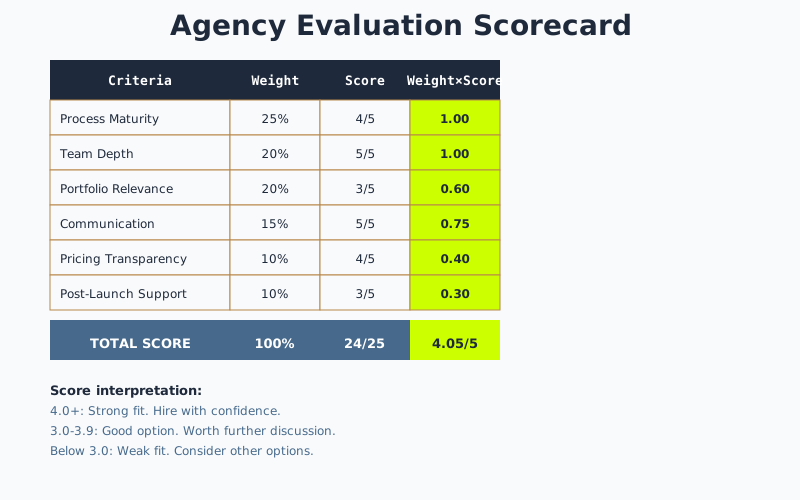
| Criteria | Weight | Score | Weighted |
|---|---|---|---|
| Process Maturity | 25% | 4/5 | 1.00 |
| Team Depth | 20% | 5/5 | 1.00 |
| Portfolio Relevance | 20% | 3/5 | 0.60 |
| Communication | 15% | 5/5 | 0.75 |
| Pricing Transparency | 10% | 4/5 | 0.40 |
| Post-Launch Support | 10% | 3/5 | 0.30 |
| Total | 100% | 24/25 | 4.05/5 |
Interpretation: 4.0+ = strong fit; 3.0–3.9 = worth further discussion; below 3.0 = consider other options.
Understand the engagement model.
Each model has different tradeoffs. Here’s how to think about them:
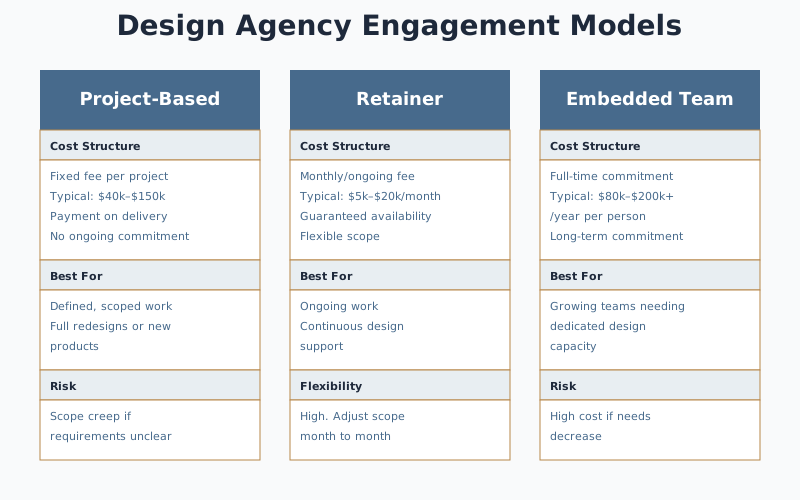
| Model | Cost Structure | Best For | Risk/Note |
|---|---|---|---|
| Project-Based | Fixed fee per project; typical $40k–$150k; payment on delivery | Defined, scoped work; full redesigns or new products | Scope creep if requirements unclear |
| Retainer | Monthly fee; typical $5k–$20k/month; flexible scope | Ongoing work; continuous design support | High flexibility – adjust scope month to month |
| Embedded Team | Full-time commitment; typical $80k–$200k+/year per person | Growing teams needing dedicated design capacity | High cost if needs decrease |
- Fixed fee projects: You agree on scope, timeline, and price upfront. Good for well-defined work. Bad if requirements shift.
- Time-and-materials: You pay for hours. Flexible but risky if they’re inefficient.
- Hybrid: Fixed fee with clear change order process if scope changes. Usually best.
Fixed fee is better for you if it’s well-scoped. But if they’ve underbid or the scope is fuzzy, they’ll resent the project or cut corners.
How do you evaluate agency proposals for a combined brand-identity and product redesign?
A combined brand-and-product engagement is two disciplines under one SOW, and the most common failure is an agency strong in one treating the other as a bolt-on. Evaluate the proposal by making the seam explicit. Ask how the brand work (positioning, identity, visual language) feeds the product work (interface, interaction, design system) – a real proposal sequences them, with brand direction locked before high-fidelity product design begins, not run in parallel by two disconnected teams. Check that research covers both halves: brand needs market and positioning input; product needs user and usage input. Confirm named owners for each discipline and a single accountable lead across both, because the handoff between a brand team and a product team is where combined engagements break. On pricing, insist on a work breakdown that separates brand hours from product hours so you can see where the budget actually goes. A proposal that quotes one lump sum for “brand + product redesign” without that split is hiding which half is thin.
Understanding Pricing and Avoiding Overpayment
Typical Ranges and Cost Drivers
Most agencies are not transparent about pricing. They build custom proposals and hope you don’t know what others are paying.
Typical pricing ranges for product design:
- Small/early-stage projects (4–6 weeks, limited scope): $30k–$50k
- Medium projects (8–12 weeks, full redesign or new product): $60k–$100k
- Large/complex projects (12–16 weeks, multiple products or complex strategy): $100k–$150k+
These are U.S.-based, mid-to-senior-tier agencies. Budget agencies might be $20k–$40k. Elite agencies (IDEO, etc.) might be $200k+.
What’s included in these ranges:
At $40k for 8 weeks, you should expect:
- 1–2 weeks of research (user interviews, audit, stakeholder mapping)
- 1 week of strategy/synthesis
- 2–3 weeks of concept and design execution
- Testing/validation with users
- Design specs or prototype
- Basic design system documentation
At $100k for 12 weeks, you should expect:
- 2 weeks of in-depth research (15+ user interviews, competitive analysis, analytics audit)
- 2 weeks of strategy and opportunity mapping
- 3–4 weeks of concept exploration and design
- Extensive user testing and iteration
- High-fidelity design system with documentation
- Implementation support
- Multiple senior-level reviews
How to avoid overpaying:
-
Don’t pay for their overhead. A $150k proposal for 8 weeks is probably overpriced. That’s $37.5k per week or ~$4,700/day. If their team is 3 people (designer, researcher, PM), that’s $1,500+ per person per day. Reasonable, but on the high end.
-
Watch for scope creep built into the budget. Some agencies pad every line item. “Discovery” becomes 4 weeks instead of 1. “Design execution” becomes 6 weeks instead of 2.
-
Understand what drives their cost. Ask them directly:
- What’s your hourly cost per person?
- How many people are on the project?
- What’s the timeline?
- Then: Cost = (hours per person × hourly rate × # people) + overhead
If the math doesn’t work, something’s off.
-
Get a second opinion on feasibility. A senior product designer who knows your market can estimate whether 12 weeks is realistic. If three people say 12 weeks and one says 6, trust the outlier – they might see something the others missed.
-
Watch for the “design system tax.” Building a production-quality design system adds 20–30% to the budget. That’s fine – it’s valuable. But make sure you actually need it. If you’re a small team with one product, a design system might be overkill. A well-documented design file might be enough.
-
Understand the revision model. If they’re building in unlimited revisions, that’s expensive for them and incentivizes bloated process. If they’re building in 2 rounds, that’s tight but normal.
Negotiating without looking cheap:
You can push on price without insulting them.
- “We were expecting something closer to $65k. What would we lose?”
- “Can you show us where this breaks down by phase? We might be able to trim scope in one area.”
- “What’s included in discovery? We might be able to accelerate this.”
Don’t ask for free work or spec work. Don’t ask them to cut rate without cutting scope. Do ask them to justify the cost and show you the math.
The value question:
The real question isn’t “Is this the cheapest?” It’s “Will this solve my problem and leave me better off?”
If an agency charges $80k and delivers a design system that your team can maintain and extend for years, that’s worth $80k. If another charges $40k and hands you a one-off design that needs a complete redo in 18 months, the cheap one is expensive.
A good product design agency is an investment in your product and your team’s capability. The price should reflect the quality of thinking, not just the hours billed. For context on how design investment scales, see website design vs. development to understand how cost structures differ across design disciplines.
Key Signal
The cheapest proposal isn't the best deal. The expensive agency that clearly explains their thinking and shows past work you admire is usually better value than the agency underbidding to win the deal.
Related Guides
- Product Development Outsourcing – When design-only is not enough and you need an end-to-end product partner
- UX Design Consultant – Know when an outside perspective reduces risk vs. when to build internal capability
- Hire a UX/UI Designer – Evaluate individual designers vs. agencies for your team
- AI Design Agencies – The emerging variant and how to tell substance from marketing
- Website Design vs. Development – Understand how design and development need to collaborate
- How to Select a Technology Partner – Vendor evaluation framework that applies to design agencies
- Technology Vendor Due Diligence Checklist – Process for vetting any service provider
Frequently Asked Questions
How much does a product design agency cost?
Small projects (4–6 weeks): $30,000–$50,000. Medium (8–12 weeks): $60,000–$100,000. Large (12–16 weeks): $100,000–$150,000+. Budget shops dip to $20,000. Elite agencies (IDEO-tier) can exceed $200,000.
What should be included in a product design agency engagement?
Discovery with user interviews, strategy and synthesis, concept exploration, high-fidelity design execution, user testing, and handoff or design system documentation. If a proposal skips research or testing, it is not product design work – it's decoration.
What team should a product design agency bring?
At minimum: a senior designer who owns the work, a UX researcher, a product strategist (often the principal), and a project manager. Proposals listing 'five designers' with no hierarchy are selling a factory. A single name doing everything is a freelancer with overhead.
What are red flags in a product design agency proposal?
Vague deliverables ('design artifacts,' 'design system' without specifics). Unlimited revisions. No mention of research or user testing. One designer on a multi-month project. Promised outcomes ('we'll increase conversions 30%'). Real agencies promise process.
Fixed fee or time-and-materials for a design engagement?
Fixed fee for clearly scoped work. Time-and-materials for open-ended or exploratory projects. Hybrid – fixed fee with a defined change-order process – is usually best because real design work requires some iteration that a pure fixed fee punishes.
How do I tell a good design agency from a mediocre one?
Ask how they handle ambiguity: a good answer describes validating assumptions and pivoting. Ask to meet the team (bait-and-switch is common). Ask for a work breakdown in hours. Agencies that cannot quantify their work have not thought it through.
How much should I pay for a design system?
A production design system adds 20–30% to the engagement budget. It's worth it for products with multiple features and a growing team. A small team with one product often needs a well-documented design file – not a full system. Match the investment to the scale. For the timeline an agency needs to deliver a v1 product design system, see the [product design process guide](/guides/product-design-process).
How do you evaluate agency proposals for a combined brand-identity and product redesign?
Make the seam explicit. Ask how the brand work feeds the product work – a real proposal locks brand direction before high-fidelity product design rather than running two disconnected teams in parallel. Confirm research covers both halves, name a single accountable lead across both, and insist on a work breakdown that separates brand hours from product hours. A lump sum for 'brand + product' hides which half is thin.
What should I look for when evaluating product design agencies for a Series B tech company?
Agencies that design within an existing product and design system, not just greenfield concepts. At Series B you have usage data and real users – an agency that ignores both for taste is wrong. Look for a senior designer who owns the work, a researcher, and a strategist who can hold their own with your PM and engineering leads. Avoid generalists; shallow product thinking compounds across every feature.