Small Business Branding Framework
Key Signal
When three agencies quote wildly different amounts for "branding," they're selling three different things. Don't compare prices. Compare what's included: strategy, visual identity, application, revisions. The $5k logo is not the same product as the $60k rebrand.
A branding agency for a small business delivers some combination of three layers: brand strategy (positioning, voice, audience), visual identity (logo, type, color, guidelines), and application (website, collateral, launch). Prices range from $5,000 for logo-only work to $60,000+ for strategy-led rebrands. You’re sitting in a board meeting and someone says “we need to rebrand.” Everyone agrees. You call three agencies for quotes. One says $5k. One says $25k. One says $60k. They’re using the same word – “branding” – but they’re describing three completely different projects.
The $5k person is probably just doing logo design. A nice logo, maybe. The $25k person is doing logo plus brand guidelines – the visual rules that keep your brand consistent. The $60k person is doing strategy (understanding your positioning), visual identity, and launching it across your website and marketing materials.
The problem is: you don’t always know which scope you need. Founders get told “you need to hire a branding agency” without understanding what that actually means or when they should do it. So you either underpay for a mediocre logo, or overpay for a comprehensive rebrand when all you actually needed was visual consistency. This sits in the same family as the common decision errors we see across technology partner selection: scope misalignment driven by fuzzy upfront definition.
Here’s how to think clearly about what you’re buying and when you should buy it.
What a Branding Engagement Should Include
Branding breaks down into three distinct layers, and understanding the difference between them is critical.
Layer 1 is brand strategy – the thinking about who you are and who you’re talking to. This is about positioning: What’s your unique value? Who do you serve? Why are you different from three other companies doing something similar? It’s about brand personality: Are you serious or playful? Trustworthy or innovative? Corporate or scrappy? It’s voice and tone – how do you actually talk to customers? Formal or conversational? It’s key messages: What are the 3-5 most important things you want people to know about you? And it’s audience definition: Who are you trying to reach, and what do they actually care about?
This is the foundation. Everything else flows from this. If you don’t know who you are and who you’re talking to, no amount of visual design will fix it. You might know strategy already – you know who you serve, you know what makes you different. Or you might need an agency to help you figure it out because you’ve been too close to the business to see it clearly.
Layer 2 is visual identity – how your brand looks. Logo and wordmark (your primary marks). Color palette (primary, secondary, accent colors and the rules for using them). Typography (what font families do you use, and where). Photography style (what kind of photos do you use? Lifestyle, product, professional?). Illustration style if you use illustrations. Maybe a visual pattern that becomes recognizable. Iconography if you use icons. Spacing and grid – how much white space, what’s your layout system. This is the stuff people see and remember. It matters, but only if the strategy underneath is solid.
Layer 3 is brand application – where your brand lives in the real world. Brand guidelines document how to use everything above. Your website, where the brand is most visible. Business cards and collateral. Email templates. Social media templates. Presentation decks. Product design if you have a product. Packaging if you sell physical goods. Signage if you have a physical location. The more touchpoints you apply the brand to, the more expensive this layer gets.
Here’s the mistake most small businesses make: they hire an agency assuming “branding” includes all three layers. The agency, seeing a small business and concerned about scaring them off with price, quotes low and then delivers just Layer 2 (a logo). You get a nice logo. But nothing changes about your positioning. You still sound the same. Your website still looks mediocre. Six months later you haven’t seen any business impact. Then you assume branding doesn’t work. (It does work – you just got one piece without the other pieces.)
What you actually need depends on where you are. If you’re pre-launch with an idea, you might not need branding at all yet. Validate the idea first. If you’ve found product-market fit but nobody knows you exist, Layer 1 (strategy) is critical. You need clarity on positioning. Layer 2 matters but is secondary. If you’re confusing yourself with competitors, you need Layers 1 and 2. If you’re scaling and want to feel more professional, Layers 2 and 3 might be enough – your positioning might be fine already. If you’re transitioning (pivoting, entering a new market, completely rebranding), you need all three.
The right agency asks you which problem you’re solving, then recommends the minimum scope to solve it. If they recommend all three immediately without understanding your situation, they’re selling, not advising. When evaluating agencies, use the technology partner selection process framework to structure your evaluation.
What You’re Probably Overpaying For
A good way to calibrate your budget: understand what you’re probably overpaying for.
Brand strategy that’s really just a PowerPoint template. An agency charges you $8k for “brand strategy.” What you get: Three hours of interviewing, a presentation deck about target audiences, and some positioning language that sounds smart but could apply to any business like yours. Real brand strategy is based on research – customer interviews, market analysis, competitive positioning. It surfaces real insights that change how you think about your business. Fake brand strategy is a boilerplate deck with your company name inserted.
Common Failure Mode
An agency sells you $8k "brand strategy" that's really just a PowerPoint template. Three interviews plus positioning language that could fit any SaaS. You get a logo based on assumptions, not insight. Nothing changes about how you talk to customers.
How to evaluate: Ask them to show you what’s unique about your positioning compared to three competitors. If they can articulate clear, specific differences, they did research. If they’re vague (“you’re customer-focused, they’re not”), they skipped the work. Avoid: Agencies that promise to discover your positioning in 2-3 hours of interviews.
Logo redesigns that are just refreshes. You have a logo. It’s fine. An agency suggests “refreshing” it. You end up paying $5k-10k for something 90% similar to what you had. Sometimes a logo needs updating. Sometimes you’re just being sold a refresh because refresh sounds good.
How to evaluate: Ask them to show you the original and justify each change. “We simplified the wordmark” (maybe needed). “We adjusted the color to be more modern” (probably not needed). “We refined the curves” (often unnecessary). Avoid: Agencies that immediately suggest a logo refresh before understanding why you’re rebranding.
Brand guidelines that are really documentation of documentation. You get a 100-page PDF with rules about logo rotation, spacing grid, color usage, typography samples, and 47 variations of how to use your brand across different scenarios. You will never use half of it. It’s process documentation, not brand guidance. Real brand guidelines are 10-20 pages. Here’s the logo. Here’s how much space around it. Here are the colors. Here’s the typography. Here’s the voice. Done.
How to evaluate: Ask for the guidelines upfront. If they’re running to 80+ pages, you’re paying for documentation of documentation. Avoid: Agencies that pride themselves on “comprehensive” guidelines (usually code for verbose).
Website design bundled with branding. You’re hiring a branding agency to rebrand your business. They come back with a beautiful website. The website is nice, but that’s web design (paid in a different model – see what a website redesign actually costs for calibration). It’s not branding. Your branding should inform the website, not the other way around. You should be able to apply your brand to email, business cards, and social media just as easily as the website. If all your brand application is the website, you haven’t done branding – you’ve done a website project.
How to evaluate: Ask them to show you the brand guidelines separate from the website. If they can’t, the website is the brand guide (which means no flexibility). Avoid: Agencies that bundle website design and branding and charge as though you’re getting both (you’re probably just getting design).
Campaign launches you didn’t need. You rebrand. The agency suggests “a launch campaign” to announce it. Coordinated social posts, email announcement, blog articles, maybe paid ads. Campaigns cost money (usually $5k-15k). They’re optional if you’re just updating your visual identity quietly.
How to evaluate: Ask whether the campaign is separate scope. “Branding is $X. Launch campaign is $Y.” If they bundle it, negotiate it out if you don’t need it. Avoid: Agencies that treat launch campaign as non-negotiable.
Strategy workshops that are just meetings. Three hours in a room. You talk about your business. They take notes. They call it strategy. Strategy is the output (a document, recommendations, positioning framework). A workshop is input gathering, not the strategy itself.
How to evaluate: Ask what comes after the workshop. If the answer is “we’ll synthesize and write it up,” that’s real. If the answer is “we’ll have the strategy decided by end of workshop,” they’re confusing discussion with thinking. Avoid: Agencies that position the workshop as the deliverable (it’s not).
Budget by Stage and Scenario
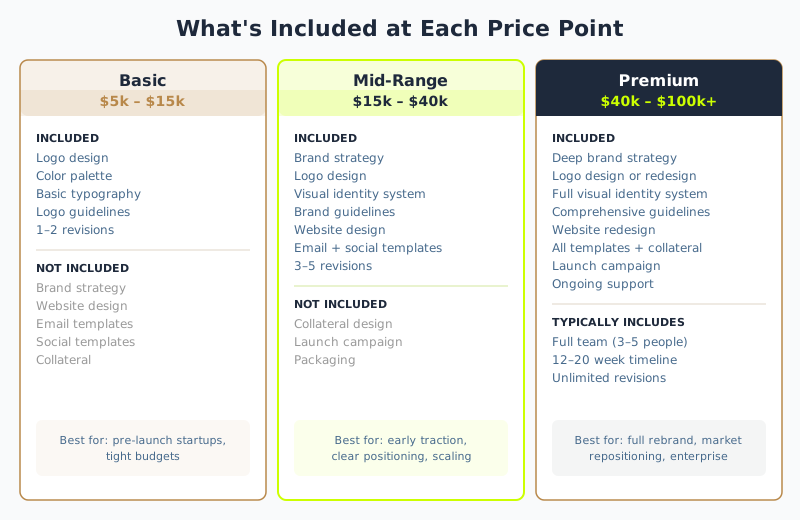
Different stages of your business need different branding investment. Here’s what’s realistic.
Stage 1: Pre-Launch Startup. Your timeline is less than 6 months to public launch. You’re looking at visual identity plus some application. Budget: $8k-15k. What you need: Logo and wordmark, color palette, typography, basic guidelines, website. What you don’t need: Extensive brand strategy (you’ll pivot when you meet real customers), comprehensive guidelines for things you won’t do yet, launch campaign.
Red flag: Agency wants to do extensive market research and position you against competitors. You don’t have customers yet. Strategy is informed by reality, not theory. Hire: Freelancer or small agency. You don’t need overhead. You need speed.
Stage 2: Early Traction (1-2 years, some revenue). Timeline: 8-12 weeks. Scope: Full rebrand or brand refinement. Budget: $15k-35k. What you need: Brand strategy (now you have real data), visual identity overhaul, website redesign, basic brand guidelines, email and social templates. What you don’t need: Extensive collateral design (business cards, brochures) unless B2B, internal rebrand campaign, packaging design (unless selling physical products).
Red flag: Agency wants to design extensive materials you won’t use. Hire: Small agency or experienced freelancer who can do strategy plus design.
Stage 3: Scaling (3-5 years, clear product-market fit). Timeline: 12-16 weeks. Scope: Full rebrand with strategy and comprehensive application. Budget: $30k-60k. What you need: Brand strategy and positioning audit, visual identity refresh or overhaul, comprehensive brand guidelines (but not 100 pages), website redesign, application across marketing and product, launch campaign (optional but worth it at this scale). What you don’t need: Extensive internal change management (your team will adopt it), multiple rounds of stakeholder workshops, packaging design (unless you’re a CPG).
Red flag: Agency wants to design for channels you don’t use. Hire: Mid-sized agency or strong freelance principal designer. You need strategic thinking and quality execution.
Stage 4: Market Repositioning or Pivot. Timeline: 12-20 weeks (longer than standard rebrand). Scope: Full strategy, identity, application, and possibly launch campaign. Budget: $50k-100k+. What you need: Deep market research and competitive analysis, positioning audit and redirection, new visual identity that reflects new positioning, comprehensive brand guidelines, website redesign, marketing collateral redesign, launch campaign. What you might not need: Product redesign (unless your product changes), packaging redesign (unless directly relevant to reposition).
Red flag: Agency suggests changing everything including product and operations. Brand is one part of repositioning, not the whole thing. Hire: Full-service agency or strategic brand consultancy. This is complex enough that you need team thinking.
Budget reality check: These ranges are for people in the U.S. You might find cheaper options. Hire a freelancer from a lower cost-of-living country and you’re 40-60% cheaper but with geographic/timezone friction. Use a template-based service (Fiverr, 99designs) and you’re 70% cheaper with 70% mediocre results. Hire a recent grad and you’re 50% cheaper with 50% less experience.
The question isn’t “what’s the cheapest?” It’s “what’s the minimum investment needed to solve my problem?” A $8k rebrand that lands (clear positioning, cohesive identity) is cheaper than a $2k logo that doesn’t solve anything.
How to Compare Proposals and Avoid Landmines
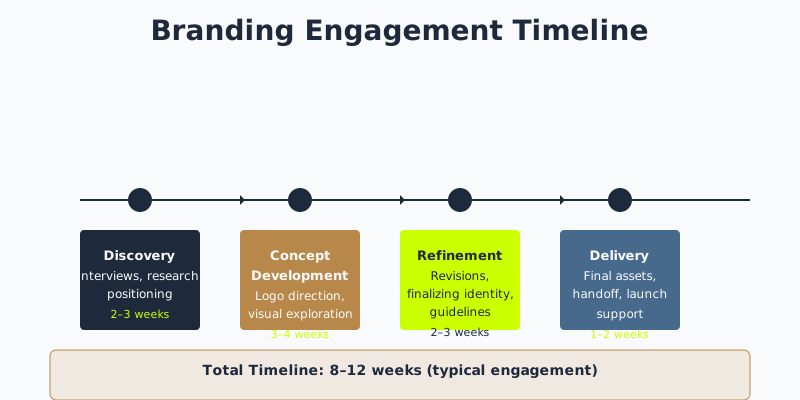
When proposals come back, they won’t use the same language, so direct comparison is hard. Create a comparison matrix. For each proposal, extract: what’s included (layers and deliverables), timeline, cost, what’s not included (scope boundaries), and what happens if you want changes. The same evaluation framework we use for software and product partners applies – score against criteria you defined before any proposal arrived, not after.
Ask about the scope of brand strategy. Their answer should specify: How many customer interviews or research activities? Competitive analysis (yes/no)? Market positioning (yes/no)? Brand personality definition (yes/no)? If they say “included” but can’t quantify it, they’re vague about the work.
Ask what visual identity includes. Logo and wordmark (yes). Color palette (primary/secondary/accent). Typography (how many font families). Photography or illustration style (yes/no). Additional elements (patterns, icons, etc.). If they include a bunch of additional elements, ask whether they’re necessary or padding.
Ask what brand application includes. Website redesign (yes/no)? Email templates (yes/no)? Social media templates (yes/no)? Print collateral (yes/no)? Be clear what application you need. “Everything” is not a number.
Ask about revision rounds. This is critical. Is it “2 rounds of revision on logo” or “unlimited feedback until you’re happy”? Unlimited sounds good until revision 8 hasn’t resolved anything and you’re out of time. Standard should be: 2-3 rounds on strategy/direction, 2 rounds on logo/identity, 1 round on brand guidelines. More than that is scope creep.
Questions to Ask
Ask every branding agency: "What happens if we're not happy after round 2?" If they say "we'll keep going until you're satisfied," they're either padding the estimate or they'll deliver low quality to get you off their plate. Good answer: "Round 3 is X per round as a change order."
Ask what happens if you want to change direction. If they say “we’ll rework it at no cost,” that’s either padding the estimate or they’re going to do low quality. Good answer: “We can do one strategic pivot. More than that is additional scope.”
Key Signal
If an agency keeps design files or charges extra for high-res exports, you're locked in. You can't use another designer later. You can't adapt your brand without paying them. Get this in writing: you own all files and assets. Period.
Ask what you get at the end. Should be: All final design files (Figma, Adobe files). Brand guidelines (PDF or living document). Any templates (Canva, Figma, Word). High-res assets for web and print. If they keep files or charge for high-res, that’s vendor lock-in. Avoid.
Red flags in proposals:
- Vague scope (“we’ll deliver a complete rebrand”)
- Unlimited anything (revisions, deliverables, timeline)
- No timeline or “timeline TBD”
- No clear deliverables (what are you actually getting?)
- Cost seems unreasonably high or low (50%+ above/below market)
- Lots of flowery language and no specifics
- No mention of what happens if you want changes
- They recommend more scope than you asked for without justifying it
Green flags:
- Clear, specific scope
- Defined revision limits with change-order process
- Realistic timeline (8-12 weeks minimum)
- Specific deliverables list
- Transparent about what’s not included
- References to past similar work
- Clear explanation of their process
The final question: “Why does this cost what it costs?” Their answer should break down: Strategy/research X hours, design execution X hours, applications/templates X hours, project management X hours, revisions and refinement X hours. If they can’t explain, they’re guessing or padding. The way they answer also tells you whether fixed-fee or time-and-materials is the honest pricing model for the scope they’re describing.
A word on the cheap option: You’ll probably get a proposal for $3k-5k for logo plus basic guidelines. This is viable if you’re pre-launch and just need something to ship with, or if you want to test the market before investing in full branding, or if you plan to upgrade later. You’re making the tradeoff consciously: less strategy, faster execution.
It’s not viable if you need positioning clarity (you need research), or if you want comprehensive brand application, or if you’re pivoting (you need strategy). A cheap rebrand is fine as a first step. Just don’t mistake it for a full rebrand.
What actually matters: The cheapest agency might be fine. The most expensive might be overpriced. What matters: Do they understand your business? Did they ask good questions about your goals? Can they show relevant past work? Are they transparent about what’s included? Do you trust them to push back if you’re making a mistake? The cleanest way to test the “show relevant past work” question is structured reference checks against the agency’s most recent shipped engagements.
Common Failure Mode
Picking the cheapest agency because the scope looks the same. You end up with a logo that doesn't reflect who you are, generic brand guidelines, and a designer who's juggling 5 other clients. Three months later you realize you bought a logo, not a rebrand.
Pick the agency where the answer to all five questions is yes. Price is tertiary.
Related Guides
- Design RFP Guide – How to write an RFP for branding agencies
- Website Redesign Costs – If your rebrand includes a website component
- How to Hire a Product Designer – Similar evaluation framework for design hires
- Hiring a UI/UX Designer – When you need specialized design skills
- Technology Partner Selection Process – End-to-end methodology for evaluating agencies
- How to Evaluate a Technology Partner – Framework for comparing branding proposals
- Reference Checks for Technology Partners – How to validate a branding agency’s past work
Frequently Asked Questions
Should a small business hire a rebranding agency or a branding agency?
Same agency type, different scope. A branding engagement establishes positioning and visual identity from scratch; a rebrand carries existing equity through a transition – managing customer recognition, migrating collateral, and avoiding the loss of accumulated trust. For most small businesses the question isn't 'which kind of agency' but 'which scope of engagement,' and strong agencies handle both. The signal to look for is whether they ask about your existing brand equity, customer perception, and migration risk early – not whether their site uses the word rebrand.
How much does a branding agency for a small business cost?
$5,000 for logo-only work. $15,000–$35,000 for early-traction rebrands including strategy. $30,000–$60,000 for scaling companies. $50,000–$100,000+ for full market repositioning. The range reflects scope – 'branding' is three different products.
What does a branding engagement include?
Three layers. Brand strategy (positioning, voice, audience). Visual identity (logo, type, color, guidelines). Brand application (website, collateral, launch). Agencies pricing the same scope 12x apart are selling different layers. Compare what's included, not the sticker.
What level of branding does my small business need?
Pre-launch with no customers: visual identity only, $8K–$15K. Early traction: strategy plus identity, $15K–$35K. Scaling with product-market fit: comprehensive rebrand, $30K–$60K. Repositioning or pivot: full strategy and application, $50K–$100K+.
How long does a branding engagement take?
8–12 weeks minimum for anything worth doing. Pre-launch work: 4–6 weeks. Early-traction rebrand: 8–12 weeks. Scaling rebrand: 12–16 weeks. Market repositioning: 12–20 weeks. Faster than that means something real is being cut.
How many revision rounds should a branding engagement include?
Two to three rounds on strategy and direction. Two rounds on logo and identity. One round on guidelines. 'Unlimited revisions' is either padded into the price or a signal they'll deliver low quality to get you off their plate.
What should I avoid paying for in a branding engagement?
Brand strategy that's a PowerPoint template with your name inserted. Logo refreshes that change 10%. Brand guidelines that run 100 pages. Website design bundled into branding. Launch campaigns you didn't need. Strategy workshops where the workshop is the deliverable.
What are red flags in a branding agency proposal?
Vague scope ('complete rebrand'). Unlimited revisions or deliverables. No timeline. Cost more than 50% above or below market. No explanation of what happens if you change direction. Recommending more scope than you asked for without justifying it.