UI/UX Designer Hiring Model Comparison
Hiring a UI/UX designer comes down to three delivery models: an agency (packaged process, highest cost), a freelancer (fastest start, variable depth), or an in-house hire (full commitment, slowest to staff). The right choice depends on scope duration and how much research and strategy work you need. UI/UX design is also overloaded terminology. Some people use it to mean visual design (UI) plus user experience (UX), treating them as a single discipline. Others use it to mean digital product design in general. Before you post a job, you need to be clear about what you actually need.
Are you hiring someone to make things look good? Design interactions? Run research? All three? If the honest answer is the first one only, the narrower hire – a UI designer – is usually cheaper and faster to find; this guide covers the combined role.
If you already know the answer, we have a dedicated playbook for each discipline: how to hire a UI designer when the problem is how the product looks, and how to hire a UX designer when the problem is how it works. This guide covers the combined role and the freelance-agency-in-house decision that applies to all of them.
This distinction matters because it changes who you hire, what you pay, and whether you end up with the right person or the first good portfolio who can’t actually do the work you need.
Common Failure Mode
Posting a job for "UI/UX Designer" without clarity on what you're solving for. You get applicants who are pure visual designers, pure researchers, or people who've built web apps. You hire the first good portfolio. Then discover they can't do the thing you actually needed.
UI Designer focuses on visual interface: colors, typography, buttons, components, how things look.
UX Designer focuses on experience: task flows, information architecture, how people accomplish goals, testing with users.
Product Designer does both plus strategy: understands business goals, validates assumptions, makes recommendations. (See how to hire a product designer for a deeper dive on that role.)
UI/UX Designer (the job title most common) usually means you want someone who can do both, or you haven’t decided, or you’re using the term loosely.
When you’re hiring, think about this: If you just need things to look better, a UI designer or visual designer is your person. If you need to solve interaction problems – people are confused about how to do something, or the experience is broken – you need a UX designer who can think about workflows and mental models. If you need someone to own the whole experience and make strategic recommendations about what to build and why, that’s a product designer role, typically at a senior level. If you’re not sure which, hire someone with product design experience (senior level) who can do both.
Now that you know what you’re looking for, here’s how the three models compare.
In-House Designer: Salary, Equity, and Commitment
You hire someone full-time. They’re on payroll. They go to your meetings. They live in your product. This is a long-term bet on a single person understanding your business deeply.
Compensation and Costs
In 2026, salary ranges in the U.S. fall into clear tiers. A junior designer with 0–3 years of experience (recent grad or self-taught) typically earns $60k–$80k. Mid-level designers with 3–7 years and a solid portfolio command $85k–$130k. Senior designers with 7+ years and leadership capability run $130k–$180k. If you’re in San Francisco, New York, or Seattle, add another 10–15% to those numbers. Smaller markets let you subtract 10%. Remote work is compressing geography anchors, but they’re still real.
Many companies sweeten the package with equity to make the offer more attractive, especially startups where cash is tight. A junior designer might get 0.05–0.15% equity. A mid-level designer might get 0.1–0.3%. Senior might hit 0.3–0.75%. On paper, this looks great. In reality, it’s worth zero if the company doesn’t exit.
All-in cost is higher than salary. You’re paying for payroll tax, health insurance, 401k, and a share of overhead. Budget 1.3–1.5x the salary. So a $100k designer actually costs you $130k–$150k per year.
What You Get (and Don’t Get)
In-house designers bring consistency. Same person, deep knowledge of your product, understands your business context without needing a week of onboarding every time you need something. They’re there for ongoing refinement and iteration. They become part of your team culture and can mentor juniors. When something doesn’t work, they own it. That accountability matters.
The tradeoff is that they can get too deep in your product. After a year, they miss patterns they’d see looking at other products. They only work on what you’re building, which might not be enough to keep them growing. If the hire doesn’t work out, you have to manage a firing or wait out a contract – that’s expensive and painful. And if you need specific expertise in accessibility or design systems for a month, you can’t just hire it temporarily.
When This Model Works (and When It Doesn’t)
This works when you have a mature product with ongoing changes and a clear roadmap. You need multiple designers so this person can specialize or lead a team. You can commit to a 2+ year horizon for the role. You have enough work to keep them busy and growing. And critically, you have money and want to avoid the friction of hiring contractors.
This doesn’t work when you’re pre-launch and everything might pivot. You have 6 months of work and don’t know what comes next. You can’t afford a full-time salary plus overhead. You need specialized expertise for a short period. Or you might need to resize quickly in a downturn.
Key Signal
In interviews, ask candidates: "Tell me about a design decision you made and how you validated it." Their answer will tell you if they're a thinker or a decorator. Weak answer = they're executing someone else's ideas and can't own work.
Watch for red flags. If they’ve only worked at one company, they have limited perspective. If their portfolio is weak or just UI decoration, they can’t think strategically. If they want to join but have no design philosophy or opinions about their own work, that’s a problem. And if they can’t talk about the research or thinking behind their designs, they’re probably just executing other people’s ideas.
To get them productive fast, give them 2–3 weeks before expecting them to ship anything – they need context. Pair them with your product person for the first month so they understand your users. Have them audit your current product and give recommendations. Good learning plus useful output. Don’t expect them to solve everything on day one.
Freelance Designer: Flexibility, Pace, and Hidden Costs
You hire for specific projects or hours. They work for multiple clients. You only pay for what you use. This is flexibility at the cost of consistency.
Rates and Economics
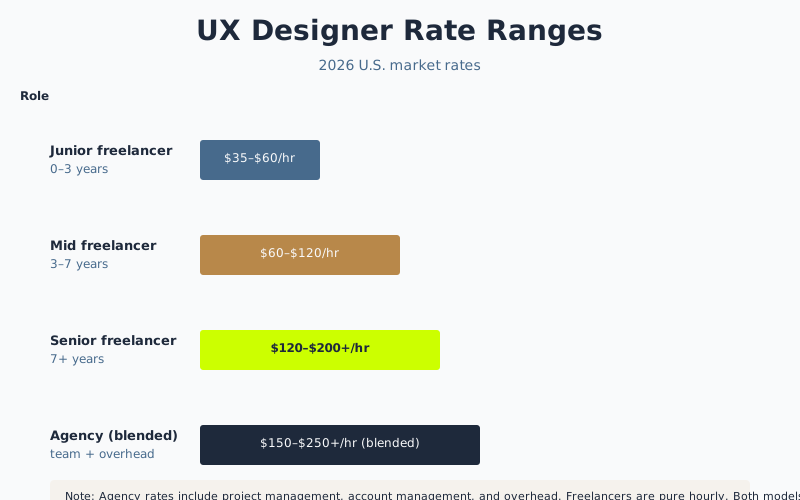
| Role | Experience | Hourly Rate (2026 U.S.) |
|---|---|---|
| Junior freelancer | 0–3 years | $35–$60/hr |
| Mid freelancer | 3–7 years | $60–$120/hr |
| Senior freelancer | 7+ years | $120–$200+/hr |
| Agency (blended) | Team + overhead | $150–$250+/hr |
Agency rates include project management, account management, and overhead. Both models often work out to similar total cost.
Rates vary more than salary does. Someone at $45/hour in rural Indiana and someone at $150/hour in San Francisco might have similar experience. Geographic cost of living is the anchor, though remote is flattening this. Rates also vary by specialty. Someone doing primarily UI design is cheaper than someone doing UX research plus design plus strategy.
What You Get (and Don’t Get)
With a freelancer, you get flexibility. Hire for specific projects, pause when you don’t have work. You know the budget per project upfront. They’ve worked on other products, so they bring patterns from elsewhere – fresh perspective is real value. It’s easy to hire someone for a specific skill (interaction design, micro-interactions, design systems). When the project ends, the relationship ends. You’re not managing an employee.
But continuity suffers. A new freelancer every 6 months means relearning your product. They’re not in your meetings, don’t know your customers, have limited business understanding. If your urgent deadline hits while they’re on another project, they’re not available. They won’t build your internal design capability. There’s always a ramp-up period where they learn your product – 1–2 weeks of learning and questions. That’s expensive when you’re paying by the hour. And if things go wrong, you have limited recourse.
The real cost of freelancers is discovery overhead. Every project with a new freelancer includes 1–2 weeks of them learning your product, asking questions, understanding context. That’s wasted money compared to having someone already embedded.
When This Model Works (and When It Doesn’t)
Use freelancers when you have specific, well-defined projects (redesign the checkout, new feature). You know what you want and don’t need them to figure it out. You have variable workload – some months busy, some quiet. You need specialized skills for a limited time. You want an outside perspective to challenge internal thinking.
Don’t use them when you have ongoing, continuous work (that should be full-time). You need someone available immediately (freelancers book up). The work requires deep product knowledge and iteration (too much ramp-up). You need mentorship and team building. You need consistent quality across multiple projects.
Questions to Ask
Before hiring a freelancer, ask: "How many concurrent projects are you usually juggling? How do you prioritize?" If they have 4+ active clients, your project isn't getting focus. If they're vague about availability, you'll discover mid-project that they're booked.
Watch for red flags. They push to extend the project (“we’re just getting momentum”). They take weeks to get back to you on feedback. They’re confused about scope partway through. Their portfolio is all similar-looking work (might be working from templates). They avoid talking about process (“I’ll just do the design”). They have multiple active projects that could conflict with yours.
To work well with them, over-specify the first time. The more they understand upfront, the fewer clarifying questions. Pay on project completion, not hourly. Hourly incentivizes them to take longer. Weekly touchbases, even brief ones, keep you aligned. Provide feedback quickly – they’re on the clock while waiting for your input. Scope is king. A 2-week project is fine. An “open-ended” project will blow up.
Vetting designers or agencies right now?
Bring the portfolios or proposals you're weighing – in 15 minutes we'll tell you which are worth the callback and what the work should cost.
Get a second opinion →Agency: Process, Overhead, and Specialization
You hire an agency (team of designers, strategists, researchers) to design for you. This trades control for expertise and process.
Project Costs
A small project redesigning one section runs $15k–$30k. A medium project (redesign a major flow or feature) is $30k–$60k. A large project (full rebrand plus website) is $80k–$150k+. Agencies typically charge project-based or daily-rate. Project-based is better for you (fixed cost). Daily-rate is better for them (they get paid while scope creeps).
What You Get (and Don’t Get)
With an agency, you get a team. If they need research, they have a researcher. If they need interaction design, they have a specialist. They have established methodology, checkpoints, deliverables, documentation. They’re responsible for the outcome, not just the hours. If things go wrong, they have skin in the game and reputation risk. Fresh eyes, industry patterns, research-backed thinking.
But they won’t become product experts. Different team every project (unless you have a retainer). They have their timeline (usually 8–12 weeks minimum). If scope changes, you renegotiate cost. You work with an account manager, not the actual designer (sometimes). And overhead is real. Agencies have higher overhead than freelancers (office, project management, business development). You pay for this. A freelancer at $100/hour might produce similar output to an agency at $150/hour, with the difference being overhead.
When This Model Works (and When It Doesn’t)
Use an agency when you have a significant project ($40k+). You want research backing your design decisions. You need a team (strategy plus design plus research). You want formal process and deliverables. You want to hand it off and trust them.
Don’t use an agency when you have small projects or variable work. You need continuity and deep product knowledge. You want fast iteration and quick feedback. You need someone embedded in your organization. You have limited budget.
Key Signal
If an agency promises specific outcomes ("We guarantee 25% conversion increase"), they either don't understand design impact or they're overselling. Good agencies say "Based on our past work, we've seen 8–15% improvements, depending on your baseline."
Red flags: They can’t articulate their process clearly. Portfolio is mostly beautiful work without talking about outcomes. They’re heavy on the pitch, light on the thinking. They promise guaranteed outcomes (“We’ll increase conversion 20%”). They have minimum project sizes that are way bigger than you need. Account manager is non-designer (means designers aren’t talking to you directly).
To work well with them, get clear scope before starting – scope creep is how agencies make money. Weekly touchbases keep you connected. Be available for feedback so they’re not waiting on you. Have a main contact. Multiple stakeholders giving conflicting feedback kills projects. Check-ins at phase gates. Before they go deep on execution, you agree on direction. See how to write a design RFP for guidance on setting clear phase gates in your agreement.
The Decision Framework
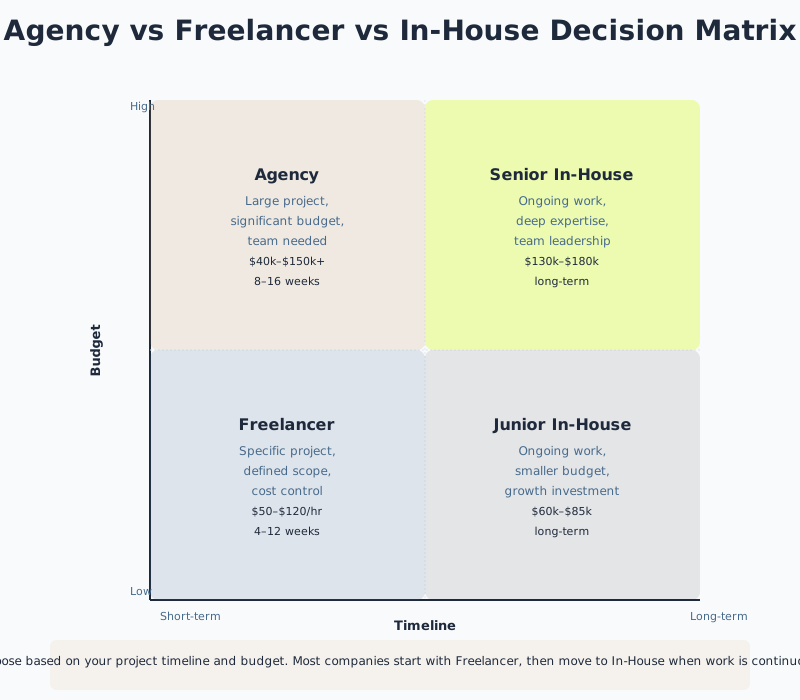
| Short-term | Long-term | |
|---|---|---|
| High Budget | Agency – large project, significant budget, team needed; $40k–$150k+, 8–16 weeks | Senior In-House – ongoing work, deep expertise, team leadership; $130k–$180k |
| Low Budget | Freelancer – specific project, defined scope, cost control; $50–$120/hr, 4–12 weeks | Junior In-House – ongoing work, smaller budget, growth investment; $60k–$85k |
Choose in-house if you have a mature product with a multi-year roadmap. You have enough work to keep someone busy and growing. You can commit to salary plus benefits plus overhead. You want to build design culture internally. You want continuity and deep context.
Choose freelance if you have specific, well-defined projects. You need flexibility or specialized skills. You want to test someone before going full-time. You can clearly scope work upfront. You want fast execution without process overhead.
Choose agency if you have a significant project with research needs. You want a team with different specialties. You want formal process and accountability. You don’t have the bandwidth to manage details. You’re willing to pay for overhead.
Real Scenario Comparisons
Scenario 1: Early-stage startup with an MVP
You need to fix your onboarding flow – it’s confusing. Timeline is 4 weeks. Budget is $8k–$12k. Best choice: Freelancer. Why? The scope is specific and well-defined. Timeline is short and you need fast feedback. Agency would be overkill. Full-time would be waste. You know exactly what’s broken.
Scenario 2: Established SaaS with 50 employees
You need ongoing product refinement, new features, design system maintenance. Timeline is ongoing. Budget is ~$130k/year. Best choice: In-house mid-level designer. Why? You have continuous work. You need context and consistency. You want to invest in design capability. Freelancer turnover would be death by a thousand ramp-ups.
Scenario 3: E-commerce company doing full rebrand
You need a new visual identity, brand strategy, website redesign, internal system design. Timeline is 4 months. Budget is $90k–$120k. Best choice: Agency. Why? Scope is large and complex. You need research and strategy. You want a team with different specialties. You want formal deliverables and process.
Scenario 4: Designer already on staff, need overflow
You need extra hands for overflow work. Timeline is ongoing and variable. Budget is whatever freelance rate is. Best choice: Freelancer or contractor. Why? You have continuity. Your existing designer can brief the freelancer. You’re hiring for hours, not breadth.
Cost Reality Check
Here’s where the numbers converge: An in-house designer with full cost runs ~$130k–$150k/year. A freelancer busy 50 weeks/year at $80/hour runs ~$160k/year. A freelancer busy 40 weeks/year is ~$128k/year. An agency for equivalent work is $100k–$150k/year.
They cost similar amounts when you account for everything. The difference is what you’re buying: continuity versus flexibility, depth versus breadth, commitment versus exit. The real decision isn’t cost. It’s: Do you want someone embedded in your organization, or someone available when you need them?
Related Guides
- How to Hire a Product Designer – Full framework for hiring product designers (broader scope than UI/UX)
- Design RFP Guide – How to write an RFP when hiring an agency for design work
- Website Redesign Costs – Understand what design work costs across project types
- Fixed-Fee vs. Time-and-Materials – Contract structures for freelance and agency engagements
- Technology Partner Selection Process – End-to-end methodology for evaluating design partners
- How to Evaluate a Technology Partner – Framework for comparing proposals and capabilities
- Reference Checks for Technology Partners – How to validate claims about past design projects
Frequently Asked Questions
What's the difference between UI, UX, and product design?
UI designers focus on visual interface – type, color, components. UX designers focus on flows, architecture, and testing. Product designers do both plus strategy. 'UI/UX designer' as a job title usually means 'we haven't decided' or 'we want someone who can do both.'
Freelance, in-house, or agency for a UI/UX designer?
Freelancer for defined short projects or specialized skills. In-house when the roadmap is 2+ years and you have enough work for 40 hours a week. Agency when scope is large ($40K+), research is needed, and you want a team with different specialties.
What does a UI/UX designer cost in 2026?
In-house: $60K–$80K junior, $85K–$130K mid, $130K–$180K senior (US salaries, +10–15% in SF/NY/Seattle). Full cost 1.3–1.5x salary after benefits. Freelance: $45–$150 per hour by geography. Agency: $15K–$150K per project.
When do the three hiring models cost the same?
When you account for everything. In-house runs ~$130K–$150K per year loaded. A freelancer busy 50 weeks at $80 per hour runs about $160K. An agency for equivalent work is $100K–$150K. The real decision is not cost – it's embed versus on-demand.
How much does ramp-up cost with a new freelance designer?
One to two weeks of learning your product before they produce useful work. Paying hourly during ramp-up means ramp-up is your cost. Over-specify the brief up front to cut that overhead; pay on project completion, not by the hour.
When is an in-house designer the wrong hire?
When you're pre-launch and the product might pivot. When you only have six months of work lined up. When you need specialized expertise for a short period. When you might need to resize in a downturn. Full-time commitments become sunk cost in those cases.
What are red flags when hiring a freelance designer?
They juggle four or more active clients. They push to extend the project ('we're just getting momentum'). They avoid talking about process. Their portfolio looks all similar (template work). They take weeks to reply to feedback.