Website Redesign Cost Breakdown
A website redesign in 2026 costs between $15,000 and $80,000 for most companies. The wider published ranges ($50k–$200k) are anchoring devices, not averages. If you ask 10 agencies “how much does a website redesign cost?” you’ll get 10 different answers. The truth is narrower.
Key Signal
Published agency ranges ($50k–$200k) are anchoring high to make you think all redesigns are expensive. Reality: most land between $35k–$65k. If someone quotes outside that range without detailed justification, ask what's driving it. There's usually padding or a fundamentally different scope.
Where you fall in that range depends on how many pages you’re redesigning, how much research and strategy is involved, whether it’s a rebrand or a facelift, whether you need custom functionality or integration, how many rounds of revision you build in, and who you hire. Most agencies won’t tell you this because they want you thinking about value and outcomes, not hours and deliverables. That’s fair. But you still need to know what’s reasonable. Understanding these cost drivers will help you write a better design RFP when you’re ready to solicit proposals.
What “Website Redesign” Actually Means
This matters because “redesign” is a spectrum.
A light refresh keeps the general structure, updates the visual design, improves the copy, maybe adds a few new sections. The information architecture mostly stays the same. You’re fixing tone-deafness and age, not reimagining the experience.
A moderate redesign changes the information architecture. The homepage gets reorganized. Some sections get merged or split. The visual design is completely new. Maybe some functionality gets added, but not major new features.
A major redesign starts from scratch on information architecture. You’re adding significant new functionality. You’re changing how people move through the site. It’s rebrand-adjacent.
A full rebrand with website redesigns the brand alongside the website. New logo, new color palette, new visual language. The website is one expression of a bigger rebrand. This is the most expensive because you’re making decisions upstream that affect everything – the brand-strategy half of that work falls outside the scope of this guide.
These cost wildly different amounts. If you call a light refresh a “redesign,” you’ll either underbid it or get an overprice because you and the agency are interpreting the same word differently.
Cost Breakdown: What You’re Paying For
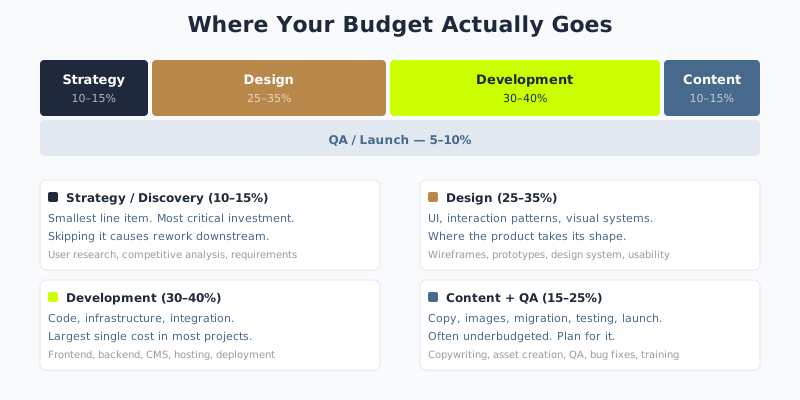
When you pay for a website redesign, you’re buying these categories:
Discovery & Strategy
This phase costs $5k–$15k, typically 15–20% of total. Real discovery takes 2–4 weeks. You’re doing competitive analysis (what are competitors doing, is it better?). You’re interviewing users (typically 6–10 people). You’re reviewing analytics to understand where the current site fails. You’re auditing content (what’s outdated, what needs rewriting?). You’re talking to stakeholders (2–3 internal interviews about business goals). You’re synthesizing findings into recommendations.
If an agency skips discovery or compresses it to a kickoff meeting, they’re taking a risk. You’re building on assumptions instead of facts. Cheap discovery costs $0–$3k (they’re skipping it or calling strategy “free”). Standard discovery is $5k–$10k. Thorough discovery is $10k–$15k.
Information Architecture & Wireframing
Cost: $8k–$20k (20–25% of total). This is where structure happens. You’re creating a site map and hierarchy. You’re mapping user flows and task sequences. You’re sketching wireframes of primary pages. You’re documenting interaction patterns.
Is the new site actually easier to navigate? Does the hierarchy make sense? You can validate this without perfect visual design. This phase is about proving the information architecture works before you spend money on pretty.
Cheap wireframing is $2k–$4k (maybe low-fidelity sketches). Standard is $8k–$12k. Thorough (multiple rounds, testing, detailed flows) is $15k–$20k.
Visual Design
Cost: $10k–$25k (25–35% of total). You’re creating mood boards or design direction. You’re building a style guide or design system. You’re making high-fidelity comps for primary pages (homepage, key landing pages, interior pages). You’re documenting visual variations and patterns.
A good design system is worth paying for because it makes development faster and maintains consistency. Some agencies skimp here and hand off a pile of disconnected comps. You should push back on that.
Cheap visual design is $5k–$8k (simple design, limited comps). Standard is $12k–$18k. Thorough (design system, extensive comps, multiple variations) is $20k–$25k.
Design Specs & Handoff
Cost: $2k–$8k (5–10% of total). This is where the designer makes sure developers can build exactly what was designed. You’re creating annotated designs with measurements, spacing, typography. You’re documenting components and interaction specifications. You’re providing code-ready assets.
Lazy agencies skip this and throw the comps over the wall to developers who then guess about spacing and behavior. Good ones spend time making sure the design can be built as intended.
Cheap handoff is $0–$2k (minimal specs, generic). Standard is $3k–$5k. Thorough (detailed specs, component library, interaction flows) is $6k–$8k.
Development Costs
This is separate from design. If you’re redesigning a brochure site (5–10 pages, mostly static), development is $15k–$30k. If you’re rebuilding a web app or e-commerce site, it’s $40k–$150k+. Most design agencies don’t do this. They hand off designs to developers you hire separately or to your internal team – see how to select a technology partner when you’re ready to scope that side. Some full-service agencies include it, which changes the cost structure completely.
Project Management & Communication
Cost: $3k–$8k (5–10% of total). Someone’s organizing the work, managing feedback, making sure deliverables are clear. Kickoff and alignment meetings. Stakeholder management. Revision coordination. Status updates and reporting. This is invisible but real. Big agencies build this in. Freelancers sometimes undersell it.
Total for design only (without development): $33k–$76k
Total with development: $50k–$150k+
Key Signal
If a proposal is 50%+ below market or 100%+ above, it's a red flag for misalignment – not necessarily on price, but on what you're buying. Ask them to break down hours by activity. Transparent breakdown = real estimate. Vague lump sum = padding or guessing.
Most companies should land in the $35k–$65k range for design. If someone’s quoting $25k, they’re cutting corners. If they’re quoting $120k, they’re adding things you don’t need.
Price Ranges by Project Type
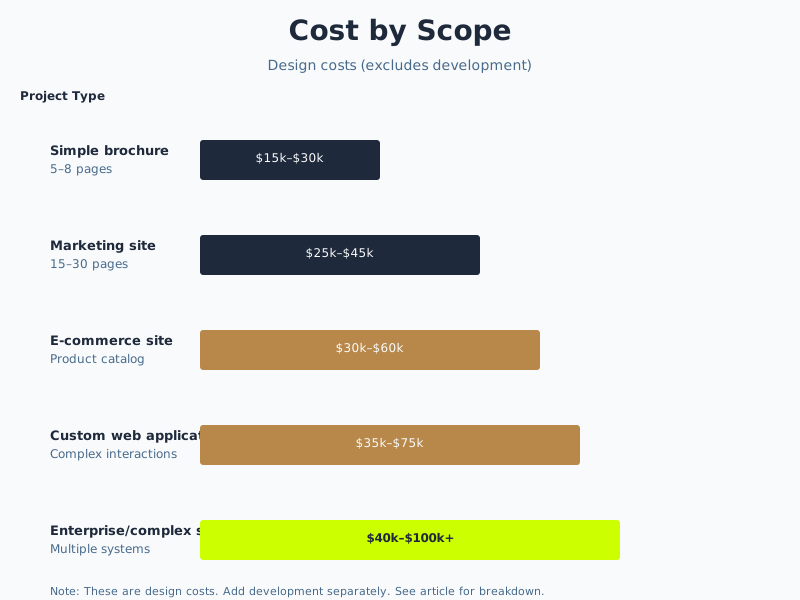
Design costs only – development billed separately.
| Project type | Scale | Design cost |
|---|---|---|
| Simple brochure site | 5–8 pages | $15K–$30K |
| Marketing site | 15–30 pages | $25K–$45K |
| E-commerce site | Product catalog | $30K–$60K |
| Custom web application | Complex interactions | $35K–$75K |
| Enterprise / complex site | Multiple systems | $40K–$100K+ |
Brochure/Marketing Site Redesign (5–15 pages, mostly static)
What’s included: Full discovery and research. Information architecture. Visual design and design system. Detailed specs for handoff. No custom development.
What’s not included: Development (you build it or hire a developer). Copywriting (light copy refinement only). Photography or video.
Agency: $35k–$60k Freelancer: $15k–$35k (usually no research, less polish)
This is the most common redesign. You’re refreshing how the site looks and is organized, but the underlying technology stays mostly the same. You know what you’re getting into. Timeline is typically 8–12 weeks.
Web App or Dashboard Redesign (complex interaction, multiple screens)
What’s included: User research (your users struggle with this, why?). Extensive information architecture and flows. Interaction design (animations, states, error handling). Visual design. Component system documentation. Usability testing (optional but recommended).
What’s not included: Development/implementation. Backend changes.
Agency: $50k–$90k Freelancer: $25k–$50k (usually lighter on research, faster iteration)
This is more expensive because interaction design is harder than visual design. The cost of getting it wrong is higher. You’re fixing how people actually work in the product. If your dashboard is confusing or your app loses users mid-workflow, redesign work here has high ROI.
E-Commerce Site Redesign (product pages, checkout, account management)
What’s included: Deep research on your customers. Competitive analysis of checkout flows. Information architecture for product discovery. Conversion-focused design. Shopping cart and checkout flows. Account management and order history. Extensive testing and validation.
What’s not included: Development/implementation. Copywriting.
Agency: $60k–$100k Freelancer: $30k–$60k (less recommended here because conversion focus is specialized)
E-commerce redesigns are expensive because the stakes are high. A 2–3% improvement in conversion rate pays for the redesign. But you need someone who’s done this before and knows the patterns. A generic designer won’t understand why reducing form fields in checkout matters, or how to test pricing page changes, or what behavioral psychology drives cart abandonment. Use the evaluation criteria framework to filter for actual e-commerce experience versus a portfolio of unrelated work.
Web design quotes range from $5K to $80K – how do I know what’s reasonable for an ecommerce site?
The spread is real, and it maps to scope, not just vendor greed. At the $5K–$15K end you are buying a themed platform build – Shopify or WooCommerce with a customized template, no original design, no research. That is reasonable for a small catalog and a standard checkout. The $20K–$45K band buys custom design on a platform: original product and category pages, a considered checkout, and light conversion work – the right range for most growing ecommerce businesses. Past $60K you are paying for deep conversion research, custom functionality, and extensive testing, which pays back only at enough order volume that a 2–3% conversion lift covers the fee. To place a specific quote, ask what is custom versus templated, whether conversion research is included, and who actually builds it. A $70K quote that is mostly a theme swap is overpriced; a $6K quote promising custom conversion-optimized design is underscoped. Match the spend to your order volume and the complexity of your checkout.
Fast/Budget Options
Some agencies offer faster, cheaper redesigns. Using a platform like Webflow or a theme plus customization runs $8k–$20k. You get speed and lower cost. You sacrifice uniqueness and often end up with limitations in what’s possible. Some agencies have internal templates they customize for each client: $25k–$45k. Faster than custom work. More flexible than platforms. Usually good for brochure sites.
These aren’t bad options if you know the tradeoff. You’re trading customization for speed and cost. Be honest with yourself about it.
Holding a quote for one of these?
Bring it to a 15-minute call – we'll tell you whether the number is defensible and where we'd push back. No pitch; that's the whole meeting.
Get a budget sanity check →Where Agencies Pad and How to Negotiate
Agencies add cost in ways that aren’t always obvious. Some are legitimate. Some are padding. Here’s how to spot it and push back.
”Discovery” that’s just meetings
You should get actual research. User interviews or surveys. Competitive analysis. Data review. A report with findings and recommendations. What you might get instead: Two kickoff meetings, some questions, and then “we think your site should be modern and fast.” That’s not discovery. That’s them confirming your existing bias.
How to negotiate: Ask for a specific deliverable. “We want a discovery report with findings, competitive analysis, and your recommendations for the new information architecture.” That forces them to do real work.
Unlimited revisions
This is a cost killer. “Unlimited rounds of revision” sounds good until the fifth revision still isn’t what you wanted and you’ve blown the timeline. What’s reasonable: Two rounds of revision on high-fidelity comps. One round on design system/components. If you need more, that’s a scope change and should cost more.
How to negotiate: “Two rounds of revisions included. Additional revisions are X per round.” This incentivizes the agency to get it right and prevents endless tweaks. See fixed-fee vs. time-and-materials for more on structuring contracts to align incentives.
Extra pages “to show the design system”
Agency says: “We’ll show you 15 pages to demonstrate how the system works.” You actually need 5 pages. They’re justifying their hours by adding pages. Designs take longer when there are more of them. Each additional page is another mockup, another round of revision, another stakeholder opinion.
How to negotiate: “We need designs for the homepage, one product page, one article page, the checkout, and the account page. That demonstrates the system. Other pages follow the pattern.” Simple. Scoped. Done.
”Strategy” that’s really just advice
They want to add strategy to justify higher fees. Some is needed. Some is theater. Real strategy is research-backed recommendations for information architecture, customer segmentation, positioning. Something that changes how you approach the design. Padded strategy is “You should focus on mobile first” and “your value prop should be clearer.” That’s advice, not strategy.
How to negotiate: “What’s your recommendation based on?” If they can’t point to research or data, it’s opinion, not strategy.
”Design system” that’s just components
A real design system documents component usage guidelines, when to use what, states and variations, accessibility documentation, theming rules. A lazy deliverable: Here are 20 components.
How to negotiate: “Design system means documented patterns, usage guidelines, and variations. Here’s what we expect to receive in the handoff.”
Version control (design changes you weren’t expecting)
You sign off on a direction. Two weeks later, the agency says, “We rethought this. Here’s a completely new direction.” They reset the work. That’s a scope change. You’re paying for it twice.
How to negotiate: Get sign-off at each phase. Kickoff → rough concepts → refined direction → high-fidelity. Lock each one so you can’t keep changing your mind.
Development “included” that’s really just handoff
Agency says: “We include development.” What they mean: We’ll hand off designs to your developer and they’ll build it. What you think: We’ll build it. Those are different.
How to negotiate: “Does ‘development included’ mean you’re building the site or providing handoff?” If it’s handoff, remove it from scope/cost.
Subcontractors doing the work
You hire an agency. They hire a freelancer. You pay agency markup plus freelancer. You could have hired the freelancer directly for 40% less. Not always bad if the agency is managing quality and process. But if you’re not getting value-add, you’re paying middleman fees.
How to negotiate: “Will this work be done by your full-time team or contractors?” If contractors, ask for 10–15% discount since they have lower overhead. Verify the answer through reference checks against recently shipped engagements – ask the references who actually did the work day-to-day.
Price negotiations that make sense
Volume: “We’re also redesigning our help docs and landing pages.” Bundle them for a discount. Bundled projects are more efficient.
Long-term: “We’re planning to refresh the site every 18 months. Will you give us a retainer rate?” Some agencies will discount for ongoing work.
Timeline: “We can push the start to Q3 instead of Q2.” If they have capacity issues, flexibility saves them cost and they pass it on.
Scope: “Can we launch with 8 pages instead of 15 and add the rest in phase 2?” Smaller scope, lower cost, faster launch.
Price negotiations that don’t work
Asking for a 30% discount because you have three other quotes. They’ll just cut corners to hit that number.
Asking them to match a lowball bid. They’ll cut corners.
“Can you do it faster for less?” Pick one.
Requesting equity or future business in lieu of payment. They won’t, and neither should you.
The final check
Before you agree to a price, ask these questions: What happens if we want to make changes after launch (cost per change)? What’s included if we discover a technical issue (usually no – that’s on development)? Is the design system proprietary or do we own it (you should own it)? Will we get source files or just final exports (you should get everything)? Run the full technology vendor due diligence checklist before signing – these IP and ownership questions belong in writing, not in handshake agreements.
Common Failure Mode
Agencies evade questions about what they own vs. what you own (design files, source files, design system IP). You launch, then realize you can't modify anything without hiring them. That's vendor lock-in disguised as service.
The honest agency will answer these clearly and directly. Evasiveness is a red flag. If they’re avoiding the question, there’s something they don’t want you to know.
Related Guides
- How to Hire a Product Designer – Complete hiring guide for product designers
- Design RFP Guide – How to write an RFP that gets accurate cost estimates
- Hiring a UI/UX Designer – Compare hiring models (in-house, freelance, agency)
- Fixed-Fee vs. Time-and-Materials – Choose contract structures that prevent cost surprises
- Technology Partner Selection Process – Methodology for evaluating design partners
- How to Evaluate a Technology Partner – Framework for comparing vendor proposals
- Reference Checks for Technology Partners – How to validate a design agency’s claims
Frequently Asked Questions
How much does a website redesign cost in 2026?
Most companies spend $15,000 to $80,000 on a website redesign. The average lands between $35,000 and $65,000. Published agency ranges of $50k–$200k are anchoring devices, not averages.
What determines website redesign cost?
Page count, research depth, whether it's a rebrand or facelift, integrations and custom functionality, rounds of revision, and who you hire. Light refreshes start at $15k; strategy-led rebrands run past $80k.
How long does a website redesign take?
Six to twelve weeks for most projects. Light refreshes land at six to eight weeks. Strategy-led rebrands take twelve to sixteen. Timelines slip when stakeholder alignment is fragile or content isn't ready.
What's a reasonable design agency day rate?
Senior designers bill $1,500–$2,500 per day. Mid-level designers bill $800–$1,500. Agencies invoice at the senior rate even when mid-level designers execute – which is where most padding hides.
What should I avoid paying for in a website redesign?
Excessive discovery workshops, unlimited revisions, custom CMS builds when Webflow or WordPress will do, stock-photo art direction sold as 'branding,' and hourly contingency buffers that never get refunded.
Is a cheaper website redesign worth it?
Under $15,000 usually means a template swap with no research and no strategy. That's fine for early-stage companies. For established businesses, the strategy gap shows up in conversion rate, not line-item savings.
Web design quotes range from $5K to $80K – how do I know what's reasonable for an ecommerce site?
The spread maps to scope. $5K–$15K buys a themed platform build (Shopify or WooCommerce, no original design); $20K–$45K buys custom design on a platform with light conversion work, right for most growing stores; past $60K pays for deep conversion research and custom functionality, worth it only at high order volume. Ask what's custom versus templated and whether conversion research is included.