UX Consultant Decision Framework
A UX design consultant is an outside expert – typically $200–$400 per hour or $15,000–$60,000 per engagement – who diagnoses usability problems and recommends fixes without owning long-term execution. They reduce risk when your team lacks research rigor or pattern recognition. Most companies hire UX consultants for the wrong reasons.
You know something’s broken with your product. Conversion is too low. Churn is too high. Engagement isn’t moving. You know it’s a UX problem. You just don’t know what to fix first. So you hire a consultant.
Sometimes that’s the right call. More often, you’re paying for validation of what you already believe, or confidence disguised as expertise. A good UX consultant reduces your risk by bringing outside perspective, research rigor, and frameworks you don’t have internally. They tell you what’s actually broken and why. A mediocre one nods along with your hypothesis, charges you six figures, and you end up doing exactly what you were going to do anyway – just with external validation attached.
This guide is for founders, product leaders, and executives deciding whether to hire a consultant or solve the problem internally. If you’re considering a larger engagement, see product design agency to understand how that differs from consulting.
What UX Consultants Actually Do
UX consulting covers a wide range of activities. The title means almost nothing.
Real UX Consultants
What strong consultants actually do: User research. They talk to your users (or potential users). They run structured interviews, observe how people use your product, analyze behavioral data. They uncover the gap between what you think people do and what they actually do.
Usability testing. They watch people try to use your product. They identify where people get stuck, where they make mistakes, what confuses them. This is often where massive insights appear.
Problem diagnosis. Your product has low conversion, high churn, or poor engagement. You know something’s wrong, but not what. A consultant talks to users, analyzes data, and tells you specifically what’s broken. They diagnose before prescribing.
Process review. They audit your product design process. Are you making decisions based on data or gut feel? Are you testing with users or just building? Are you measuring outcomes or shipping features? They recommend changes to how you work, not just what you build.
Strategy and prioritization. With your product team, they help you figure out: Of all the things broken, which matter most? What should you fix first? Where will you get the best return? They force you to be honest about impact and cost.
Implementation recommendations. They tell you what to build, why, and in what order. Sometimes they help your team execute. Sometimes they just advise. The good ones know their limits and stay in their lane.
Mediocre and Bad Consultants
What mediocre consultants do: They talk to 3 of your customers, make beautiful slides, and confirm your hypothesis. They cost you 2–3 months and $30k, and you end up doing exactly what you were going to do anyway, but now with external validation. You leave the engagement thinking, “Well, at least we know we’re on the right track.” But you already knew that.
What bad consultants do: They sell you an engagement, don’t talk to enough users, and deliver recommendations disconnected from your constraints or roadmap. You get a report you don’t trust, recommendations you can’t execute, and months wasted. They’re disconnected from your reality.
Key Signal
The consultant should ask about your roadmap, your constraints, and your team's capacity before proposing solutions. If they jump to recommendations before understanding what you can actually execute, they're not thinking about your problem – they're thinking about their engagement.
When You Actually Need One
Use this decision tree to figure out if a consultant is the right choice:
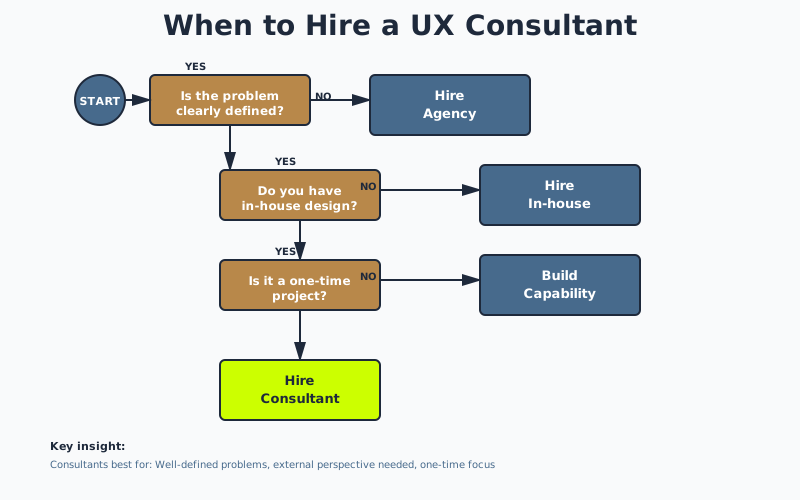
Decision path:
- Is the problem clearly defined?
- No → Hire Agency
- Yes → Do you have in-house design?
- No → Hire In-house
- Yes → Is it a one-time project?
- Yes → Hire Consultant
- No → Build Capability
Consultants work best for: well-defined problems, one-time focus, external perspective needed.
Situation 1: You have a specific, high-stakes problem
Your SaaS product has 50% monthly churn. You don’t know why. You’ve tried internal fixes and nothing worked. You need someone to dig into the behavioral and attitudinal data and tell you specifically what’s driving churn.
This is a perfect consultant problem. You have a clear, measurable problem (churn). The cost of getting it wrong is high (50% monthly churn is existential). You have internal uncertainty (you’ve tried things that didn’t work). You have a specific window for answers (you need to know in 4–6 weeks).
Cost: $15k–$40k for a 4–6 week deep dive. They’ll talk to churned users, analyze behavioral data, interview your team, synthesize findings, and tell you what’s actually happening.
Situation 2: You’re entering a new market and need to validate your assumptions
You’re a B2B product planning to expand into a new vertical. You think you understand the new customer’s workflow, but you’re not certain. A consultant talks to 20 customers in that vertical, maps their workflows, identifies where your product fits, and tells you what you need to change to win.
This is a perfect fit because you have external uncertainty (you don’t know the new market). The cost of being wrong is high (wasting 6 months building wrong). User research is the way to reduce that risk. A consultant has speed and networks to recruit quickly.
Cost: $20k–$50k for 6–8 weeks of research and analysis.
Situation 3: You’re stuck between two directions and need data to decide
Your product team can’t agree on whether to build a feature set for professionals or hobbyists. Both seem viable. You need user research to tell you which market is real and which is fantasy.
A consultant designs a research plan that will inform the decision. Conducts research with both audiences. Comes back with data about which is more viable. You make the decision with evidence instead of guessing. This is a forcing function that gets your team aligned.
Cost: $15k–$30k for 4–6 weeks.
Situation 4: Your internal product and design teams aren’t strong on process
You ship features but don’t validate with users. You make decisions based on stakeholder opinions. You don’t have a framework for prioritizing. You need someone to come in, audit your process, and coach your team on how to do this better.
This is a great fit if you’re willing to change how you work. You want to build capability, not just get an answer. You have 3+ months to implement changes. You have a committed leader (usually the VP of Product) driving adoption.
Cost: $25k–$50k over 3 months (part-time engagement, coaching included). This is a higher investment but the payoff is that you never have to hire someone for this again.
Situation 5: You’re designing a new product and need confidence in the initial direction
You’re a startup building a new tool. You’ve built an MVP and have early users, but you’re not sure if the core concept is right. Before you invest significant engineering, you want validation.
A consultant defines what “validation” looks like (what data would prove or disprove your hypothesis?). Runs user research and testing. Tells you specifically whether the direction is viable. Recommends pivots if needed. They’re essentially derisking your roadmap.
Cost: $15k–$35k for 4–8 weeks, depending on research scope.
When You Don’t
Situation 1: You just want someone to tell you the answer is obvious
“We know our product is confusing, we just need a consultant to validate it so we can get budget to fix it.”
This is waste. You don’t need a consultant to validate the obvious. You need to fix the problem. If you need external validation to get internal buy-in, that’s an organizational problem. A consultant won’t solve it. You need to fix your organization first.
Common Failure Mode
Hiring a consultant to solve an internal politics problem. You can't get budget or agreement internally, so you hire someone expensive to tell you what you already know. You spend $30k to learn nothing new and still can't execute. Fix your organization first.
Situation 2: You haven’t done basic user research yourself
If you haven’t talked to 5 users about your product, don’t hire a consultant yet. A consultant amplifies rigor, but they can’t replace basic due diligence. You can talk to users yourself for free. Do that first. If you’re still confused after talking to 10 people, then hire someone. You’ll get more value because you’re starting from a place of rigor, not ignorance.
Situation 3: You can’t implement recommendations anyway
You’re a startup with a 6-month roadmap locked in. You hire a consultant to tell you what to build. They say “rebuild your onboarding.” You tell them, “We can’t do that – engineering is committed to payment processing for the next 2 months.” Don’t hire a consultant if you can’t actually implement what they recommend. You’re buying advice you won’t take.
Situation 4: Your problem is not UX, it’s product
Your product has no competitive advantage. Your market is saturated. Your pricing is wrong. No amount of UX consulting fixes these things. If the problem is product strategy or competitive positioning, hire a product consultant or strategist, not a UX consultant. You might also benefit from understanding how to evaluate technology partners more broadly if you’re assessing multiple types of consultants or agencies.
Situation 5: You’re using the consultant to avoid accountability
“We’re bringing in a consultant to fix the product” (subtext: so if it doesn’t work, it’s their fault, not ours). This never works. A consultant can advise. Your team has to execute. If your team isn’t capable or committed, a consultant won’t change that.
Situation 6: You want to outsource your thinking
“We’ll have the consultant run all user research, analyze it, and tell us what to do.” You can outsource some work. You can’t outsource understanding your own customers. If you’re not in the research conversations, you’re not learning. You’re hiring someone to think for you, which is expensive overhead.
Engagement Types and Pricing
Different consulting engagements have different structures and costs. Here’s how to think about each type:
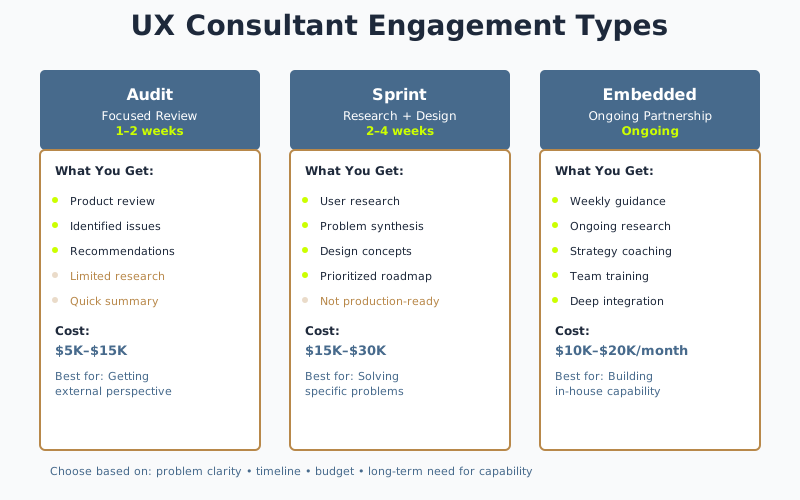
| Engagement | Duration | Cost | You Get | Best For |
|---|---|---|---|---|
| Audit | 1–2 weeks | $5K–$15K | Product review, identified issues, recommendations | External perspective on a specific product area |
| Sprint | 2–4 weeks | $15K–$30K | User research, problem synthesis, design concepts, prioritized roadmap | Solving a specific problem fast |
| Embedded | Ongoing | $10K–$20K/month | Weekly guidance, ongoing research, strategy coaching, team training, deep integration | Building in-house capability |
UX consultants typically charge: Independent consultants at $150–$250/hour or $3k–$8k per week. Small boutique firms at $200–$400/hour or $8k–$20k per week. Established firms at $300–$600/hour or $15k–$40k per week.
What does this actually mean? If a consultant charges $200/hour for a $20k engagement, that’s 100 hours of work. That’s roughly 2–3 weeks of full-time work. If it’s spread over 2 months (part-time), that’s 10–15 hours per week. The structure matters because it tells you how much attention you’re getting.
Red Flags in Consultant Pricing
Retainer without clear deliverables. “$5k/month on retainer” with no definition of what you get each month is dangerous. You end up with a consultant who attends meetings, doesn’t deliver much, and costs $60k/year. Good retainers are specific: “$3k/month for user research (2 studies per quarter), analysis, and coaching calls.” Clear. Measurable.
Extensive team on your project. You hire a consultant and suddenly you’re getting billed by a junior researcher, a senior researcher, a strategist, a project manager, and an associate. The headline rate is $250/hour, but the blended cost is $400/hour. Ask: Who will actually work on my project? What are their rates?
Hidden scope. “UX audit” starts as “review your product and provide recommendations.” Suddenly it’s interviews with 20 stakeholders, user research with 15 users, competitive analysis, benchmarking, and a 50-page report. Scope creep disguised as thoroughness. You get overcharged and underdeliver value.
Questions to Ask
What specifically are you doing in week 3–4 if interviews are done? The consultant should be able to map every hour of their engagement to a specific deliverable or activity. If they can't, scope is fuzzy.
Padding research activities. A consultant says they’ll do 10 user interviews. That’s a 1-week activity (1–1.5 hours per interview, 4–5 interviews per day). If they’re billing you for 4 weeks, they’re padding. Ask: How many hours are these interviews, and what are you doing the other time?
How to Hire and Avoid Overpaying
Define the problem first
Before you hire, write down: What’s broken or uncertain? How will you know if it’s fixed (metrics, qualitative feedback, etc.)? How many weeks do you have? How much budget? If you can’t answer these clearly, you’re not ready to hire a consultant. Most bad consultant engagements fail because the problem wasn’t clear from the start.
Ask about process, not pedigree
You might be impressed by a consultant’s credentials or past clients. But what matters is their process. Ask: How will you approach this problem? Who will you talk to? How many people? How will you validate your findings? What happens if the data contradicts your initial hypothesis? How will you present findings and recommendations? How will you support implementation?
Good consultants have clear processes. They can walk you through exactly what they’ll do and why. Bad consultants wing it.
Ask for reference checks
Don’t just trust their portfolio. Talk to people who hired them. Ask references: Did they deliver what they promised? Did their recommendations make sense in your context? Were the recommendations implementable? What surprised you (good or bad)? Would you hire them again?
References should be able to point to specific impact. “They helped us improve onboarding completion from 60% to 75%” is better than “They were great.”
Negotiate fixed-fee, not hourly
Fixed fee forces a consultant to be efficient. Hourly encourages padding. Be direct: “Here’s the problem. Here’s the timeline. Here’s what success looks like. How much?”
If they come back with a range and a detailed breakdown, that’s a good sign. If they say “let’s start with a discovery phase at $200/hour and see where it goes,” that’s a bad sign.
Require clear deliverables
Don’t accept vague promises. Your contract should specify:
Deliverable 1: User research report with 15 user interviews, findings synthesis, recommendations. Deliverable 2: Usability testing summary with test plan, findings, video highlights. Deliverable 3: Implementation roadmap with prioritization and phasing. Timeline: Deliver by [date]. Revisions: [Number] rounds of feedback.
If you don’t specify deliverables, you’ll get a 40-page slides deck and feel ripped off.
Build in checkpoints
Don’t wait until the end of the engagement to see if this is working. Create checkpoints: Week 2 (initial findings from research), Week 4 (synthesis and hypothesis), Week 6 (recommendations and validation), Week 8 (delivery and handoff). If at week 4 the consultant has nothing useful to say, cut the engagement short.
The Real Value of a Consultant
A good consultant is worth the money if they bring perspective you don’t have (market knowledge, methodological rigor, experience from other industries). They reduce your risk by validating or challenging assumptions. They save you time by moving faster than you could internally. They transfer knowledge to your team so you don’t have to hire them again. They give you confidence to make big decisions.
A bad consultant is expensive overhead that validates whatever you already believe. The difference is whether they’re willing to tell you what you don’t want to hear. If all your hypotheses come back confirmed, either you already know the answer (and shouldn’t have hired them), or they’re not digging deep enough.
The best consultants make you smarter. They teach you how to do research, prioritize, and validate. They don’t create dependency. They build your capability so you eventually don’t need them.
Key Signal
A consultant who shares their methods and templates, who teaches your team, who you could imagine NOT needing next time – that's a consultant doing their job right. If you need them again for the exact same thing, you haven't learned.
Related Guides
- Product Design Agency – When to hire an agency for a full redesign vs. a consultant for focused work
- Hire a UX/UI Designer – Evaluate individual designers for your team
- UX Design for Startups – Understanding where UX investment has the highest ROI
- How to Select a Technology Partner – Framework for evaluating any vendor or consultant
- Technology Vendor Due Diligence Checklist – Process for vetting consultants and agencies
- Website Design vs. Website Development – How design and development collaboration affects outcomes
Frequently Asked Questions
When should I hire a UX design consultant?
Five situations: a specific high-stakes problem like 50% churn, entering a new market, stuck between product directions, weak internal research process, or derisking a new product concept. Outside those, you probably don't need one.
When should I not hire a UX design consultant?
If you just want validation of something obvious. If you haven't done basic user research yourself. If you cannot implement their recommendations. If the real problem is product strategy, not UX. If you're hiring them to avoid internal accountability.
How much does a UX design consultant cost?
Independent consultants: $150–$250 per hour or $3,000–$8,000 per week. Boutique firms: $200–$400 per hour or $8,000–$20,000 per week. Established firms: $300–$600 per hour or $15,000–$40,000 per week. Engagements: typically $15,000–$60,000.
Should I pay a UX consultant hourly or fixed-fee?
Fixed-fee. Hourly rewards padding; fixed-fee rewards efficiency. Be direct: here's the problem, here's the timeline, here's what success looks like – how much? If they propose an open-ended discovery at $200 per hour, walk.
What's the difference between a UX consultant and an agency?
A consultant diagnoses problems and recommends fixes without owning execution. An agency designs and delivers the actual work. Consultants run $15K–$60K for analysis. Agencies run $40K–$150K for design and delivery. Match the engagement to what you need.
How long does a UX consulting engagement take?
Most run 4–8 weeks. Focused diagnosis: 4–6 weeks at $15K–$40K. Market validation: 6–8 weeks at $20K–$50K. Process coaching: 3 months at $25K–$50K part-time. If someone proposes an open-ended retainer, define deliverables or walk.
What should a UX consulting engagement deliver?
Research findings with specific user count, usability testing summary with test plan, and an implementation roadmap with prioritization. Vague promises produce 40-page decks that get shelved. Specify deliverables, timeline, and revision rounds in the contract.