Startup UX Investment Framework
UX design for startups is about sequencing, not spending. Pre-seed and seed-stage companies get the highest return from usability work – onboarding, pricing, and the core task flow – and the lowest return from brand polish. That priority flips at Series A. Startups systematically invest in the wrong things.
You’ve seen it. A founder spends $80k on a beautiful website from a well-known agency before they have a single paying customer. Meanwhile, their product onboarding loses 40% of users. Their pricing page confuses everyone. They haven’t talked to a user since launch. The money went to making things look good. Not to making things work.
At early stages, you’re spending money to figure out if anyone cares. Investing heavily in design polish before you know if the problem is real is waste. Speed and learning matter far more than pixel perfection. This changes at scale. At Series A, polish matters. Pre-seed, usability matters. Usability is cheap to fix compared to beautiful-but-broken.
This guide is for founders and product leaders at startups deciding where to spend limited design budget. If you’re trying to decide between hiring a full-time designer or bringing in a consultant for focused work, see how to hire a UX design consultant.
The Startup UX Mistake
Over-Investing in Design Too Early
Most startups make one or both of these mistakes.
Mistake 1 is over-investing in product design before product-market fit. You spend $50k–$100k on a beautiful app interface before you know if anyone wants it. The design is gorgeous. The interaction is smooth. Users test it in interviews and say, “This is beautiful, but I’d never use it.” You’ve polished the wrong thing. You’ve spent money that could have gone to finding out what people actually want.
Under-Investing in Conversion
Mistake 2 is under-investing in onboarding, messaging, and funnel optimization. Your product is good. Your landing page converts at 1%. Your onboarding loses 40% of users. Your pricing page is confusing. You’re spending money on paid acquisition to fill a leaky bucket. You could add 5–10% conversion across the funnel with UX work. Instead, you’re paying to bring in the same number of users and lose 40% of them. This is where a UX design consultant can have high ROI – focused work on the biggest bottleneck.
Key Signal
Before you hire a designer, measure your funnel. If 40% of users drop during onboarding, that's worth $20k to fix. If landing page converts at 1% when competitors do 5%, that's worth $10k to fix. UX work should target your biggest leak, not your most obvious problem.
Use this to prioritize which UX work will have the best return:
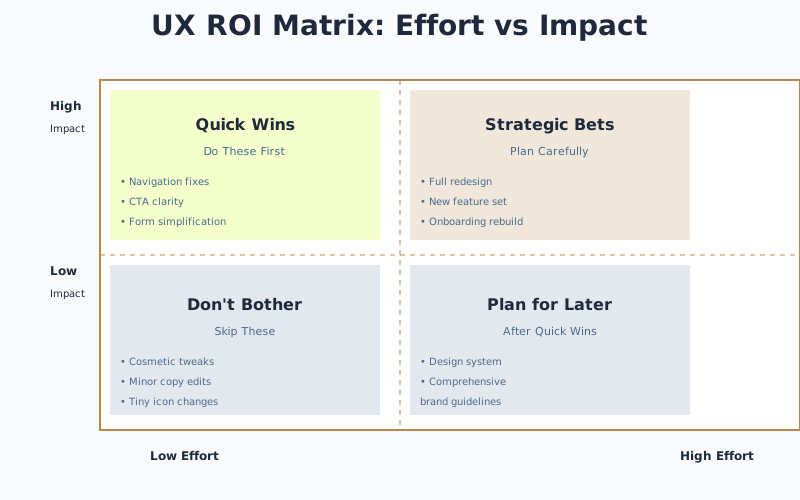
| Low Effort | High Effort | |
|---|---|---|
| High Impact | Quick Wins – do these first: navigation fixes, CTA clarity, form simplification | Strategic Bets – plan carefully: full redesign, new feature set, onboarding rebuild |
| Low Impact | Don’t Bother – skip: cosmetic tweaks, minor copy edits, tiny icon changes | Plan for Later – after quick wins: design system, comprehensive brand guidelines |
The reality is simple: Pre-seed and seed, usability beats aesthetics. A confusing product with beautiful design loses to a slightly ugly product that makes sense. A website with mediocre design that explains what you do beats a gorgeous website that leaves visitors confused. You’re not trying to impress design awards judges. You’re trying to find customers and figure out if they want what you’re building.
Where to actually invest: Clarity of message (do people understand what you do?). Usability of core flow (can people accomplish the main task?). Conversion funnel (can you convert interested people into users?). Onboarding (can new users figure out how to get value?). You don’t need a designer for these. You need someone who understands users and isn’t emotionally attached to beautiful buttons.
Pre-Seed: Do You Have a Problem to Solve?
What you’re trying to learn: Does anyone actually have this problem? Am I solving it the right way?
What to invest in: User research, talking to potential customers, testing your core hypothesis.
UX spending: $0–$5k

| Stage | Budget | Activities | Goal | ROI |
|---|---|---|---|---|
| Pre-Seed | $0–$2K | User interviews, rough prototypes, MVP validation, Figma/Webflow | Does anyone care about this problem? | Learn fast before building |
| Seed | $5–$15K | Research & core flows, landing page, onboarding, funnel tests | Convert the right users | 5–20% lift in conversion |
| Series A | $20–$50K | Design system, UX team hire, retention design, scalability audit | Retention & scalability | 30–50% retention lift |
At pre-seed, you don’t have a product yet. You have an idea. Your job is to validate whether people actually care before you build. This is the cheapest point to change direction. You have no sunk costs in engineering. You have no customers attached to the current approach.
The biggest mistake at pre-seed is building something in isolation and hoping people want it. You’re almost always wrong about something. Maybe the problem is real but you’re solving it wrong. Maybe you’re solving the problem for the wrong person. Maybe you’re solving the right problem for the right person but the market is too small to matter.
Don’t hire a designer. Instead, spend that money helping you talk to customers. This might be you or a co-founder spending 10 hours a week interviewing people. Or it might be $2k–$3k for someone to help you recruit and structure interviews. Talk to 20 people in your target market. Ask them about the problem you’re trying to solve. Do they care? They say yes in interviews but do they show up? What are they currently doing instead of your solution? How much would they pay? Would they switch from their current solution?
Show rough prototypes. Use Figma, Webflow, Framer, or even PowerPoint. Don’t spend weeks perfecting. Show a rough flow to see if the concept makes sense. You’re testing whether people understand your idea, not whether the interface is pretty.
Don’t spend money on a website. A single-page site on Webflow (template) or Carrd (very basic) is enough. You’re not optimizing landing page conversion when you have zero product. You’re just getting the idea out and seeing if anyone cares.
What you’re learning: If 20 people interviewed say the problem isn’t real, pivot. If 15 of them say they’d definitely use this, you’re onto something. If they’re lukewarm, keep learning. Money spent on learning whether the problem exists is better than money spent on designing a solution to the wrong problem.
Seed: Can You Make People Want This?
What you’re trying to learn: Can you convince the right people that this is valuable? Can they use it without help?
What to invest in: Product usability, landing page messaging, onboarding, conversion funnel.
UX spending: $10k–$40k
At seed, you have a product and early customers. You’re trying to attract the right people with clear messaging. Convince them to try it with a compelling landing page and smooth signup. Get them activated and seeing value with good onboarding. Measure whether they’re getting value and coming back. This is where UX work directly impacts your metrics and therefore your fundraising.
Landing page messaging ($2k–$8k)
Your landing page is the first impression. If it doesn’t explain what you do and why someone should care, everything else fails. Hire a UX-focused freelancer or small agency to clarify your value proposition (what problem do you solve, for whom?). Structure the messaging (headline, subheading, proof, CTA). Design the page for clarity (information hierarchy, not decoration). A/B test messaging to see what resonates. This is not “pretty design.” This is problem-solving design. Can someone land on your page and understand in 10 seconds what you do and why they should care?
Cost: A freelancer can do this for $3k–$6k. An agency charges $8k–$15k. Timeline is typically 3–4 weeks.
Product onboarding ($3k–$10k)
50% of users might abandon during onboarding. This is the most important UX work you can do at seed stage. Hire a product designer or UX consultant to map the user’s first 15 minutes (what are they trying to do?). Identify where they get stuck (what’s confusing?). Design the flow for clarity (clear next steps, helpful guidance). Test with real users (do they get it?). Fix the biggest friction points.
Cost: A freelancer for 3–4 weeks, $5k–$10k. An agency, $10k–$20k. Timeline is 4–6 weeks including testing.
Conversion funnel optimization ($3k–$8k)
Track where people drop off: Landing page → signup (30% drop). Signup → first use (40% drop). First use → active (20% drop). Each drop-off is an opportunity. Sometimes it’s messaging. Sometimes it’s friction. Sometimes it’s the wrong audience.
Hire a UX consultant or conversion expert to audit your funnel (where’s the biggest opportunity?). Identify the fix (is it messaging, process, expectations?). Design and test the fix. Measure improvement. This is tactical work, not strategic. You’re hunting for the biggest leak.
Cost: $3k–$8k for a focused engagement. Timeline is 2–3 weeks.
Pricing page and trials ($1k–$3k)
If pricing is confusing, people won’t convert. Spend a small amount to make it crystal clear. This doesn’t need a big engagement. A day or two of work: Compare your pricing page to 3–5 competitors. Identify what’s unclear. Design a clearer version. Test with users.
Cost: $1k–$3k. Timeline is 1–2 weeks.
What you’re measuring:
Landing page conversion (what % of visitors sign up?). Signup-to-first-use conversion (what % actually try it?). First-use-to-active conversion (what % come back?). Feature adoption (what % of users use the key feature?). If any of these are below 30%, UX work will likely improve them more than paid acquisition will.
Questions to Ask
Can the designer show you examples of work where they improved a specific metric? (Increased onboarding completion from 60% to 80%? Improved landing page conversion by 30%?) If they talk about "beautiful design" but not metrics, they're not the right fit for seed stage.
What not to spend money on: Beautiful design that doesn’t solve usability problems. Complex features before core workflow is smooth. Multi-page brand guidelines (you’re not a big company yet). Expensive design systems (templates are fine). Rebranding (stay focused on product).
Series A and Beyond: Can You Scale This?
What you’re trying to learn: Can you keep growing? Can users stick around? Can you support more users?
What to invest in: Retention, scalability, team productivity, market expansion.
UX spending: $50k–$150k+
At Series A, you have product-market fit (sort of). You’re raising more capital to grow. Your job shifts from learning whether people want this to learning how to keep them engaged as you scale. You need to improve retention because early users love you but growth users might not. You need to expand to new user segments or use cases. You need to support more users and complexity without breaking. You need to build a scalable product that doesn’t require custom support.
Retention and engagement design ($20k–$60k)
You have users, but maybe only 40% come back after 30 days. Or usage is declining. Or they’re not engaging with key features. This is existential. High churn means you’re spending money on acquisition just to replace people leaving.
Hire a product design team to understand what makes users stick versus churn (research and data). Design features or experiences that improve stickiness. Redesign onboarding based on what successful users do. Build engagement loops (notifications, progress, milestones). Measure impact on retention and lifetime value.
Cost: A mid-level freelancer or small team for 8–12 weeks, $30k–$60k. This is a significant engagement but the ROI is real. Every 10% improvement in 30-day retention compounds into massive LTV improvement.
Product redesign or scaling ($40k–$100k)
Your product works for early users but might be confusing at scale. Or you’re expanding to a new market and need to rethink the interface. You need someone to audit the current product and constraints. Design for scale (can the interface support more complexity?). Design for new use cases or user segments. Build a design system that your team can maintain. Test and validate before development.
Cost: A good agency for 12–16 weeks, $40k–$100k. Timeline is 3–4 months. This is a longer engagement because you’re validating design direction, iterating based on user testing, and building systems your team will maintain.
Specialized design (conversion, mobile, expansion) ($10k–$30k)
Conversion design: If your free-to-paid conversion is weak, redesign the paywall and purchasing flow. Mobile design: If you’re mobile-first but your app is confusing, redesign for mobile use cases. Expansion design: If you’re entering enterprise or a new vertical, design the product for those users.
Cost: $10k–$30k depending on scope. Timeline is 4–8 weeks.
Design system and brand ($15k–$50k)
As you grow, you’ll have more product teams and more product. A design system lets everyone build consistently without waiting for design approval. Hire a designer (or small team) to document components and patterns. Build a Figma library. Create brand and design guidelines. Train the team on the system.
Cost: $15k–$30k for initial build, plus ongoing maintenance. Timeline is 6–10 weeks for the initial system.
What you’re measuring:
Retention and churn. Feature adoption. Time-to-value (how long until a user sees benefit?). NPS or satisfaction. Growth rate and CAC payback period. These are your Series A metrics to investors. UX improvements directly impact them.
When to Hire a Designer, When to Use Templates
Use templates if you’re pre-seed and haven’t validated the problem yet. You’re trying to launch something quickly and measure response. Budget is constrained and you can afford $1–2k, not $10k+. You have a designer on your team who can customize it. The template can be customized to match your messaging.
Consider these: Webflow (drag-and-drop website builder with nice templates), Framer (component-based design tool, good for interactive prototypes), Carrd (ultra-simple one-page sites), Figma templates (community templates for common layouts), Notion (if you’re doing a simple landing page).
Cost: $100–$500 for template plus your time to customize.
Hire a designer if you need to learn whether people want what you’re building (UX research). Your landing page or onboarding is confusing (messaging/usability work). Your conversion funnel is leaking (conversion design). You’re scaling and need systems (design systems). You have budget and can afford $10k+.
What to hire at each stage: Pre-seed/seed, freelancer or small studio ($5k–$15k projects). Series A, stronger designer or small agency ($20k–$60k). Series B+, full design team or larger agency ($50k–$150k+).
Red flags when hiring: Designer whose main pitch is “beautiful design” instead of “solving your conversion problem.” Agency that wants to do a big brand rebrand when your problem is onboarding clarity. Designer who doesn’t ask about your metrics or goals. Designer who hasn’t worked with startups (doesn’t understand speed and constraints). Designer who wants 3 months when you have 6 weeks.
Common Failure Mode
You hire a designer who's great at beautiful, polished work. They spend 8 weeks designing the perfect experience. You launch and users still don't understand your pricing. You spent the budget on elegance when you needed clarity.
The ROI of UX at Each Stage
Pre-seed: $1 spent on user research could save you $10k building the wrong thing.
Seed: $1 spent on onboarding and funnel optimization could generate $5–$20 in LTV improvement.
Series A: $1 spent on retention and engagement design could improve LTV by 30–50%.
The question isn’t “Can we afford a designer?” It’s “Can we afford not to know if users understand how to use our product?”
At seed stage, if your onboarding is confusing and losing 50% of users, fixing it is one of the best ROI investments you can make. You’d pay $10k to improve conversion by 20%, which means more users, faster growth, better fundraising metrics. That’s not an expense. That’s a lever.
At Series A, every 10% improvement in retention could improve your valuation by millions. Design isn’t decoration at this stage. It’s a core driver of unit economics.
Design investment is not an expense. It’s a lever on your key metrics. The sooner you pull it, the better your growth.
Related Guides
- UX Design Consultant – When to bring in focused outside expertise vs. hiring internal designers
- Product Design Agency – Understand what agencies do and how to evaluate them for larger projects
- Hire a UX/UI Designer – Evaluate designers when you’re building a team
- Website Design vs. Website Development – Understand design and development collaboration
Frequently Asked Questions
How much should a startup spend on UX design?
Pre-seed: $0–$5,000 (use templates, spend on research). Seed: $10,000–$40,000 (landing page, onboarding, funnel). Series A: $50,000–$150,000+ (retention, scaling, design systems). The right spend tracks the stage, not the founder's taste.
Should a pre-seed startup hire a designer?
No. Spend that money on customer interviews instead. Use Webflow, Framer, or Carrd templates for your site. Ugly but clear beats beautiful but vague when you're validating whether anyone cares. Hire a designer once you know who you're building for.
What UX work has the highest ROI at seed stage?
Onboarding, landing page clarity, conversion funnel. If onboarding loses 40% of users, a $10,000–$20,000 engagement pays for itself many times over. Focus on the biggest leak in your funnel – not the most visually obvious problem.
When should a startup redesign its website?
When the site is demonstrably costing you conversions, not when it looks dated. If your landing page converts at 1% while competitors land at 5%, that's worth $10,000–$15,000 to fix. If nothing is dropping, don't redesign to impress your investors.
What does design investment look like at Series A?
Retention and engagement design ($30K–$60K), product redesigns for scale ($40K–$100K), design systems ($15K–$50K), specialized conversion or mobile work ($10K–$30K). Every 10% retention improvement compounds into meaningful LTV gains.
How do I pick a designer for an early-stage startup?
Hire someone who asks about your metrics, not your aesthetic. A designer whose pitch is 'beautiful design' is wrong for seed stage. Ask to see work where they moved a specific number – onboarding conversion, signup rate – by a specific amount.
Are design templates good enough for an early-stage startup?
Yes, until templates stop teaching you what you need to learn – usually around seed stage. Webflow, Framer, and Carrd cost $100–$500 plus your time and get you to validated messaging fast. Hire a designer once the template constraints are in the way.